I love creating patterns by folding ink in the middle, so I created the above (Course sketchbook) for fun… Then I asked people on social media “what can you see”? I got replies such as monkey, predator alien, gorillas, rabbits, ovaries, friendly octopus, snails with pink bodies and green blue shells, a mother protecting her babes, a six headed being and a rams head. So what do you see?
I didn’t even realise that seeing faces in things was called facial pareidolia, I thought everyone did this but, upon asking my husband he does not (unless I used photography – as below to highlight the “face”. I see faces often in door handles, patterns in grains of wood, light switches, clouds, the breaks in the tree branches. However, when you sometimes intentionally look for things I find it can make it harder, more so when on lockdown, normally I just day dream which leads me to seeing faces. I needed to find these “new” faces on everyday things around me. I also want to try to be unique to myself, not just see the faces that jump out at me and push myself a little. So I created a little moodboard in pinterest the intention of this is to inspire me, help me think more outside my own box/world more.
Every day items with faces – quickly sketched in my personal sketchbook (left) started doing inktoper54
While searching for inspiration I came across actually came across Keith Larsen before the exercise asked this of me, He uses his parreidolia to create characters (which can come in handy for the assignment)
My printer currently has a blocked part, meaning I’m unable to print things at the moment and have to work around this, so it limits what I’m able to print at the moment. However it does not limit me within my digital sketchbook so this exercise will be mainly digital. and ONCE I started seeing the faces I couldn’t stop, there following me every where !
This was another fun exercise to do. My main challenge was if I could make others see what I see, also sometimes if you look at something hard enough the image starts to fade, more so with clouds and patterns. I didn’t do much in my course sketchbook for this exercise as was limited by resources to carry out as I would have liked (such as use the photo as reference) but this worked very well digitally.
Maybe should have explored more with the patterns/shapes but I think I held back as I was worried people won’t see what I see.
Growing up I really had the best imagination, I saw thing in everything and anything, I would make my own little characters from sticks, pipe cleaner, cities in cracks in the walls, I would spend hours seeing things in the clouds, sand, rivers. Sadly when I grew up I lost this part of me a little just lost in busy everyday lives. Until this moment I didn’t link this part of me as “art” as it has been my world, it is as normal to me as a person writing and not everyone who writes naturally see the author within themselves, so I didn’t see the artist within this. A question remains though, can I make/let others see what I see?
I am asked to consider and develop a draw narrative around a collection of objects from a journey. Due to Covid-19 I’m unable to action out this brief fully by taking sketchbook on a journey. I did however enjoy a walk and took a camera for reference of objects, things I found and spoke to me as visual reference, before my walk I had started this exercise by finding things in magazines. (below – course sketchbook) this was a little bit of fun., with a bit of a “sea themed moment”.
Sketchbook pages by Emma Clements
I had a theme that came to me on this walk and that was “Everyday stories,” of the everyday things around us. I took quite a few photos for reference and to help me “remember the stories of the items”. (below)
The “main” collection of photos moodboard
This while not as nice as working direct within my sketchbook as found these items, it was nice to have these to refer back to and to later use to create illustrations.
Sketchbook page by Emma Clements
(Above course sketchbook) Left page – Before I created before my walk I had stuck in a raffle ticket and thought of a waiting room awaiting number to be called, I used this as a chance to draw more direct to paper without worrying about being perfect. – Right page – I started sketching the items that spoke the most to me (later adding fine liner and watercolour) making little stories as I went along.
Sketchbook page by Emma Clements
(Above – main course sketchbook) – The post and litter. The post we see most days, the face likely left by teens gives this a bit of a personality. The litter was sad to see, as nature was trying to reclaim its rightful place around them. I really drew/sketched the things that stood out to me most (I did want to sketch / draw so much)
Sketchbook page by Emma Clements
(above) This page is so pretty, however hold the sadness and thoughtlessness of the times we live in, of all the litter I saw this is a meaningful of today. A single glove littered in the mud, the sign of this covid-19 even on the peaceful walk away from others, so the stress / worries we face everyday still very much here, but also how careless we can be to others and nature that was left as litter… Plastic litter!
Sketchbook page by Emma Clements
At the end of my walk which had intentionally planned to finish at the point of this rusty can. This I felt was a perfect ending, for the bad things in life will one day rust away.
I really had a lot going on in my head and inspiring me, there are so many ways I could take this. I guess I have to just trust my own creative process to take me to completing the objectives of this exercise.
Sketchbook page by Emma Clements
(above personal sketchbook) – trying out the bench and tin in simple lines.
Sketchbook page by Emma Clements
(Above – personal sketchbook) Here I was thinking sort of old lady in the shoe and the rusty tin. Wasn’t really the result I was envisioning but could be something I go back to.
Sketchbook page by Emma Clements
The Pole face, just a moment in my personal sketchbook, creating a series based upon the face that was graffitied on the pole.
Digital work
Using my Ipad I created what I’ve been envisioning by being inspired by Saul Steinberg and Christoph Niemann.
It started with the dandelion, I may have been a little predictable in this one, but it is what I saw. I created all the digital images by working over the photos in procreate, I would have gotten a cleaner and more polish look in photoshop. I wanted an almost sketchy feeling to the pieces. It did leave some bits (edges) a little messy.
by Emma Clements
For all the intent of the exercise the above is what I wanted to create and the results that I wanted to gain. The rusty can which the touch of “humans” against the green of nature!
(left) I saw this in my head seeing all the yellow dandelions, I didn’t know it this was to be better for exercise “Exercise 2.6: Pareidolia”, but not really seeing a face/lion but I created it. The design really isn’t working for this right and may have been better with a field of dandelions to create a pride of lions (closed ones for females)
(below) when I saw the grass with seed head the “head” reminded me of a peacock tail swaying in the wind. The result is quite cute and felt could be something I could explore more! So I did, ended up painting using watercolour (withing my course sketchbooks) the first was sketched more like the photo, however it turned very loose and about the shapes (I ended up markmaking a little with this and playing with the colours bleeding into each other and ended with me adding goauche and metallic brush markers. This created a page that I could turn into a pattern with more work.
by Emma Clements
Sketchbook page by Emma Clements
personal sketchbook page by Emma Clements
I like peacocks, so I did take further and with the techniques I liked from exploring within these sketchbook pages did a painted version on water colour paper.
By Emma Clements
Photography
I wasn’t sure on this next part. (below) I wanted to do to explore the topic fully and to just to have fun with it.
by Emma Clements
by Emma Clements
by Emma Clements
It’s not as clean as I would have liked, Posca pen was running out, and I think my nerved showed trying this. I’m thinking the unicorn version isn’t the end! I can see the horse face and this may be something can take forward into the next exercise…
This pushed my comfort zones a little, while I see things easily within everyday life/items, I do not however know how to make other see it nor have a really tried in this way. This is something new to me.
I possibly lacked direction at times in this exercise, I was pulled in many directions and honestly wanted to explore a bit of everything. There are couple of areas I didn’t “relax” and was overthinking it a bit so I would need to face these elements again. (photography)
Bringing the world and my imagination closer together!
Christoph Niemann
Christoph Niemann
I like the idea of grabbing a different random object and drawing with it everyday, even if not in the same manner that Niemann uses them, just an item everyday, maybe turning into something else maybe just using as studies.
This indeed would be something I would like to try, so in the next exercise not only will I be looking at items on a journey but around the house.
Christoph Niemann
Saul Steinberg
Steinberg
Banksy
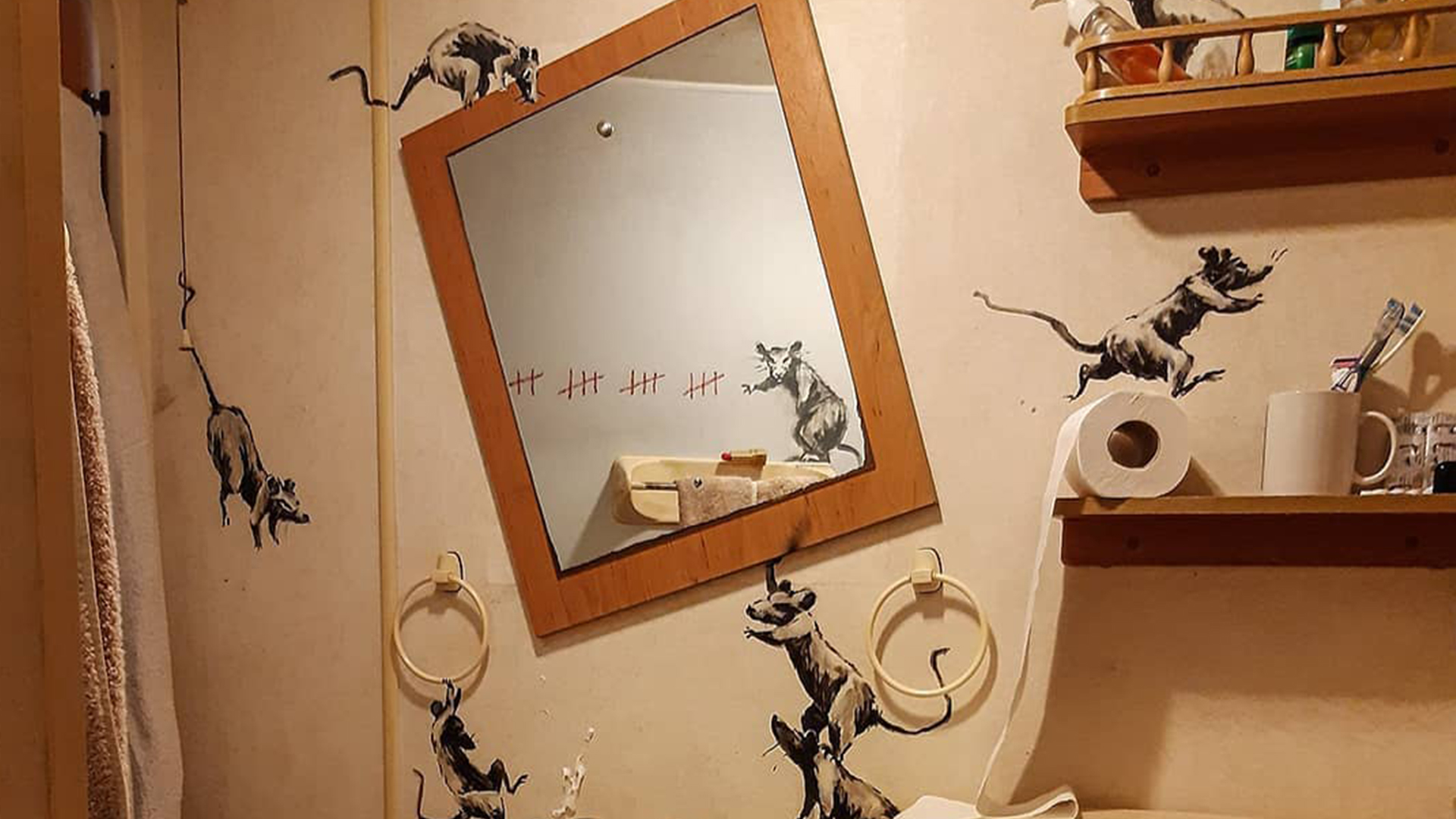
While looking at Steinberg photowork my first thoughts was I couldn’t help me compare to Banksy, more so his latest work. (rats in the bathroom – right)
There is that same touch of humor, I wonder if Banksy was in anyway inspired by Steinberg.
What I really loved Steinberg was creating paper bags on the head photography/art, I was the most drawn to this series of mask work. (which he worked with photographer Inge Morath)
My recreation
First I wanted to do a recreation with mask, with nothing can used as paper bags I thought back to the nature of these studies and created my own digitally (as seen above)
While the main purpose of study of these artist are to interact items/objects with art was fully understood (and I will get the chance to explore this in the up and coming exercises) I was however I still in the whole journey of finding my voice, started to find it more interesting for me, to find ways interact myself with my art, put a “face” to the creator.
So lastly greatly inspired by Steinberg’s own photo of himself using his hand as a face, I created my own with my own message and purpose behind it. My hands will be my part of my “voice” though the art it creates to the words I wish to sign!
Me
A fresh new way of thinking….
I can make my art interact with the world and people around me.
I can give my art a face.
I am now seeing art in everything around me, so I need to learn how to bring that alive so I can share with the world.
On the 25th April an email had landed in my inbox from Phil Davies titled “how to paint with coffee granules & coffee swabs“. It was a posted on the blog page called artTUTOR and this post was made by Bob Davies (I believe Phil’s father) – This whole thing is part of the art isolation challenge which they’re doing. So I will be doing one of my working out with coffee, after picking up some tips on this blog.
This exercise, asks that I conduct some simple studies using alternative drawing materials. I think everyone really does have their own method for this kind of thing. I tend to almost doodle with marks/ maybe small illustrations and random go with the flow.
And, I started this with Henderson Relish.
I’m from Sheffield, which is the proud home of Henderson Relish, in Key steps I had used the bottle as an illustration, I actually did wonder then if I should try painting with the relish. I don’t believe I’m the first, pretty sure a few artists that are from Sheffield actually have used as a medium. But , this will be a first for me. I started with random testing, it wasn’t as strong as a pigment as I would have thought, I had planned to water down to create contrast like watecolour, but ended up being the other way and I needed to build it up. Showing lightly though my page I could see the outline of the last portrait I did, so I used this as a base for me to test the relish, this ended up growing using the same image I used of Sheffield station in the exercise “blind contour”. I felt this was fitting as Henderson Relish is the “mascot” of Sheffield. Within the images you should be able to spot the “testing” dabbing in different ways such as tissue, brushes, I watered down, build up, I used my brush in different ways and also a nip pen. Mostly I liked using as a wash with a nice fat brush.
I also used coffee (I did however have limited grains) This one I did same test kind of test, but I found coffee behaved more like watercolour and activated easily with water. It also made an interesting textured with the grains was still in the water (even if a little sticky) most of all I liked the dabbing with the tissue technique, I liked this the result of this quite a lot. Can see myself using coffee in cafes when I come to do the classic cafe life drawing!
Tea bags I have painted with tea a few times, So this time I use the chance to experiment with different types of tea. Jasmine, mint herbal and Yorkshires finest. Jasmine was a very light wash, had a more yellow hue. Mint herbal appeared strongest in value when wet, but dried much lighter the effects when dried was the far most interesting with the water stains. Yorkshire tea, dried the strongest in colour once dried with a small orange shade to it. I started to get into experimenting more with the tea bag with this one and found it to create a great effect if dropped the teabag from a height on to the paper.
Make up. Due to isolation I felt like I had limited things I could use that was “sensible”. I really wanted to use wine and beetroot as this would be another “first”! but this one will have to wait a little (If anything it is just delayed) – So will add more later. I wanted a colour, or at least a different shade as one thing so far is that everything has been light brown / orange yellow. I could see this one being used within fashion illustrations, maybe not the whole but parts (key areas), such as using lipstick if a illustration about lipstick or advertisement.
(Above) I finished this by using ink for the out line like rapid draw/blind contour and I painted with Henserson Relish on watercolour paper. I wanted to give this one I more finished result and see how it behaves on paper more suited. I could build up the colours more, however found had to be careful as after a while the more you used the stickier the surface.
Again I had fun, I do still want to experiment more, it may have to be one I revisit when the children are back at school or a project that involved them. Like just writing this reflection I wonder if I could get the grass stains out of grass and use as a dye !
Along with wine, beetroot I am sure I can think of more to add to the list, just need the freedom to carry these out (due to Corona virus) – I’ve been limited to more sensible around the house options. This will also be something I start thinking about more, can I use what is around me as well to actually create the art and would it bring something interesting to the mix!
honestly I do, I have so much fun doing this and I love the randomness of these type of exercises.
I started doing this as a warm up since I watch a course titled “Learning how to draw: A mindset, method and exercises”. by Yuko Shimizu, I owe a lot to this course as it started me on a journey which I throw out all my pride as an artist and started again! I realized while I went to art college / did GCSE art I missed so much in my foundations, I was taught like a hearing student and expected to give the same results. So I spent all my time just keeping up and not really “taking” it in. So I started at the beginning and Yuko Shumizu classes were the “early” relearning stage for me. It was also a turning point in my mindset as an illustrator. I’ve never looked at Yuko’s at her sketch book work, so I used this exercise as a quick chance to look at Yuko’s sketchbooks and it didn’t disappoint! I’ve discovered she released a book titled “Yuko Sketchbook” which was a collaboration with the society of illustrators. Which seems now out of print, I would have liked to have a look at this fully.
I understood the purpose of the exercise and to semi-blind contour, but I was really looking forward to the randomness of fully bling contour in this most of all in this exercise.
(Above) Blind contour – based on some of my illustrations from my earlier exercises.
(Above) – Course Sketchbook Mini portraits of my family from memory and the “tree”, I had my eyes closed and listening to music, I think the music influenced the flow of my line!
(left) personal sketchbook. This was a page is random I was playing with ink and watering down (experimenting). I used this image to create my next blind contour drawing. (below) after this I went over in ink to create some line weight seeing if this created a more “final” abstract piece.
I started the semi blind contour, based on these photos I took last year Above (Flowers and areas of Sheffield)
(Above) course sketchbook Using Charcoal, I felt this would allow me to be “free”, I like the results of my flowers.
(Above) – Personal sketchbook Another page I’m in love with, I’ve been wanting to create work like this for a long time. Just loose and almost effortless kind of sketching, something until I felt I “failed” in and now realized I may have put too way much effect into gaining this time of sketch, it wasn’t what I was doing but the way I was doing it.
Above – Personal sketchbook I wondered how semi blind contour sketching will work with colour, so I picked up for my water colour pen (real brush ones) I know would be very dry on the paper so I couldn’t over work in in this method.
I went back to the flowers as I wanted to add more colour. I do tend to maybe find comfort in colour so I wrote “My world is colour” maybe my artist voice is colour ?
And…
This is where things turn personal
How personal do I want my sketchbook to be? I thought long and hard about adding this part, however I felt it is important to the sketchbook unit and hopefully my growth you will see from me.
Left – personal sketchbook I wrote again “my voice is colour”
I just intended maybe nice font and doodles, but this became a series of statements which followed by me finding my path. The yellow path has subconsciously followed me in my illustrations since my “key steps in illustration 1” sketchbooks.
I think maybe this is symbol my own desire to find my path, my own voice both as an illustrator/artist and as a person. Maybe even in this doodle things was seeming like a chapters within my sketchbook and this “story” needed an ending.
I thought back to the time I felt I had lost my “voice”, when did I start to feeling I was drowning in the sea of sounds?
So I found I was talking to myself as a child and I just wrote everything that came to mind. “To the child that lost her voice… Take my hand, it’s time to find it!” “It wasn’t one moment that she lost her voice, it was many moments!” “Each moments she remembers, each moment left a scar that never healed”
If I could say anything to her it would be… “I’m so sorry I let them take your voice.” I needed this moment to start the path that will lead to others hearing my voice!
Back to more semi blind contour
After the emotional self reflection moment in my sketchbook I felt very inspired and needed to draw… The portraits. With the help of Pinterest, I created some semi blind contours using portraits) Below is the board for reference.
Rapid, limited line, semi blind contour all happened in these portrait studies,
The most important thing from this exercise is learning how to free both my art skills and soul! This was a little emotional and empowering.
I like the results, mostly the Sheffield station image. Maybe could have tried more different mediums – can I semi blind contour with paints like watercolour, acrylic and gouache !
I like nothing more to get new art supplies, as I love testing them and so such excitement comes with the fact I have so much to learn. I also am one of them artist / illustrators that use whatever is to hand as I can get in the moment, I’m also always “losing” things, so I’ve had to be creative with my supplies in the past!
I’ve been waiting for a chance to explore more in depth ways to use and create things, so I’m using this exercise as the chance to allow myself to do this. I didn’t want to limit myself to a couple of mediums, but be open minded about them all. So I spotted I had a little theme happening in my sketchbook at the moment, which is trees/nature and leaves. As it is my really is “everyday” view at the moment, so this does makes sense I should really allow myself a chance to investigate/ play with ways I can create my trees, bark and leaves ? Maybe even push colour palettes a little as well in the process! Honestly since I’ve looking at others and my tutors sketchbook I’ve been wanting to get into micro-studies
I’m expressing a great interest in working with gouache, editing digitally and adding textures. I’m keen to create more textures/patterns myself so this is a good goal I can think about while I explore.
First mini test on this exercise, (above personal sketchbook) Is a page with an overlap of this exercises. Here I started “testing” some mark making and was the moment I had a theme for my micro studies and chapters. It was more about laying down the paint, thick and messy!
My investigation (Above – Main course sketchbook) started with the leaves and working out ways to create texture… Using well, everything and anything really I had to hand at the time. Gouache, ink (liquid) watercolour, Ink (pen), water based markers, coloured pencils. I tried different methods to add, from cotton buds to my fingers. These studies moved on to the tree, I wanted to gain the impression quickly (that was my only rule with this chapter).
Page one (above) Next came the bark test, this was all about mark making to create textures, part of this I even added some pastel paper to a section so could give the charcoal a more grainy texture. Top. charcoal, acrylic (technique one), Brown ink. Bottom. Brown pastel, Acrylic & gouache, more brown pastel but applied differently (and on a different surface) Page two (Above) The branches are in four different sections but I overlapped these on purpose to see how work next to each other and with each other, even adding newspaper to see how reacts to ink and watercolour. Top to Bottom – Gouache, watercolour and ink.
Next (above) was more in the theme of “doing things differently” I created a collage by tearing up two pages from a magazine, which isn’t something I’ve really done before I also tried both cut up leaves and doodle leaves to see which method I liked. (in the corner is some finger print leaves, the paint dried more blue that I mean it too. So it looks more like flowers.)
I randomly realised that I was still being neat! So wanting to relate my sketchbook work (both digital and physical together more with “studies”) I recreated a version of my hearing aid question mark illustration in water colour pencils and sprayed water on it to “mess it up” sadly didn’t “run” as much as I would have liked. Maybe worth testing this in a thick watercolour !
A little side track…
I’m including something a little “side track” topic to the exercise (but it’s important for the development that happened over a few exercises. Very much in tone with my personal message, finding my actual voice, lost in the sea of sound etc!) – finding my creative voice, it also will influence some of my course work.
In my personal sketch book (above), on the recommendation from my tutor was looking at the artist Lynda Barry, I loved the little messages / notebook. I made my own page inspired by Barry’s sketchbook and while at the time just thinking I should add little messages to make my sketchbook more personal! This little “research” would lead to something so much more…
Is this the END, nope! This is just the beginning, I really want to experiment more, I will be going many more micro-studies throughout the whole degree from now on! I do wonder if I should have made my “studies” more limited by to a couple of mediums, just the leaves, close up, details, colours and keeping more simple. But, the way I see this is this exercise it really is the start, I could easily use many many papers just testing and trying things, just used what was inspiring me at the moment.
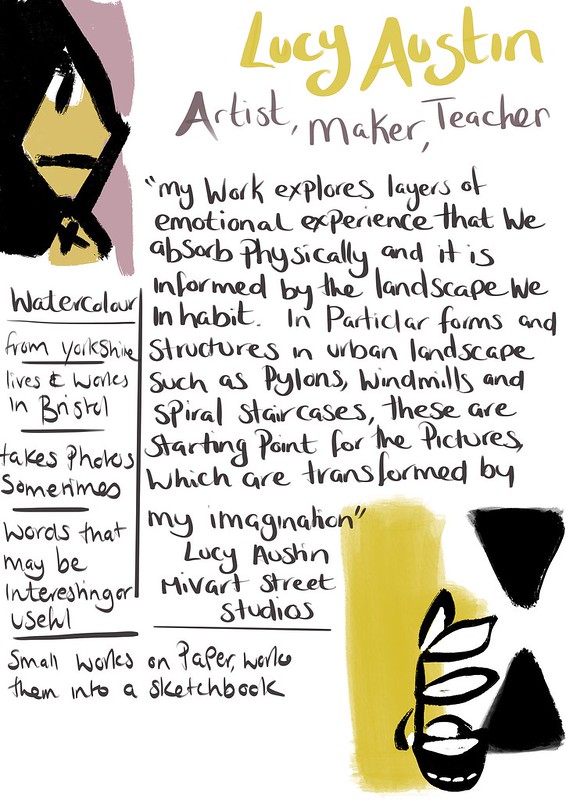
On first glace I wouldn’t have thought lucy Austin as a watercolour artist, her work seems very acrylic to me. I find it fascinating when someone breaks the mold, someone who is different within the medium itself. I love trying things differently, even so this is an eye opener as if you was to show me her work, I would reach for my acrylics. So I did reach for the acrylic to recreate an image I was drawn to, but I did it how I felt looking at the work, almost because the direct contract in the colours it could almost be a mirror in the middle of the painting… So that what I tested withing my sketchbook, a painting with a mirror in the middle.
(Above) main course sketchbook page I REALLY like these colours together and the leaves and branch theme I ended up creating.
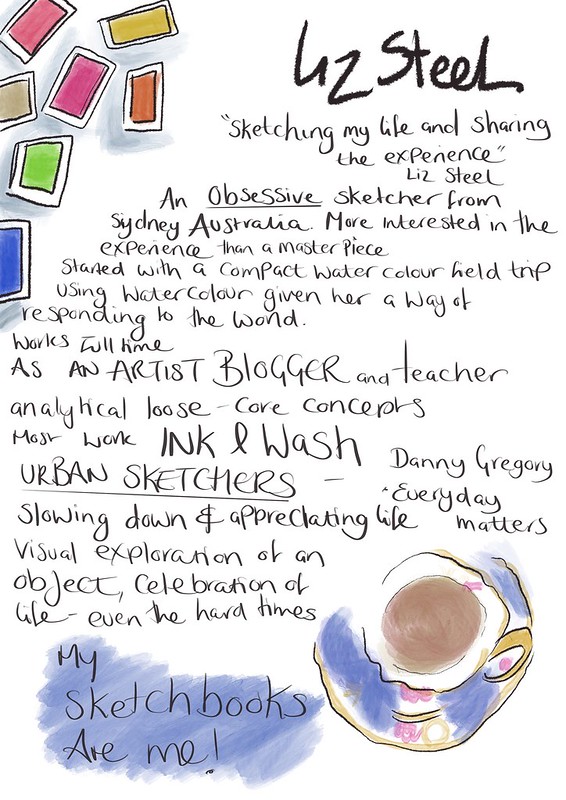
While Liz steel is similar in a way to how I use water colour now. She almost is a direct contrast to Austins work, she also reminds me of Danny Gregory in a way, more so the way she fills her pages, but more softer spoken and gentle in nature.
I’m thinking I’m naturally drawn to these sketchbook type of pages. (even if find joy and fun in the many other artist I have on my list to research, I cannot deny a pull in this direction)
My feedback was very positive and I was incredibly happy. I hoped my passion for sketchbook would shine though without me having that “perfect” sketchbook but by me being myself and was happy this was the case.
Research task – artist sketchbook I actually forgot to include the question I asked my tutor, this was a small oversight on my behalf, luckily I got the chance to ask more questions and I loved the answers, the “never a first page” gives me some serious food for thought. – I will go back and include this.
Exercise 1.1 your relationship with your sketchbook. “personal response to sketchbooks and you turned this around to your benefit. This shows a very proactive response to visual blockages.” I guess my sketchbook are more personal in a way I didn’t even realize, maybe a part of accepting who I am as a person/illustrator is coming though within these pages.
Assignment one “You have used a range of media and visual approaches in your sketchbook and your interest in colour is really coming through in your work.” I now love colour, I didn’t always in my work as used to get it soo soo wrong, I like colour to evoke emotions, I think I even have my thing when comes to the way I use colour which was never intentional but I guess a part of my artist voice.
“you mention your reticence to talk about your sketchbook and ‘failing’ to add music. How about adding ‘sounds’ that refer to what you said in your explanation “I’m lost, lost in the sea of sounds and I have no voice” This is a very powerful and descriptive bit of text that you could visually pursue in future work”
I love this idea so much and it is something I wish to pursue.
“you don’t always have to fill the page. Think about ‘less is more’ and the use of ‘white space’ This is something I will work on, I do have a habit of trying not to waste (paper) even though I know not a waste and I can also get carried away drawing and doodling until I run out of paper! I do think my sketchbook work will look better with a nice balance between the two… I will also look at this as a chance to look deeper into negative space and how to use, see if any courses on skillshare / youtube to boost my skillsets more.
Thank you for the recommended artists and books I have ordered Wreak this journal by Keri Smith as it seem like such a fun book and we need a bit of fun in these times (COVID-19 – ISOLATION)
Funny enough, I had touched upon Gestalt Theory in key steps one, as the psychological aspect behind art, illustration and the creative world deeply interests me. I find it very fascinating and I like to have hidden meaning in my work.
There are five main principles of the Gestalt Theory which are Proximity, Similarity, Continuity, Closure, and Connectedness.
Closure – we automatically fill in gaps. Continuity – We follow the flow with lines. Proximity – We group closer-together elements and separating them from those farther apart. Similarity – We seek differences and similarities in an image and link similar elements. Connectedness – We link elements that are linked by other elements.
Other principles include: Common Fate, Common Region, Convexity, Element Connectedness, Figure/Ground, Good Form, Meaningfulness, Prägnanz, Regularity, Symmetry and Synchrony.
“The whole is other than the sum of the parts.”
Kurt Koffka
I wanted to look at both MC Escher and Noma Bar, both who’s art work I instantly recognized.
I was doing my research notes on procreate (Ipad) which will be using mainly for my digital sketchbook. After doing my research notes my thoughts were “I cannot create anything like this” it is FAR too clever for me. I opened procreate with the words of Yoga in my head “No! Try not! Do or do not, there is no try!”. !
Thinking on the theme “everyday” I thought maybe a hearing aid! and the ear a question mark! and on my first try actually created very unintentionally something with GREAT meaning to myself. (Below) It isn’t perfectly “shaped” like Norma Bar’s work but what is most important this is personal.
In my physical sketchbook (main course – below) I started by creating a “header” with one line, a page exploring random photos popping up on my pinterest and then my cat came and sat by me so I sketched her, I found the “real” source are the better finished result.
(left) personal sketchbook 5 – The post it I’ve stuck on this page is for a later use, just a little something I created with my daughter showing her how to do something and I felt the abstract look would be a perfect little reference for an up and coming research task (Lucy Austin) While the main sketchbook was drying, I created more cat limited lines and I started to sketch what was in front of me – I really like how I did the paint tubes.
In my personal sketchbook I started to use the paint in front of me, to explore more and have a little play with Noma Bars work in mind. Which inspired the mini painting of a bird that I’ve tried to look like a face as well…
Really liking the paint tubes I created in my personal sketchbook, I took these into my course sketchbook (above) and created one of my favorite pages ever! I just really love this page. (Below) I still wanted to explore this more, so found a chance to sit outside and sketch my children running around the garden with limited lines. I found myself sketching the world around them! So this piece not quite in the nature of “limited” lines.
I really enjoyed this section, while not everything I created could have been classed of limited lines, I was careful not to “over use” lines. One thing I did discover, while I do not often erase my line, I tend to normally work lightly in pencil and then committing to these later by going over in pen. I liked the feeling of working direct with pen in my sketchbook, it hard to pin-point the feeling I felt… “brave” and “freeing” comes to mind! I also liked the digital piece I created, it hold a lot of meaning to me and who I am, in a way this is the very symbol of my everyday. In fact I liked so much I had a play with colours and (below) is the one I’m most happy with.
Sophie Peanut is an illustrator/Artist and urban sketcher from Halifax, she has this brilliant website for 5 minute sketches.
I found myself really drawn to Sophie Peanut illustrated recipes.
But the most important thing I think I can take away from Sophie Peanut work, is her urban sketching and 5 minutes sketches.
I do not like to think as pitfalls of another artist/illustrator, as I see everyone has a unique style even in mistakes. So I prefer to see the pitfalls of rapid sketching from what I feel could be… Details can be missed / overlooked. Sizing can be wrong and throws of the whole picture.
This all being said, I honestly feel there is no wrong way to be in your sketchbook so all these “pitfalls” have a place. There is a charm in this kind of imperfection, you have a lot to learn from rapid sketching, In a way it’s the “pitfalls” that make a person unique. This is my honest thoughts on discuss any merits and pitfalls you can identify in her work.
With Sophie Peanuts tips in mind, I created some quick sketches, the first few happens to be digit was I had to hand.
By doing my own rapid sketches I felt I was on an even ground to compare work. I feel Sophie Peanut is looser, braver and more conference in her stokes, I’m still held back by what I see rather than what I feel. Which I think Sophie has! Sophie is a lot like me in appearing to like to add colour, even if it is just a light wash!
This makes me excited to see what after this course will become of my own rapid styles, will I have hints of Sophie peanuts style or any of the artist below?
Other artists with rapid style…
Once I started this list, it kept growing. I found it hard to find styles online, but using books I have collected and borrowed for this course I was able to create my list. (book list below) All of these I can learn something interesting from!
Lapin has already gained my attention, as he is referred to quite often in “urban sketching a complete guide” by Thomas Thorspecken and his work appears more than once. Lapin is a a french illustrator, an artist, and an urban sketcher. While he does these lovely illustrated detailed illustration of cars and more, he is also a rapid sketcher, seen often sketching everywhere by the sound of things. I like the mix match of his pages, some seem highly detailed and around quick rapid sketches and sometimes even doodles or insight into the imagnation of Lapin.







 Emclemmie OCA Sketchbooks