I found myself a kid in a sweet shop, this unit has given me a sweet shop worth of inspiration. This unit has a whole started me opening up, now it is giving me a personal narrative that is overflowing into all areas of my creative interests. I’m seeing my own illustrations differently, how can I tell my stories. Can I tell it in mood, colour, words or illustration.
Another way you could look at it, before I always had my stories that made sense to just me and now I want to tell them so my “viewers” can feel.
I know I have to be careful not to go too of track in the middle of this creative overload. But, I’ve felt sketchbook as a unit has been a safe place for me to explore this side of me, a place for me to emotionally invest all while creative book design along side this unit is keeping my feet on the ground by working to a more “formal” briefs for the exercises.
I do not see this as the end of each part as this is lifelong habits that I’m picking up, this is the long hurl within my creative work. At the risk of sounding corny, something within has been awoken and she finally has a lot to say and share with the world…
I had many ideas, so many ways I could have taken this. (below)
Ideas included * Expending the conker scene * My husband is a dog story line * I miss my friend – Dialog with one of the figures. * School run * Swan lake/Swan angel * The peacock * The boy learning to fly with the help of wind.
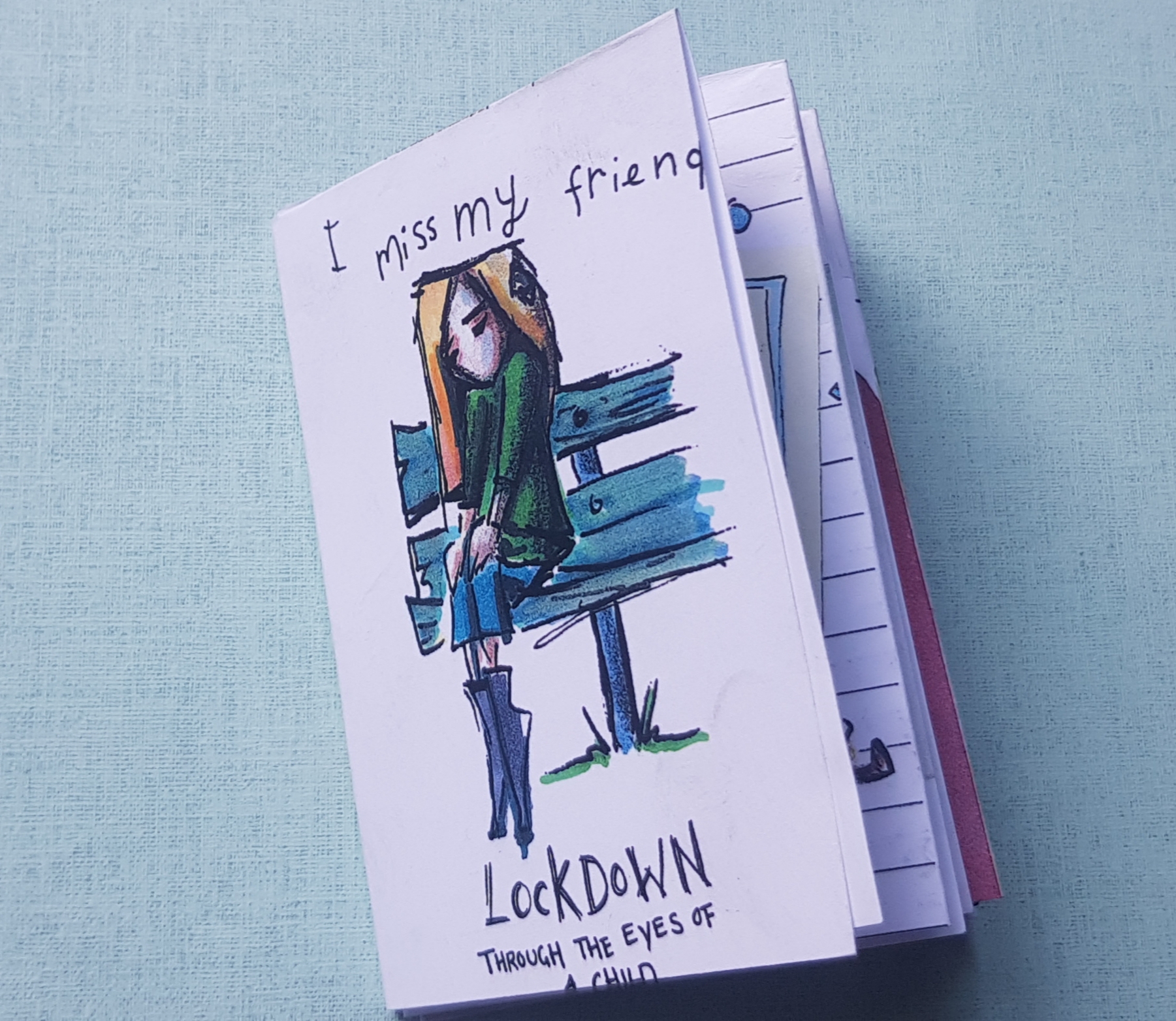
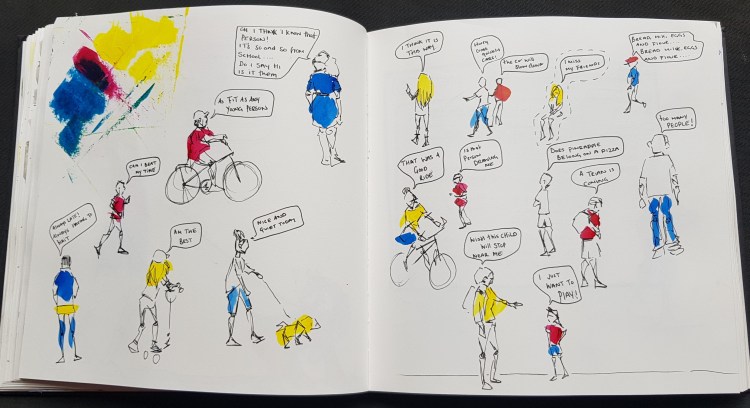
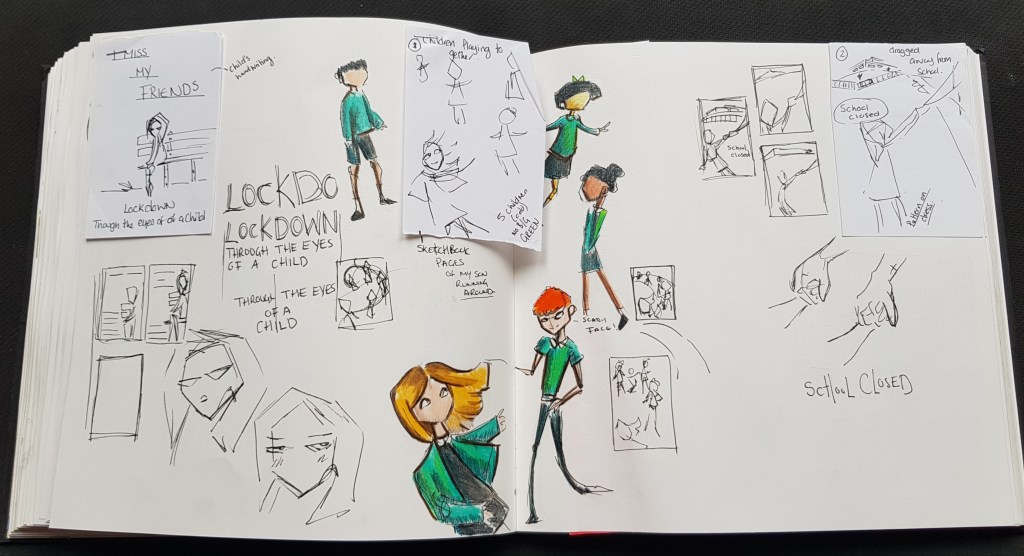
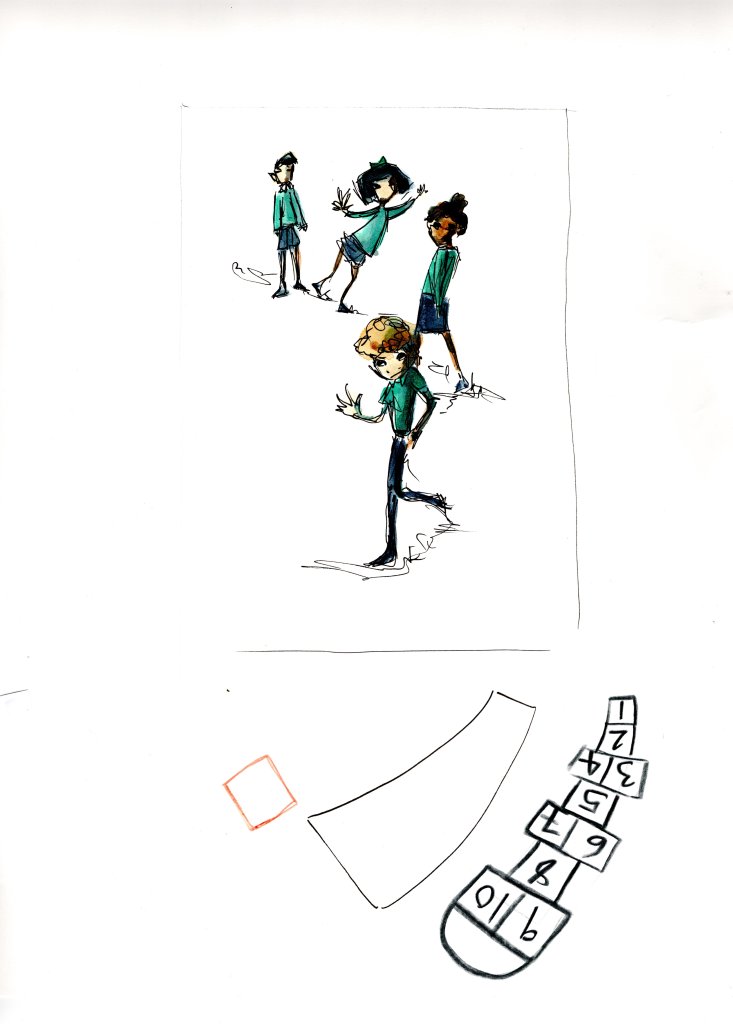
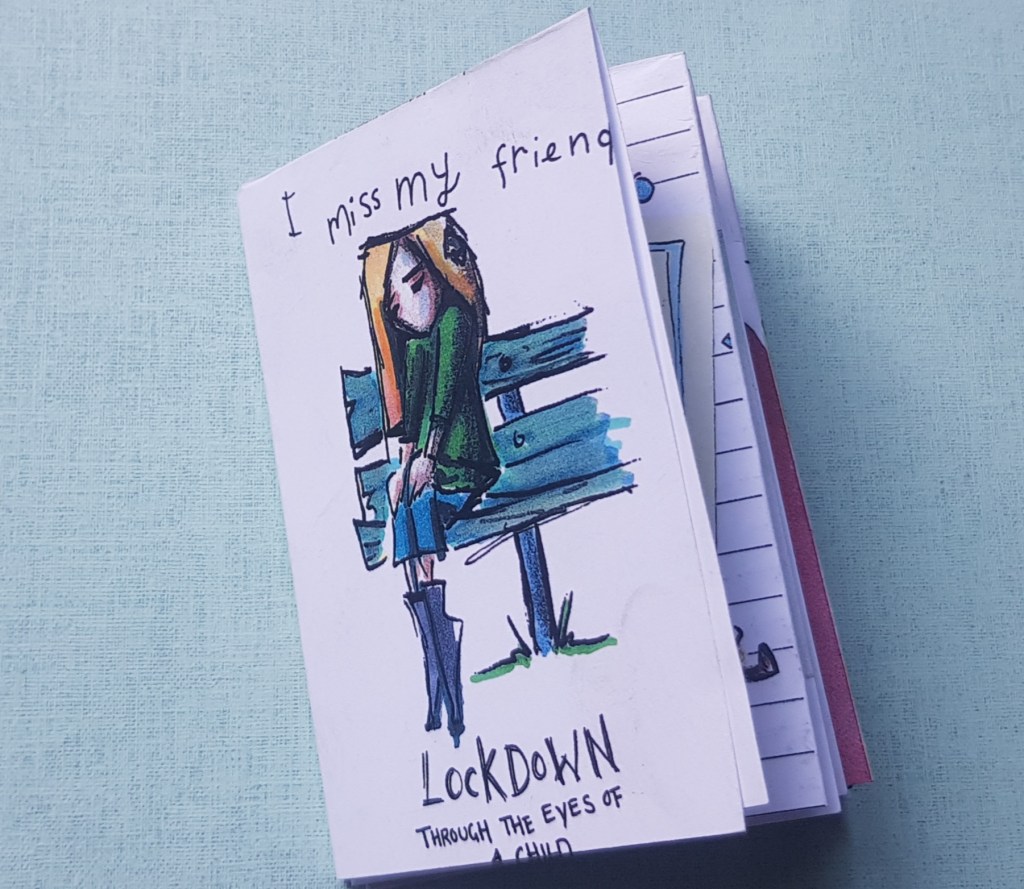
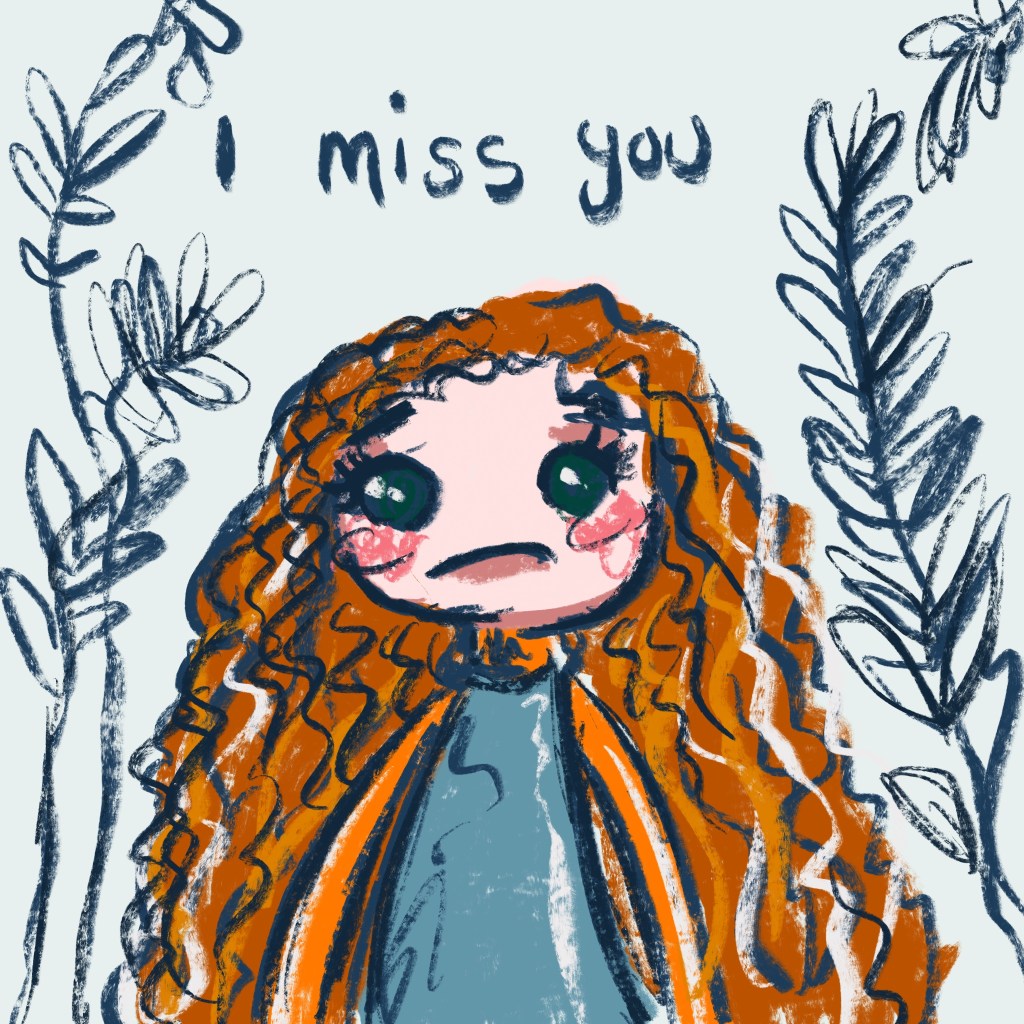
What has been important of late is for me to feed this voice within me, so I wanted something personal, something my everyday, so I picked a sketch I did for exercise 4.3 Conversations with pictures – interpretation of a young girl which I wrote the inner dialog as “I miss my friends”.
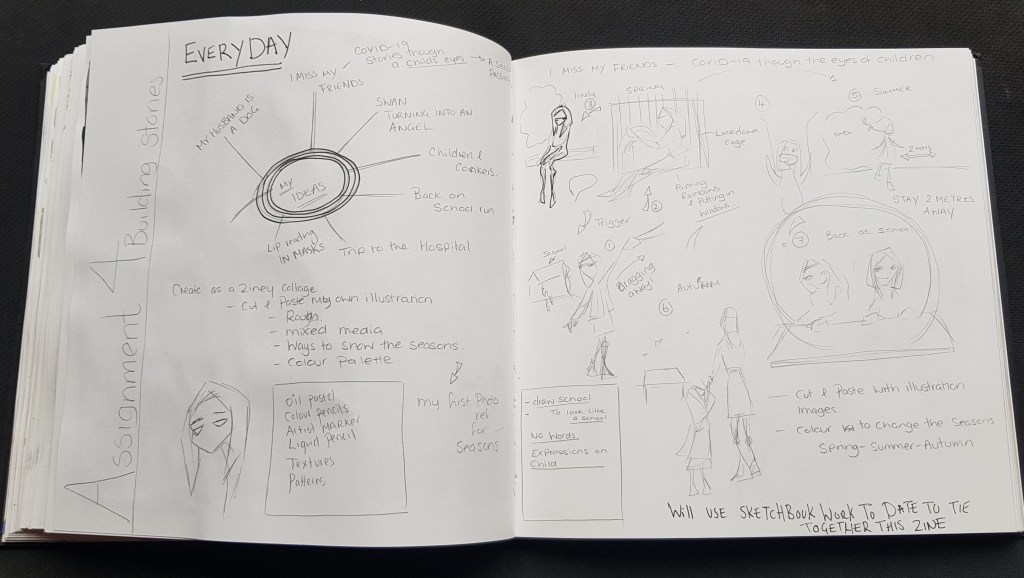
I felt an emotionally connection to this image and wanted to “tell” her story. (Below is the sketchbook page this idea formed from)
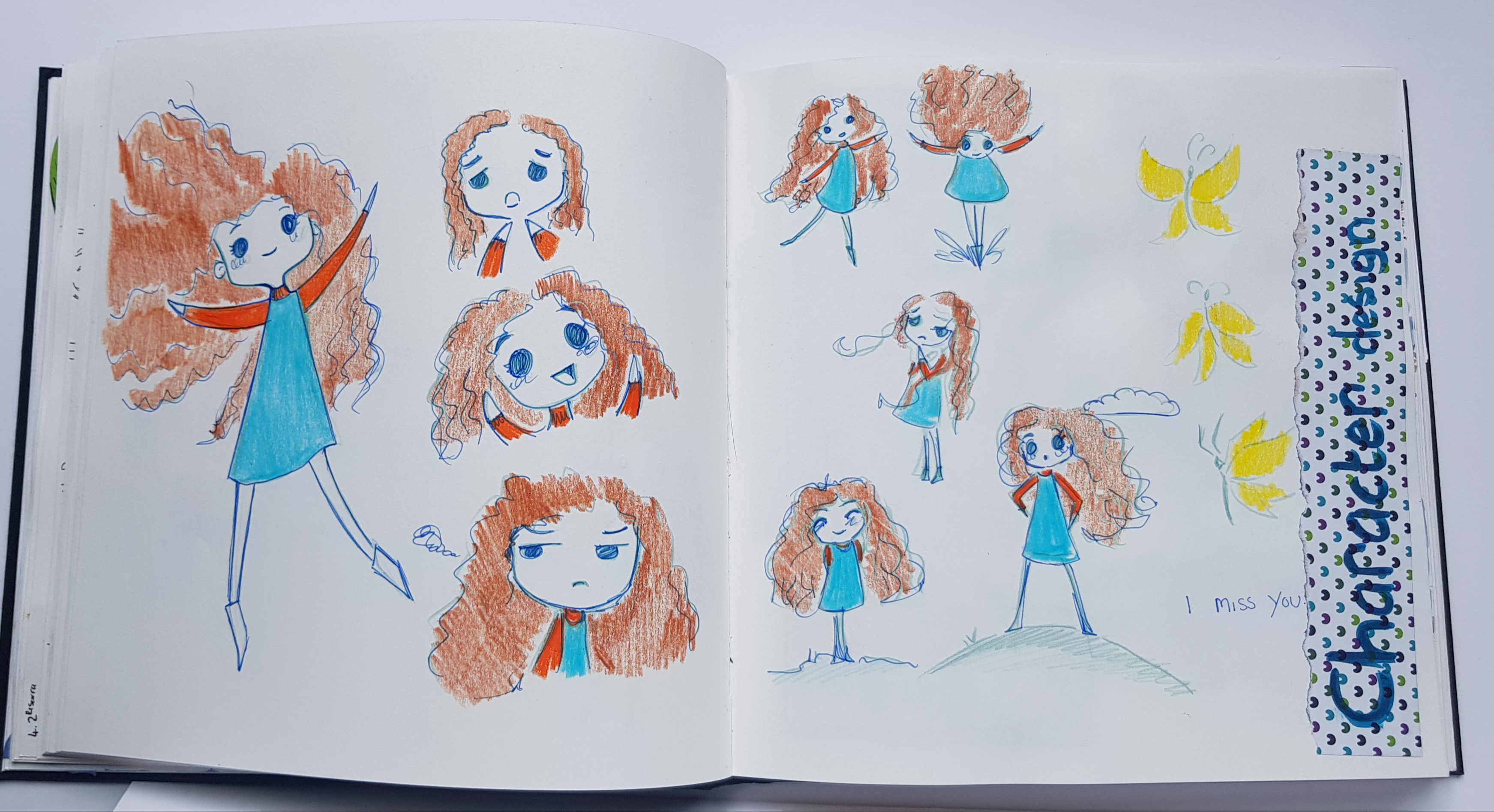
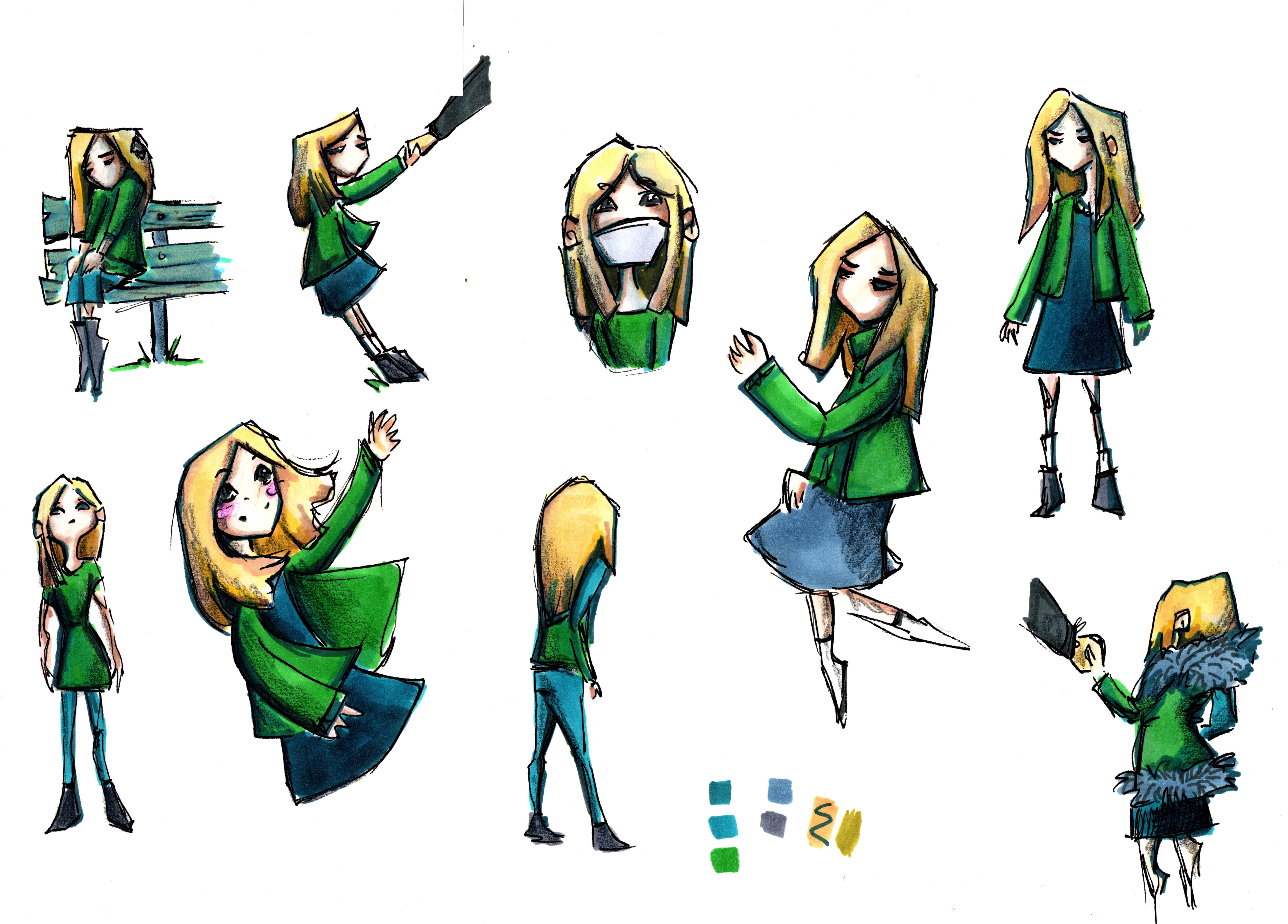
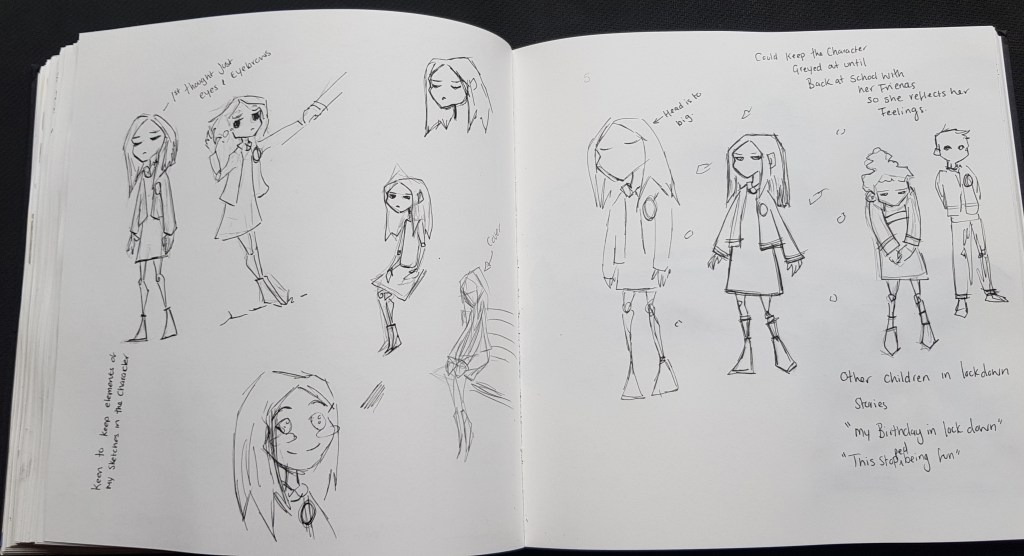
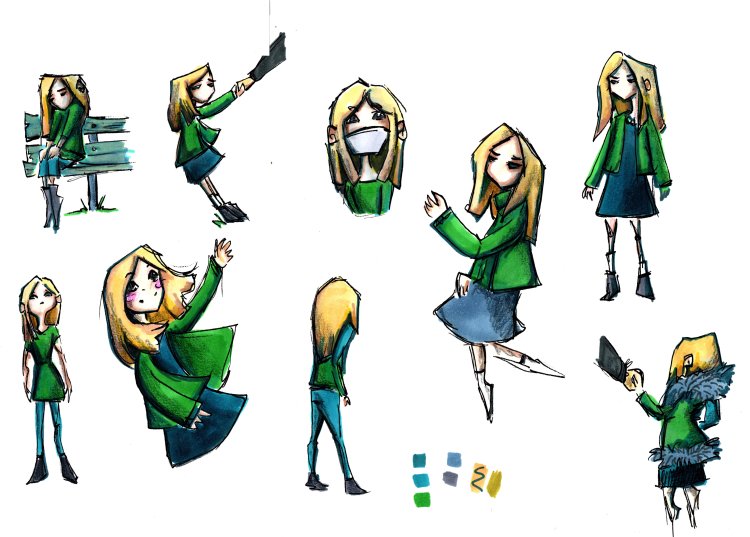
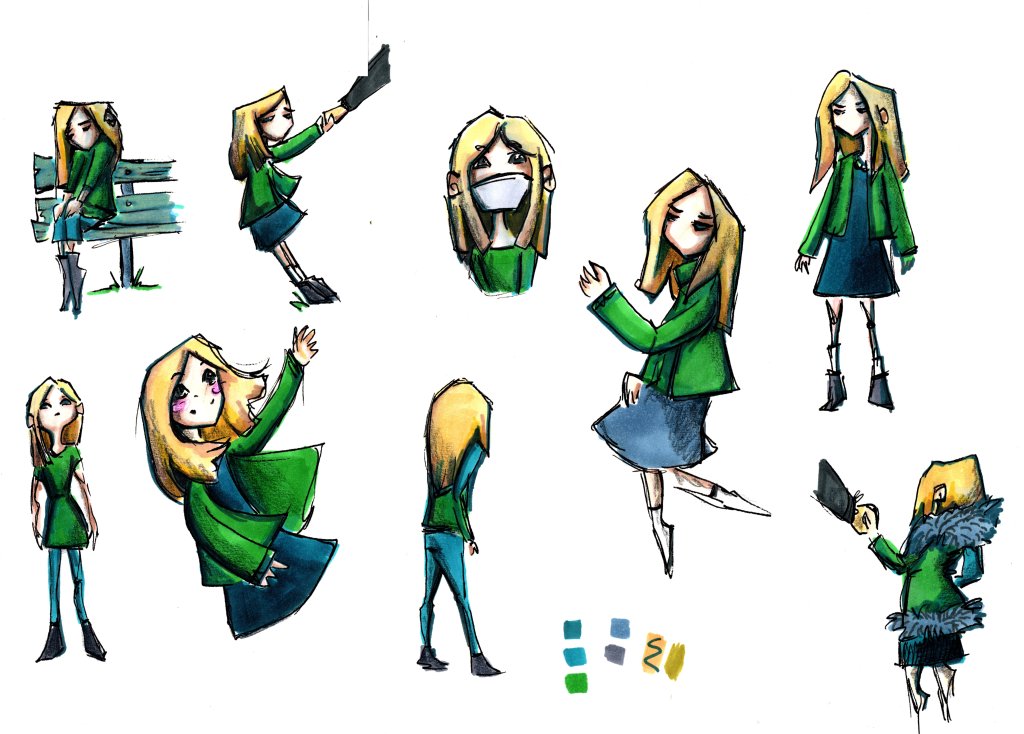
The Character, I wanted the character to make the viewer feel what I did sketching her alone on the bench looking sad. I didn’t want to give to much away, so the character key features is just eyes, I tried to get the expression in just the eyes alone (bar the panels when she was “happy”) Shapes kept simple, but clearly a young school age girl. (below) sketchbook growth of this character.
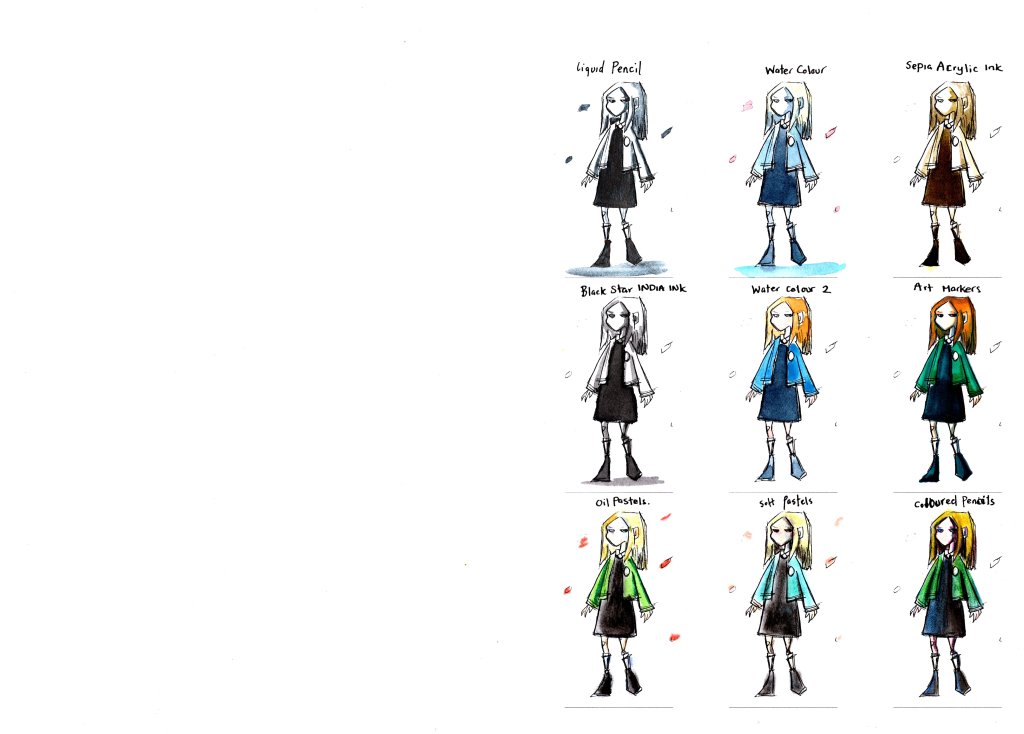
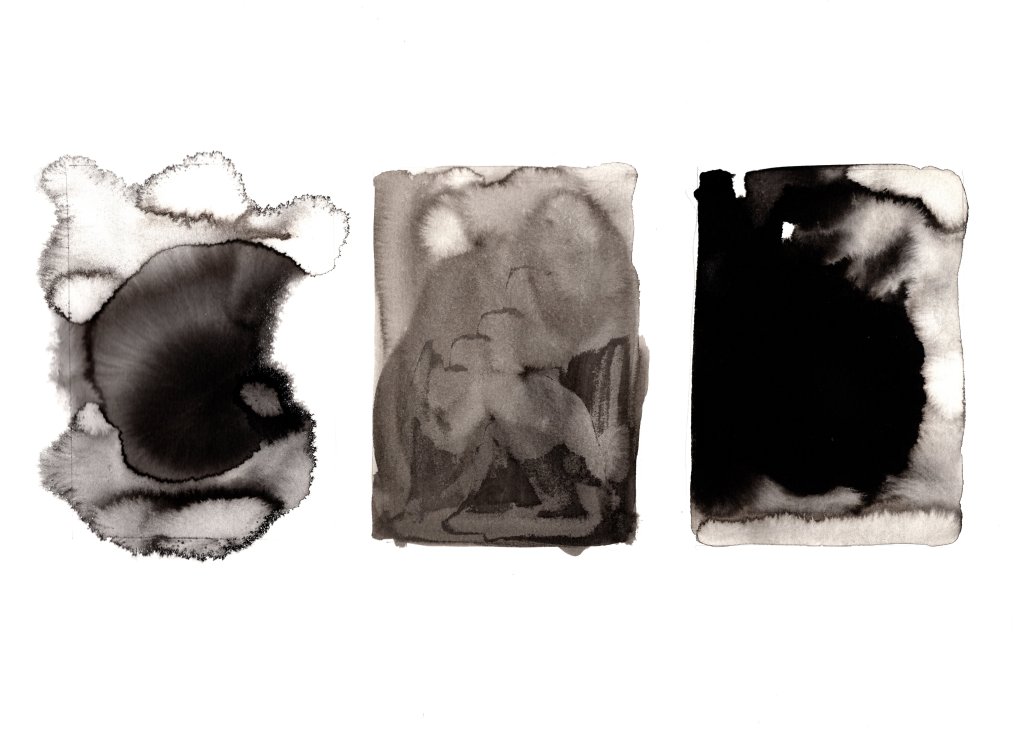
(One I had the “character” I wanted the right colours, originally my thought was more greyscale to show the mood but this was one of the ideas I dropped as felt wouldn’t come across right in the small space and work as well with watercolour/wash background. I would need to have a very bold/colourful background to pull this idea off.
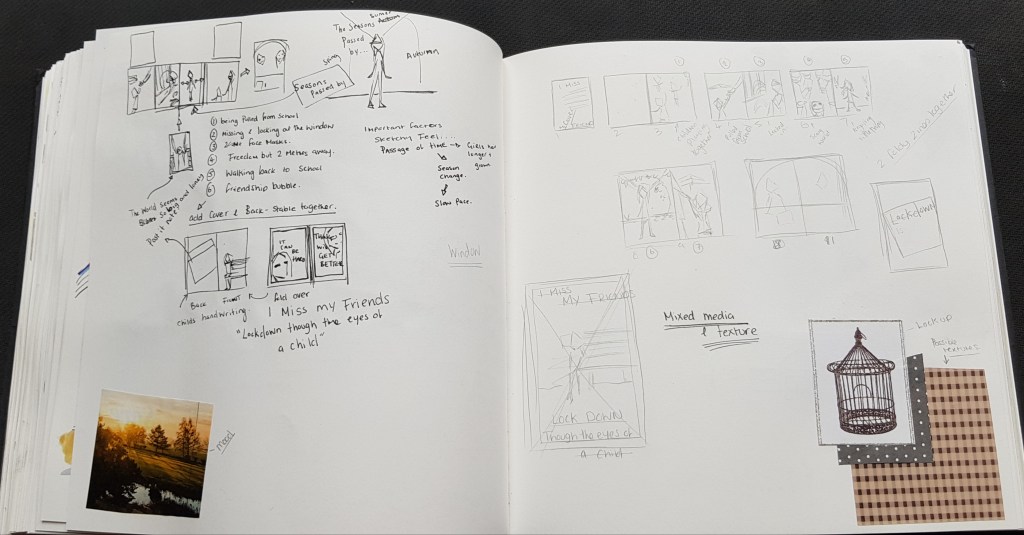
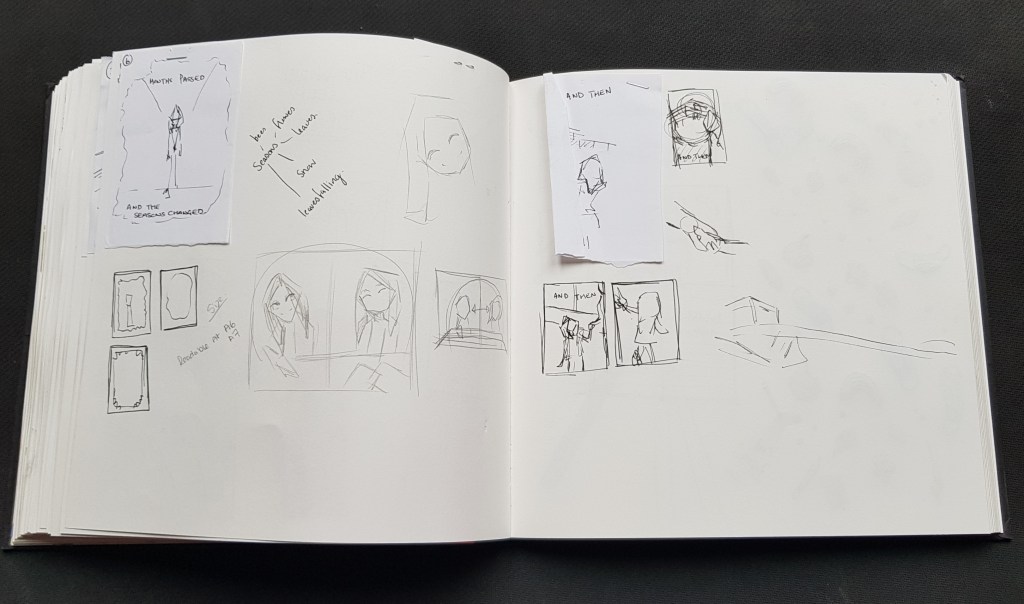
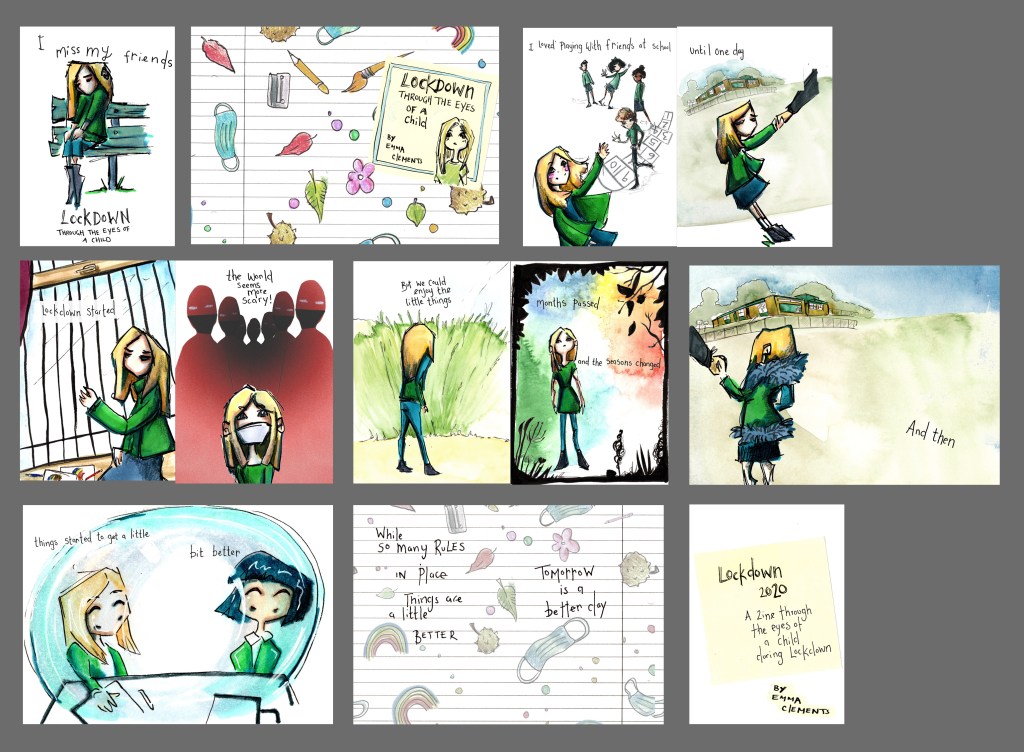
I was keen to have 8 panels, each representing 8 steps of story structures, with a bit of overlap in some panels. While the original idea was to have a single folded zine with a cover added, I felt cramped for room in this format, there is the passage of time every presence in the panels so I didn’t want the stories to flow too quickly.
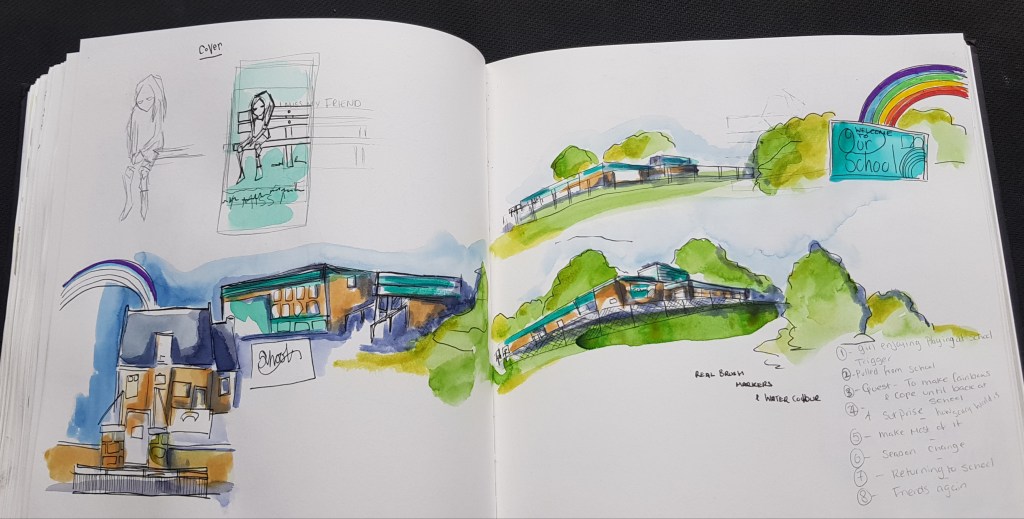
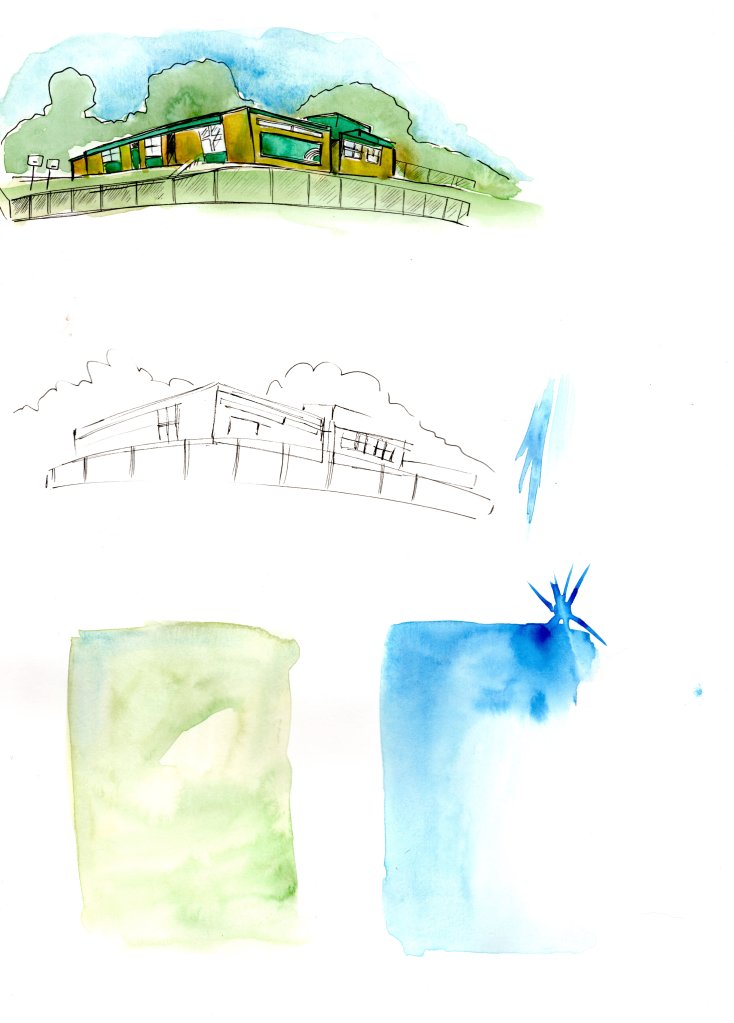
I needed more for my illustrations, I relooked though my images, I went by schools to sketch the buildings.
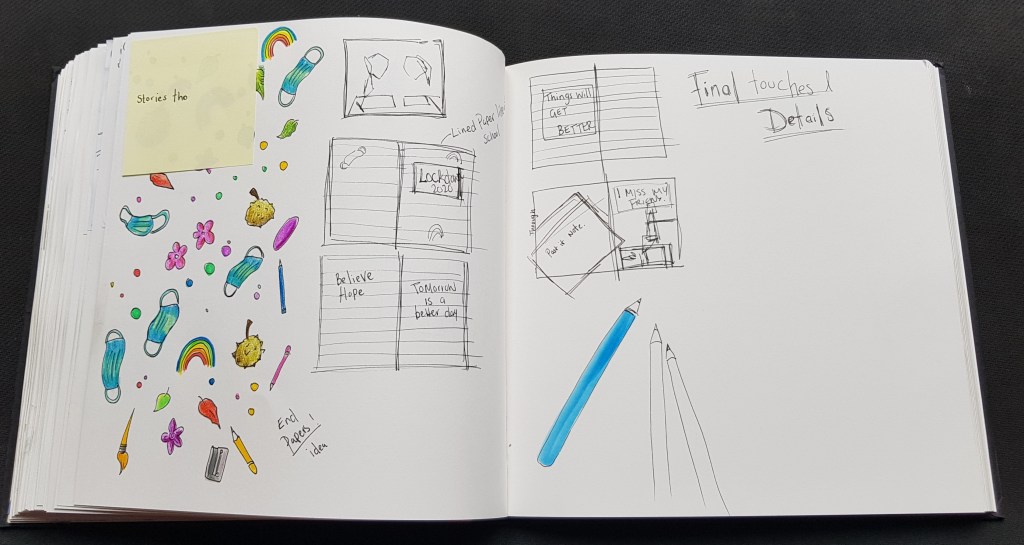
I worked things out across the panels when I had the sequence coming together. One thing I was aware of at this stage, is that this would be a A4 folded down Zine, so I had to think about space for the zine to breathe and flow. This did mean I had to drop some elements I wanted to add so that the finished Zine wouldn’t be to heavy or cluttered.
(Above) Here I started pulling ideas from sketches I did though out the course and from photos I did took as well for the same things.
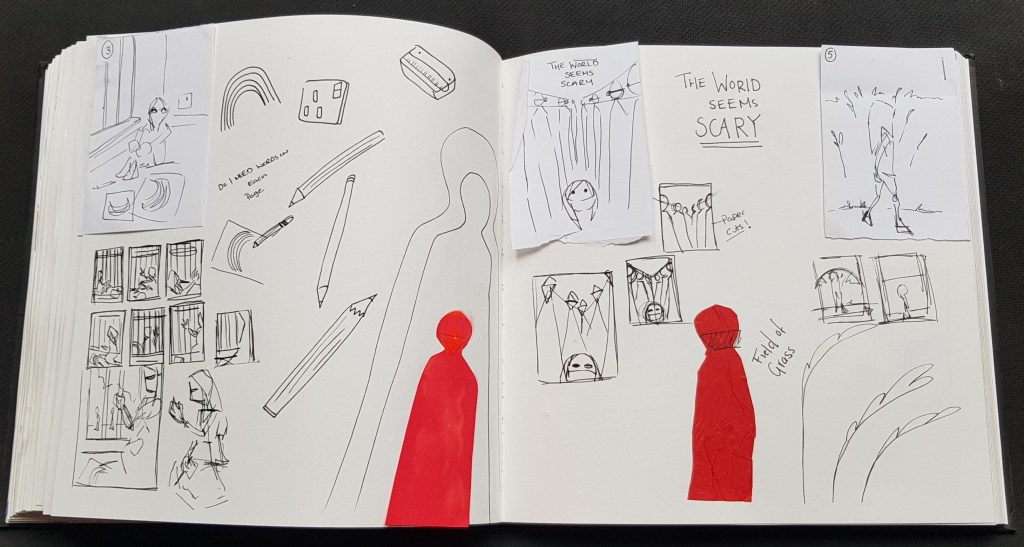
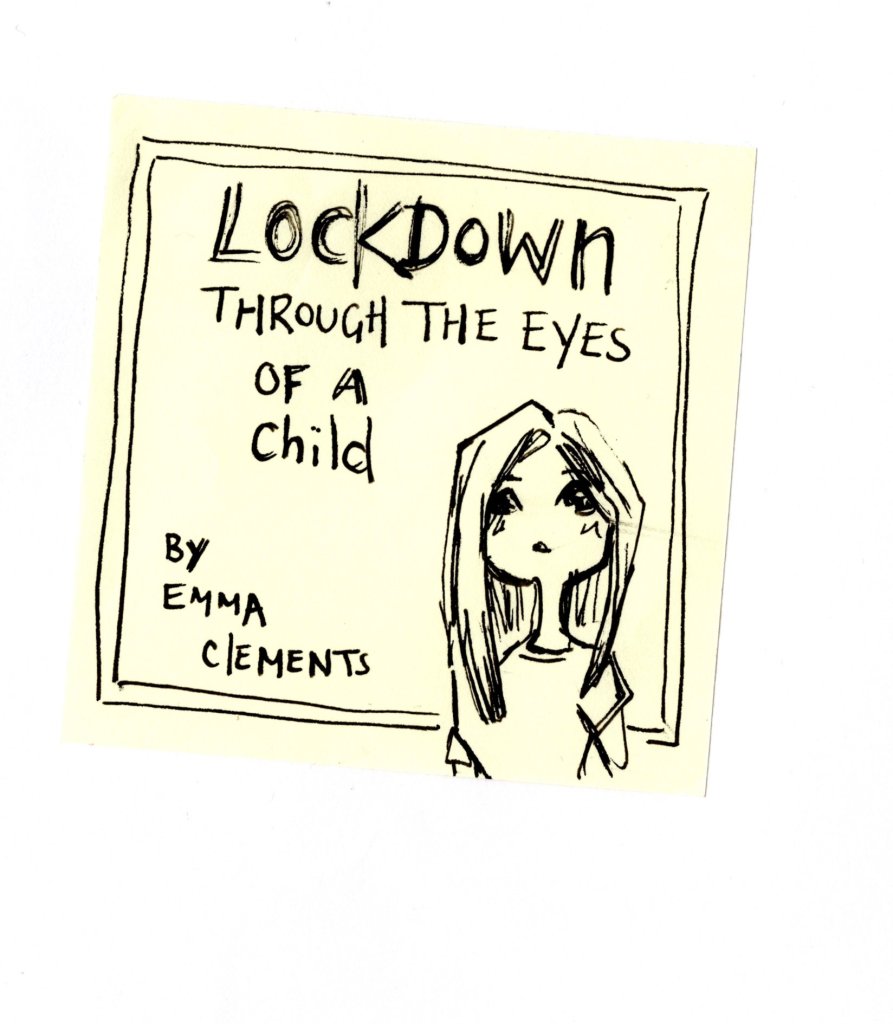
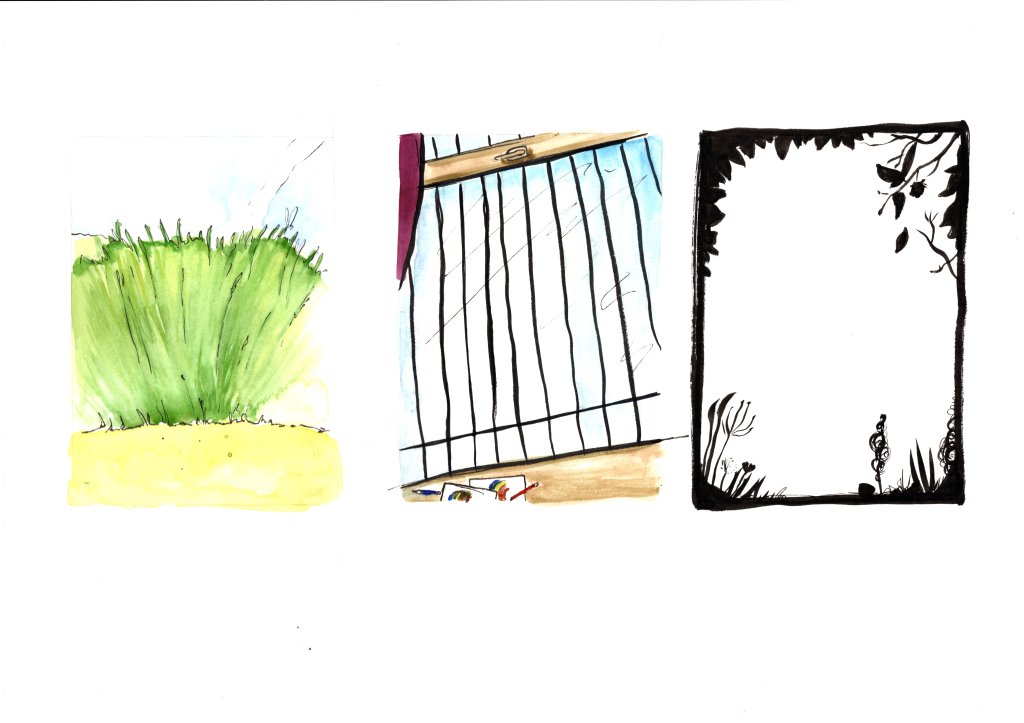
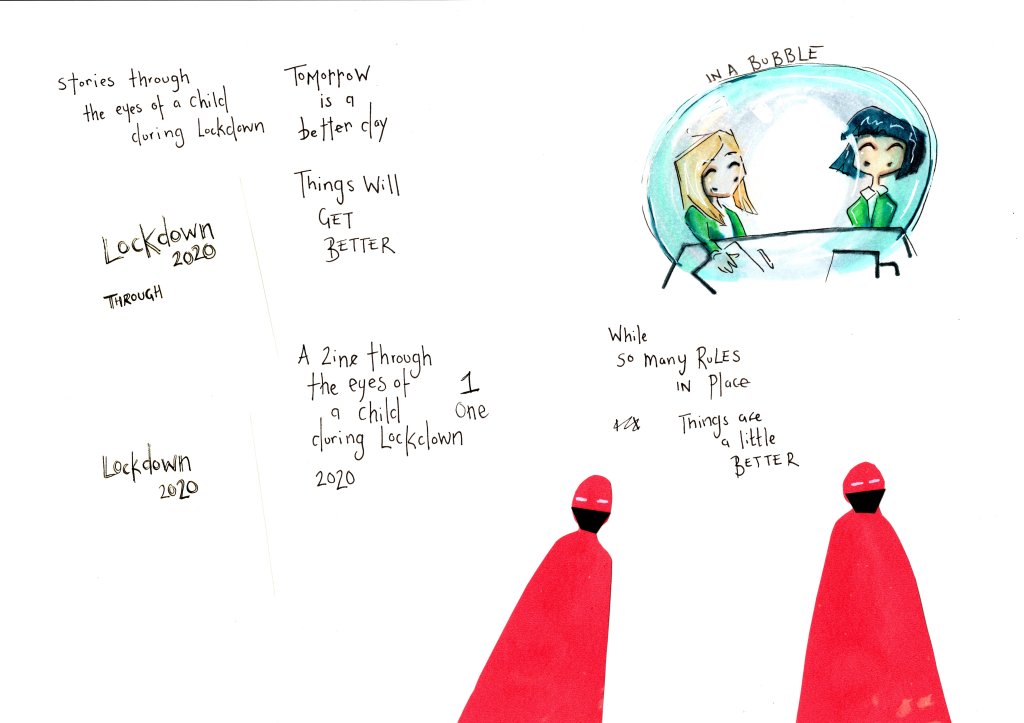
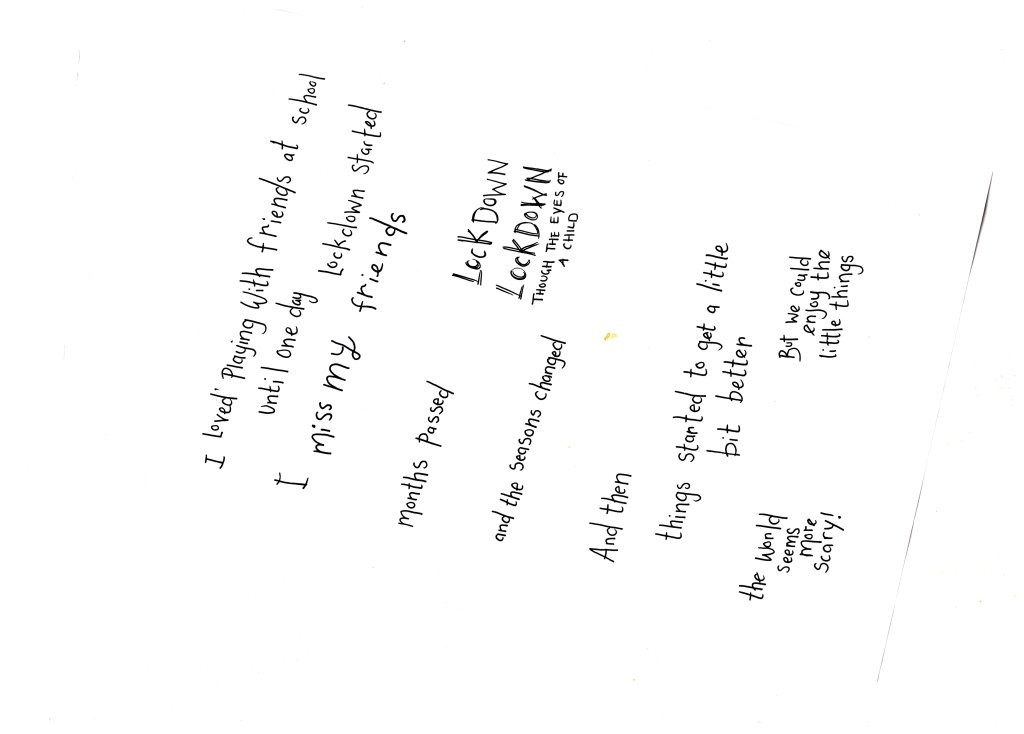
( Above ) this point I’ve made up my mind that the “cover” was going to be the images that had drawn me in, I wanted it to feel like a cover. Pg1 – Next part was the opening part which I wanted to show the girl in her element, playing with her friends. Pg2 – was the child being pulled away from school.
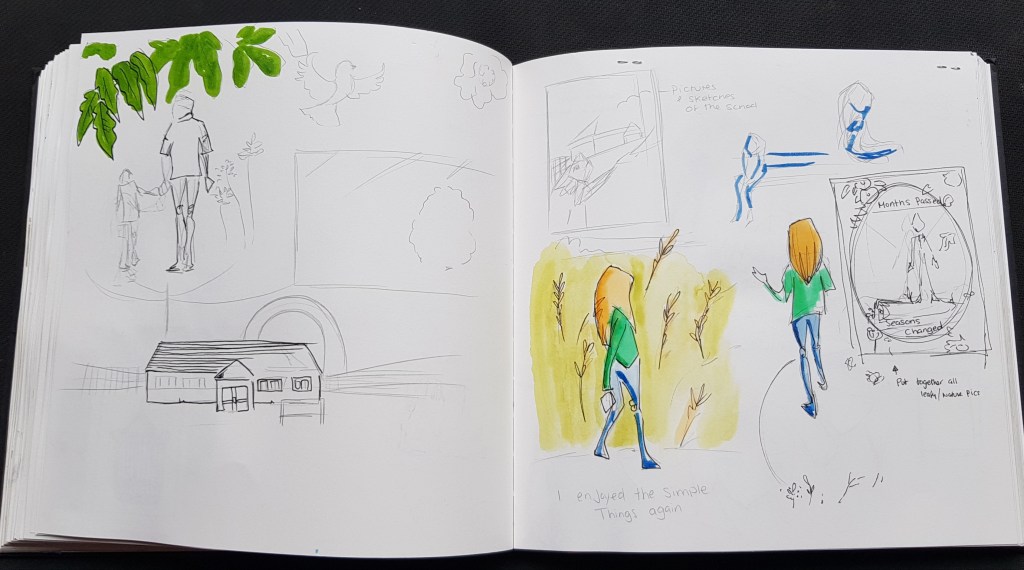
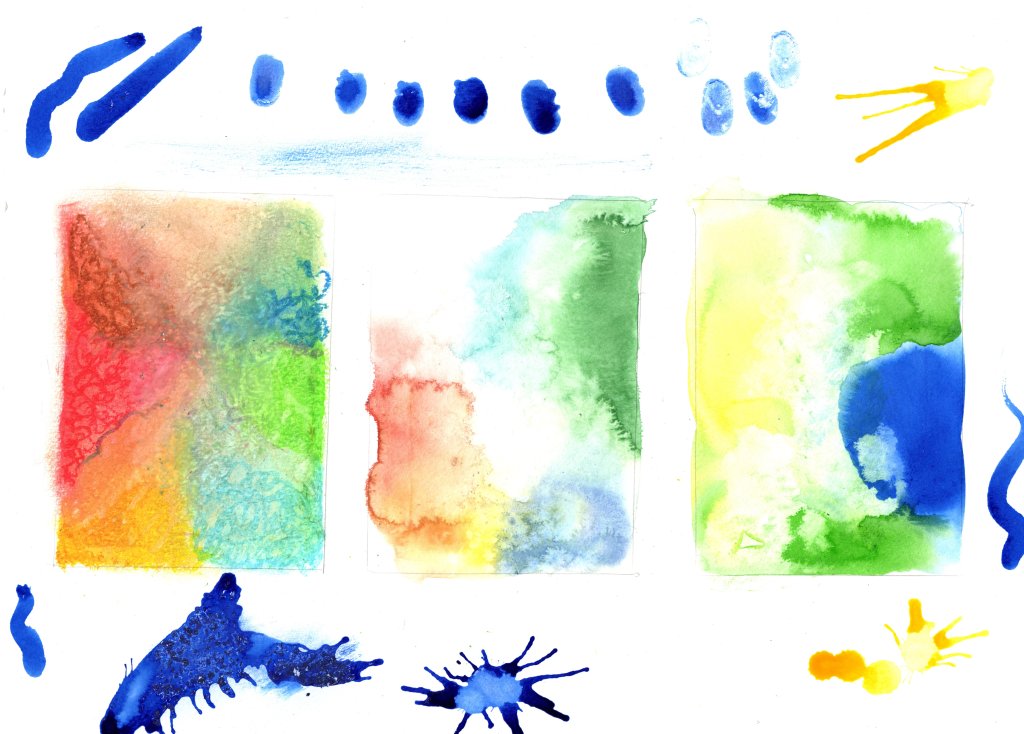
Pg3 – Child looking sad, lonely during lockdown, but making most by creating rainbow pictures. Pg4 – World is different and more scary Pg5 – Still little things could enjoy
Pg6 – Months pass Pg7 – going back to school
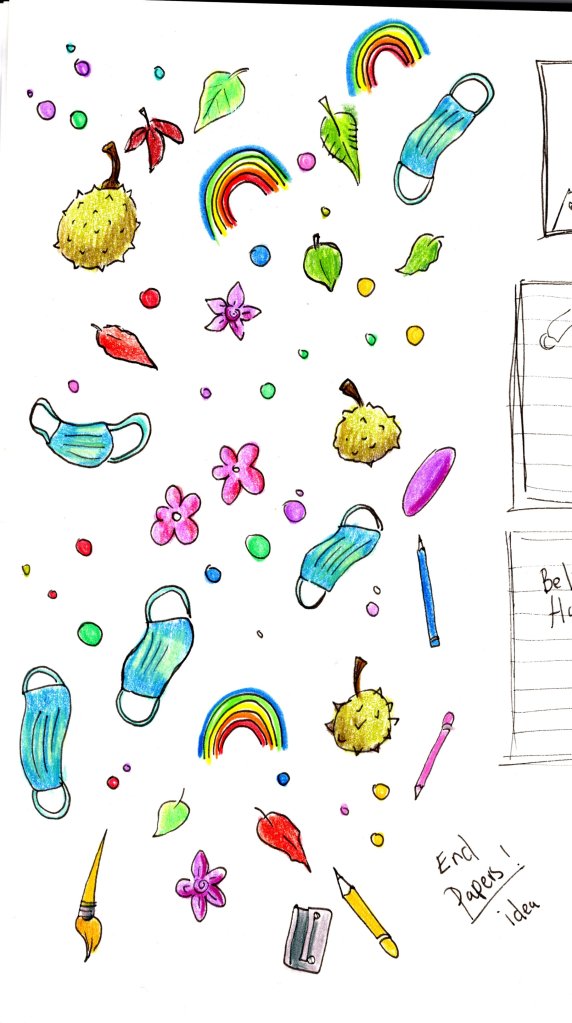
Pg 8 – Back with friends End paper pattern and back cover
I also originally planned to be text list, but due to the “slow” nature of timing, I wanted to add more feeling via wording. So I came up with the idea of very short, simple Also like the child is specking to the reader, than telling the “story” of this zine.
I got my daughter to write the cover title, which I copied and used as felt this added a realistic childlike touch and made more personal.
I wanted the zine to feel a bit like a cut and paste zine, yet bringing the childlike element to the table. I thought about everything I’ve learnt today, more so from my visual diaries studies and set about adding these elements to the zine. This took shape in using lined paper (scanned and cut/pasted into the design) creating a patterned childlike “covid-19” doodle and scanning in a post it note. I used this to create “end papers” to the zine. On the back I tried to add more positive notes.
Below is gallery view of all the individual scanned elements before “cutting and pasting” digitally together.
Using Photoshop and the scanned above images I started to paste together my pages. On the spot I made some design/layout changes as some didn’t seem to work as well as planned/hoped.
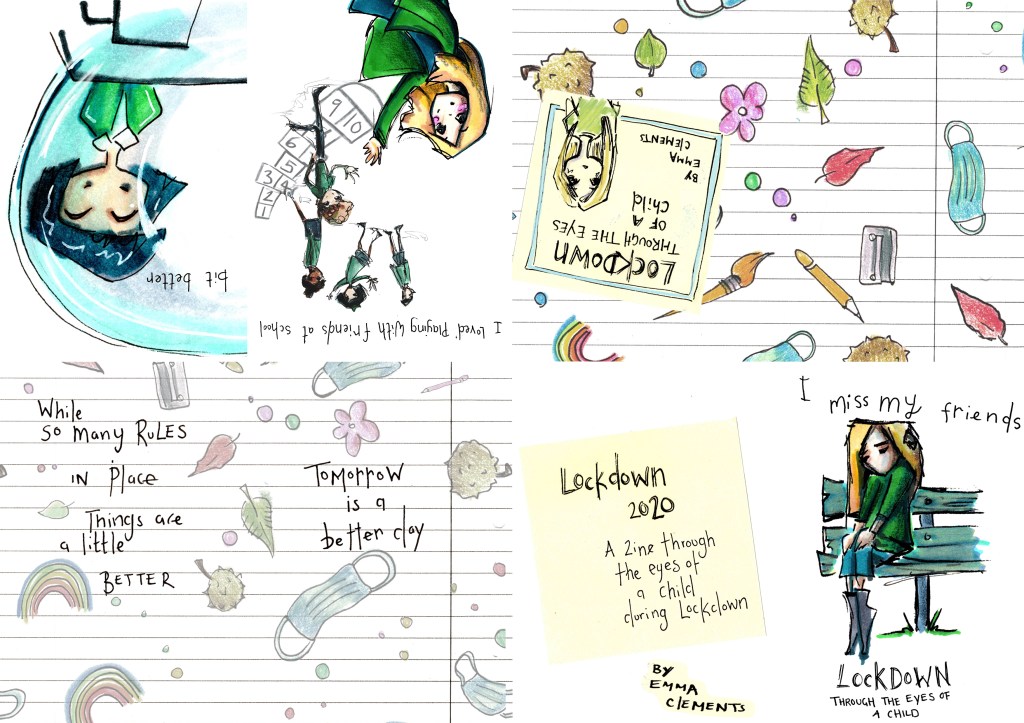
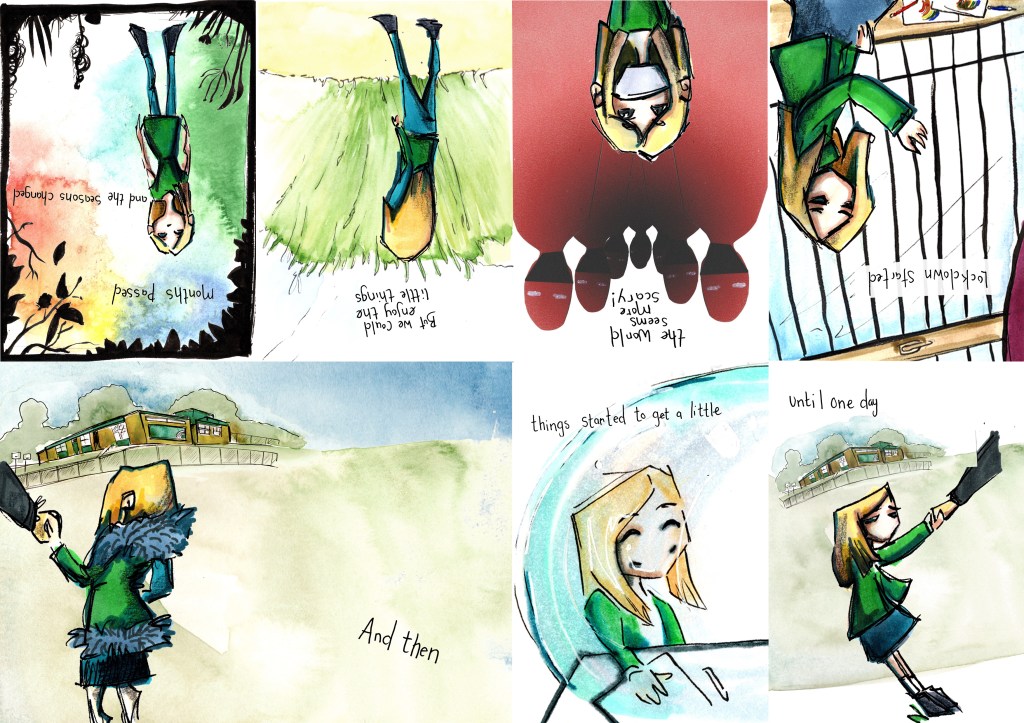
The Mock up. Due adding two foldy zines together to create this, I had to clearly work out how to fit the pages together. Below – Print layout
The first mock up Couple of Printing errors and folding Such as I used paper that was a little to thick at 160gsm to fold down this small (would have been better around 120gsm mark) and I didn’t size correctly to print. But overall gives the idea of how will look.
This is something real, something everyday in terms of narrative. So this isn’t as “fictional” as I could have been with a story. It is a risk on my behalf as so many other things I could have done. I wanted something with feeling, motivational and with a meaning.
This is what life is life during Covid-19, it is a story, while came from my illustrations, an inner dialog moment could very well be told today, something people can relate to.
Also it is a bit risky it isn’t a “narrative” that shows “movement” in a story, the time between panels are to vast to be anything like that. This is an element in my personal stories I hope I have showcased in the other exercises where I shown more real time narrative flow, this format suited this better and this is the pacing for this story, from the moment the idea was the one I was drawn to the most. I think most attachment comes from narrative with emotional / empowering meaning to me, I feel this from fact I have so much I’ve held inside me for so long now I want to use all of that to both creative stories with meaning for others and to help myself heal.
I’ve enjoyed this as it is “me”, this is what I have to say and what I want to use my voice for. I think this is the direction which my final is heading….
This unit has started something I seem to have little control over. I am VERY inspired and seem “narrative” as a whole is somewhat of a creative muse to me, giving an much needed outlet to the way I want to express myself.
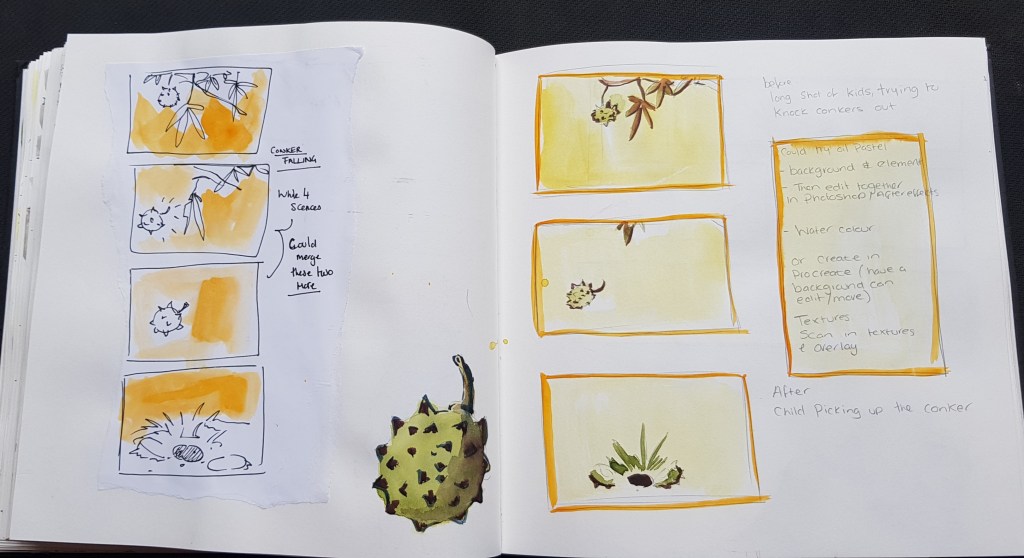
Conker falling
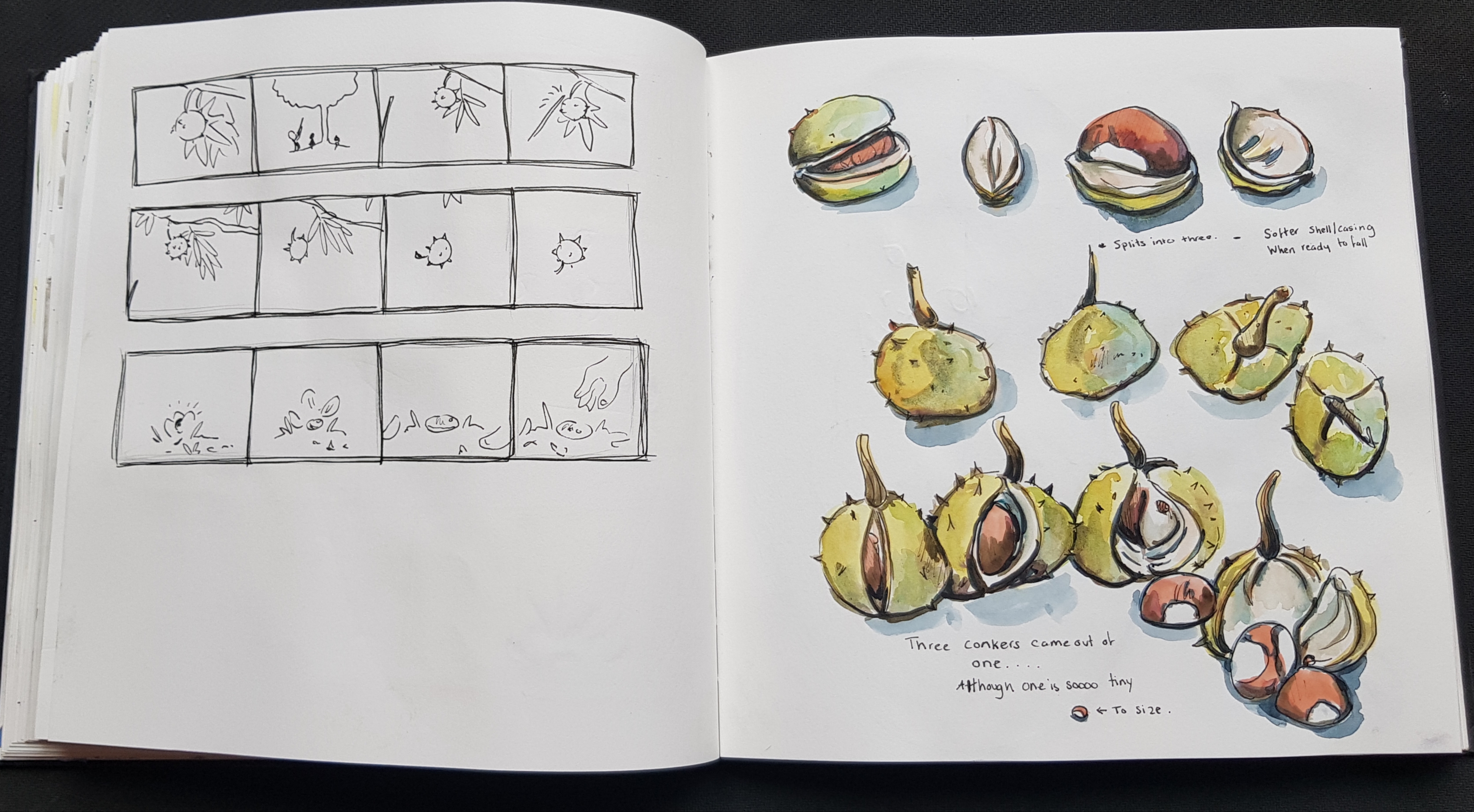
I created a mini story board, first is the basic of the conker falling to the ground. Later I added what could have happened before and after. * Kids knocking conkers out of the tree * Conker falling *child picking up conker.
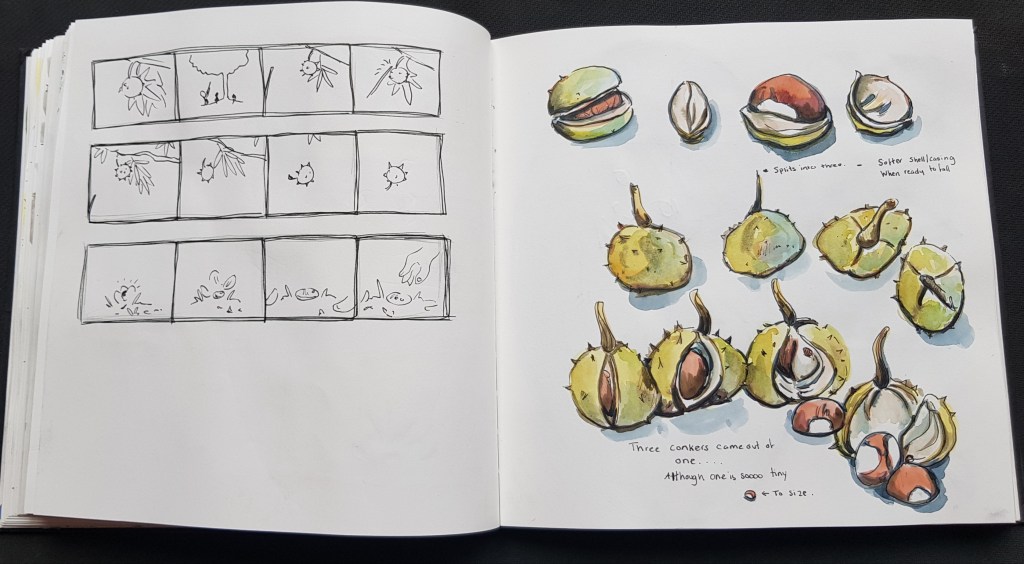
The cocker were inspired by sketches I did during exercise 4:1 Description and Depiction, I went back to the same place and sketched cockers on the tree and more pictures from the ground. I also took a shell with a cocker still inside home to slowly break out and explore (like above) – I illustrated each step.
From this I was able to create a mini animation of the conker falling
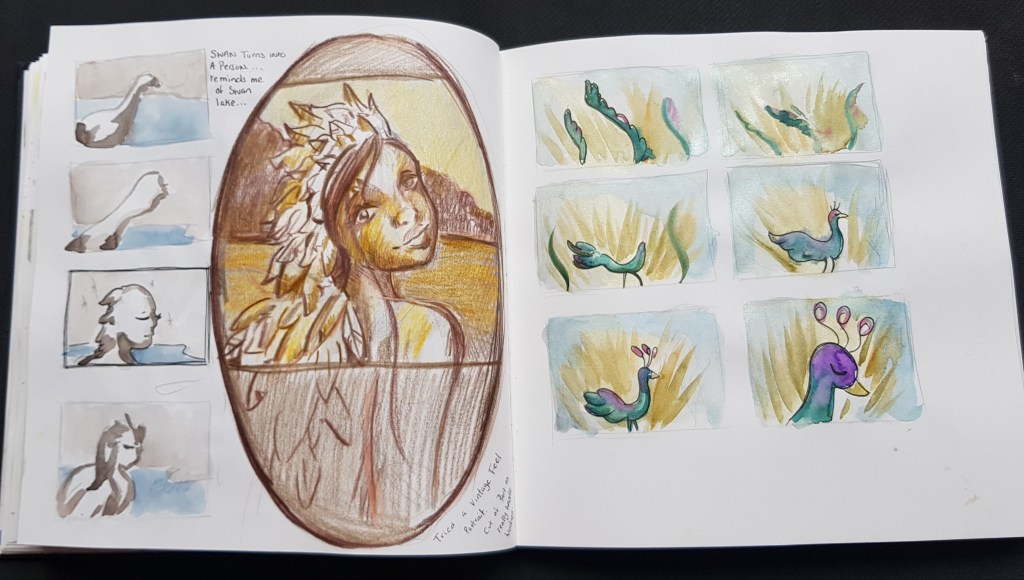
I wanted to push a little more with the idea of a character morphing The swan into a girl/angel. The grass into a defined shape of a peacock.
I was able to visualized these with the help of story boards. I took the swan into a princess to work on as animation/gif as it suited the story board I did for “swan lake”.
This was a little “messy” in areas, the lines being the part that was a little wrong in places. This is experience and practice that I need.
Below is something I actually started after Part 3, but was working animation of lawman as my tutor asked “how would Lawman walk?” and this is my answer.
There is still so much and need and want to learn, I have to remind myself to take it steady as I want to build core foundations in my skillsets and this isn’t something I can rush. It is something I can learn well by repeating a lot of the steps in all the exercises to date over a period of time as I work though this course, I can apply these step to my future exercises.
I could also try different ways to animate, create a flip book and work my way though The animator survival kit book” by completing each part as my own animation. I also have started a couple of classed “Art of Aaron Blaise” to help me build my skillset in this area, hopefully all this will start me to have a clear narrative voice as an illustrator.
Before I wanted to illustrate stories, even when knowing I couldn’t write them I started plotting my stories from a young age. Even taking some creative writing classes and always told my imagination has been one of my strongest skills.
What I’ve lacked is ways to tell these stories, even with some form of structure which naturally takes shape I found was still lacking. This research task ask of me to start to deconstruct a narrative formation for the purpose of learning how to build drama, tension and interest within a story Arc.
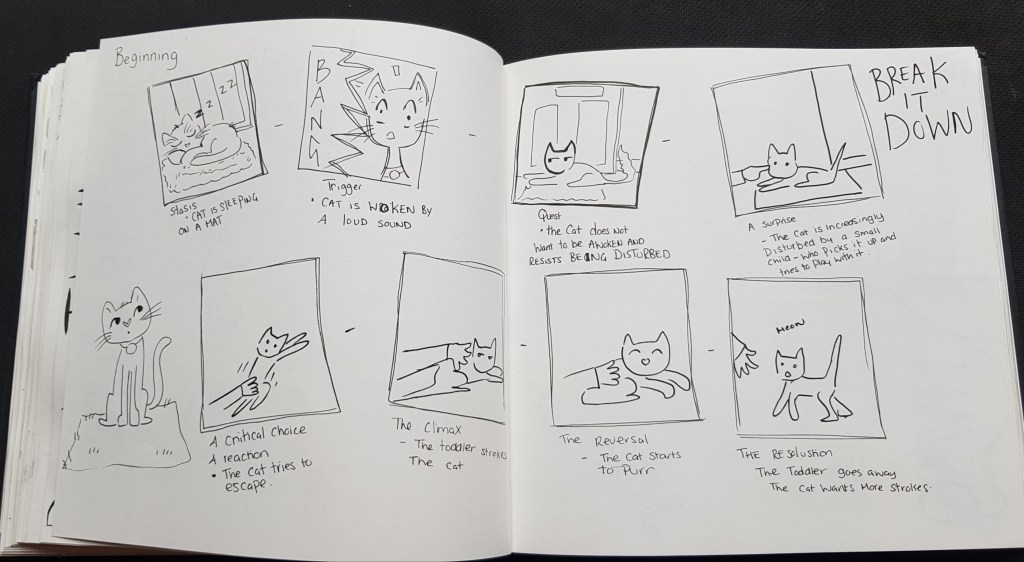
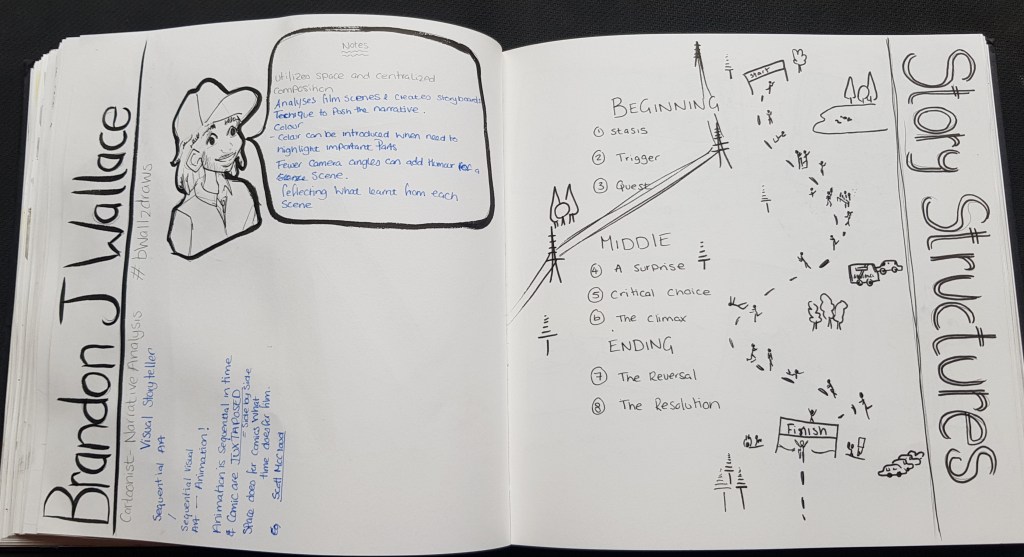
Breaking stories down into 8 parts. (from the course file information)
I wanted to study a different story arc to build upon my skill set for this task.
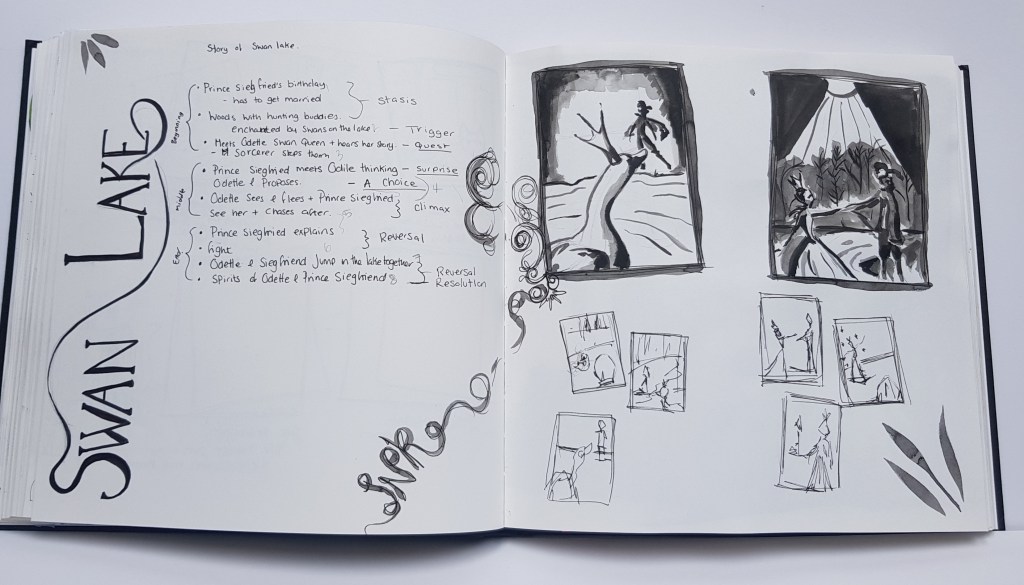
So Swan Lake It makes sense for me to use Swan Lake as a way to break down Story Structures as it seem swans/peacocks/trees are a recurring/revising theme throughout this unit. First I created a list of breaking down the story into key parts.
1. Prince’s birthday / has to get married / wood hunting with buddies 2. Meets Odette / hears her story / falls in love 3. Sorcerer stops them / quest to meet her again / dance on lake 4. Fall to meet bride / Odile / 5. purposes to Odile thinking Odette / Odette see 6. Odette flees / Prince chases to explain 7. Fight / and jump in lake / drown to be together 8. Other swans force sorcerer in lake / Odette & prince rise to heaven together.
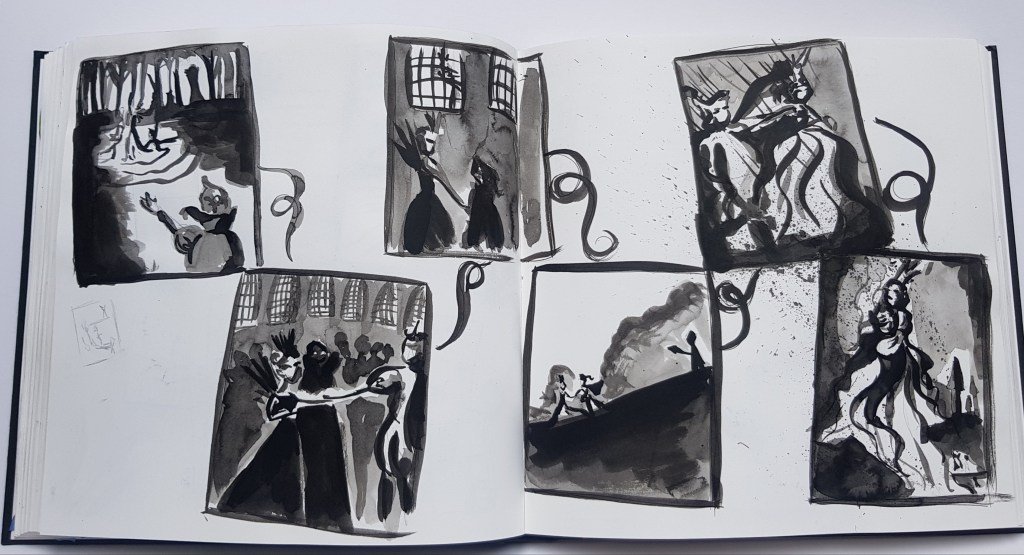
Then from this I created a quick illustrated “story board” for each of these key moments within swan lake.
This was created in ink, there are some panels I would likely move around, change to make the story more clear.
Like with storyboards this is a task I can keep doing myself to improve my skills and get better at building my own story structures.
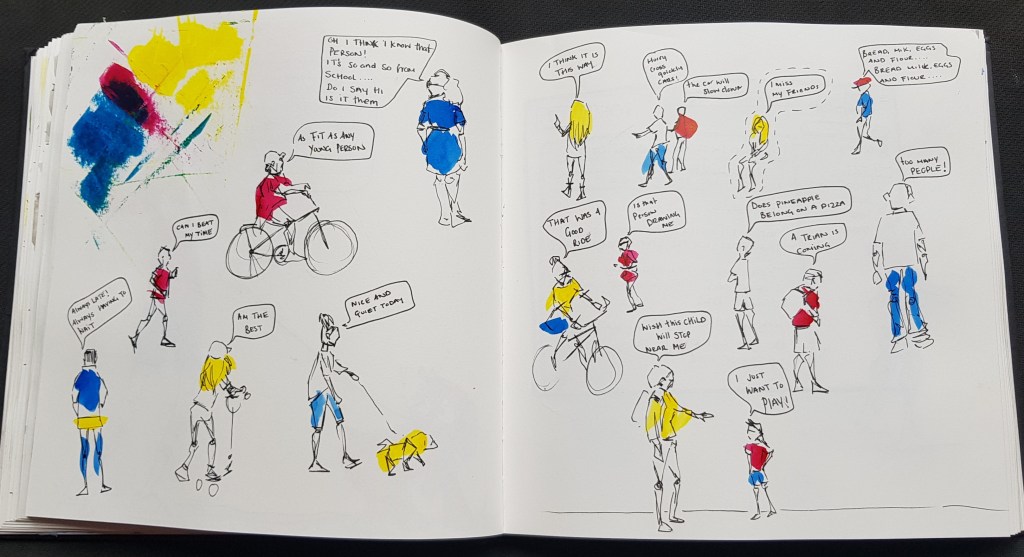
In the last exercise I was heading into this exercise and was already starting to give a story to parts of my sketchbook. So I took and bit of a step back and I started this by flipping though my sketchbook and resketching quickly some of the figures that stood out to be with an inner dialog conversation.
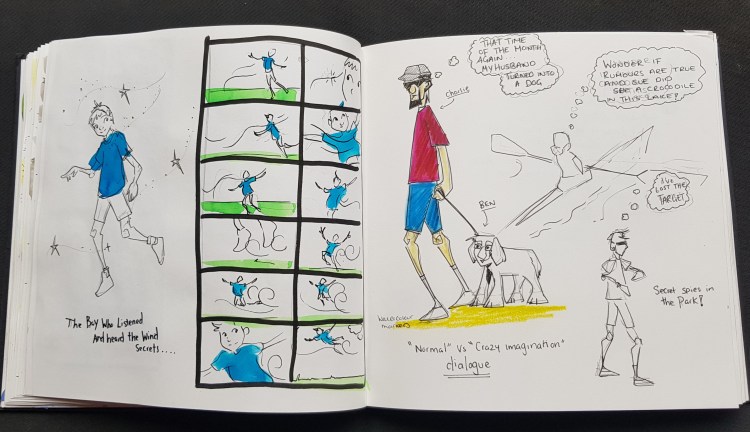
At first my thoughts on “conversations” were far from “normal”.
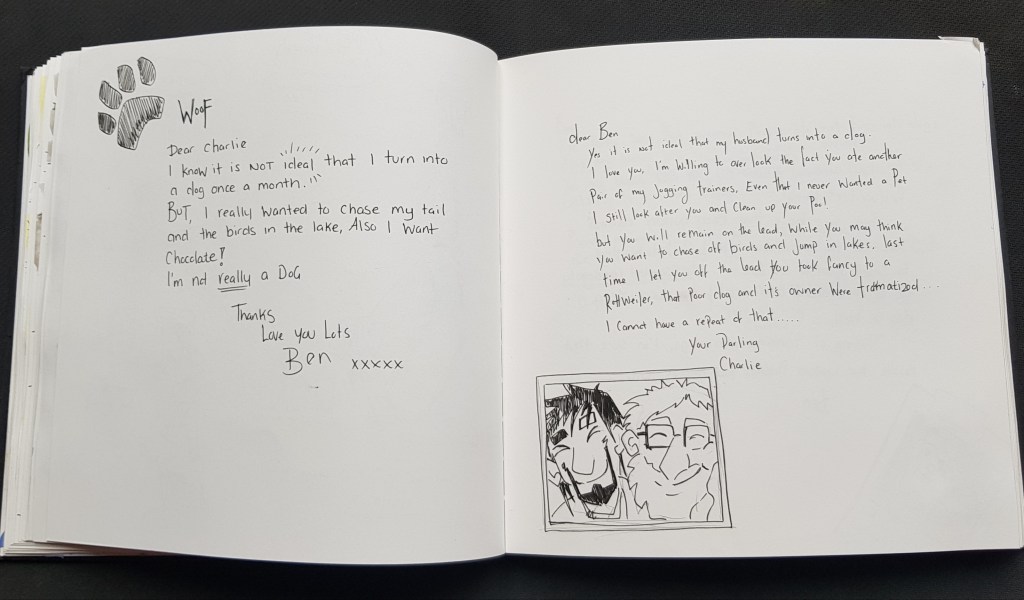
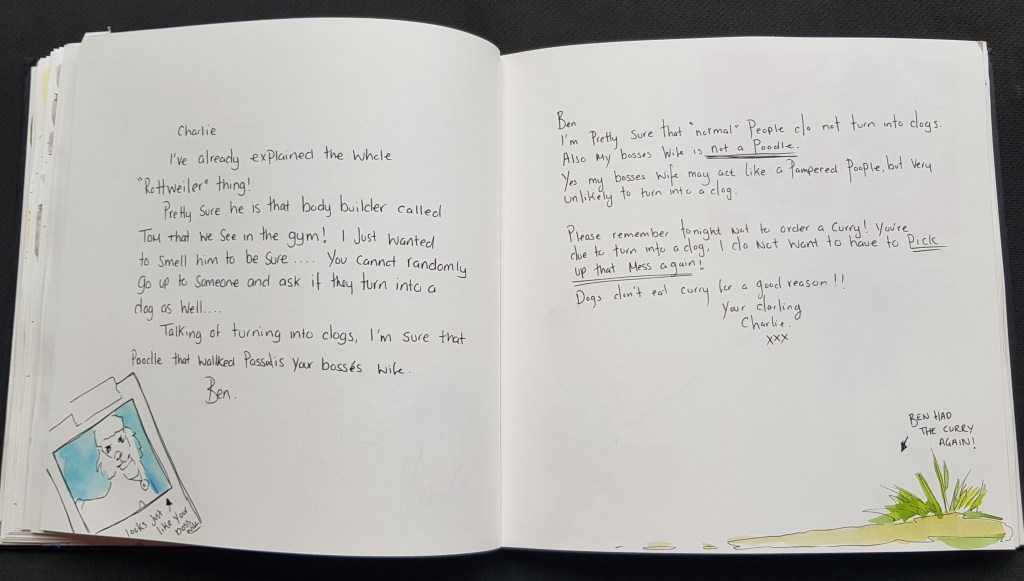
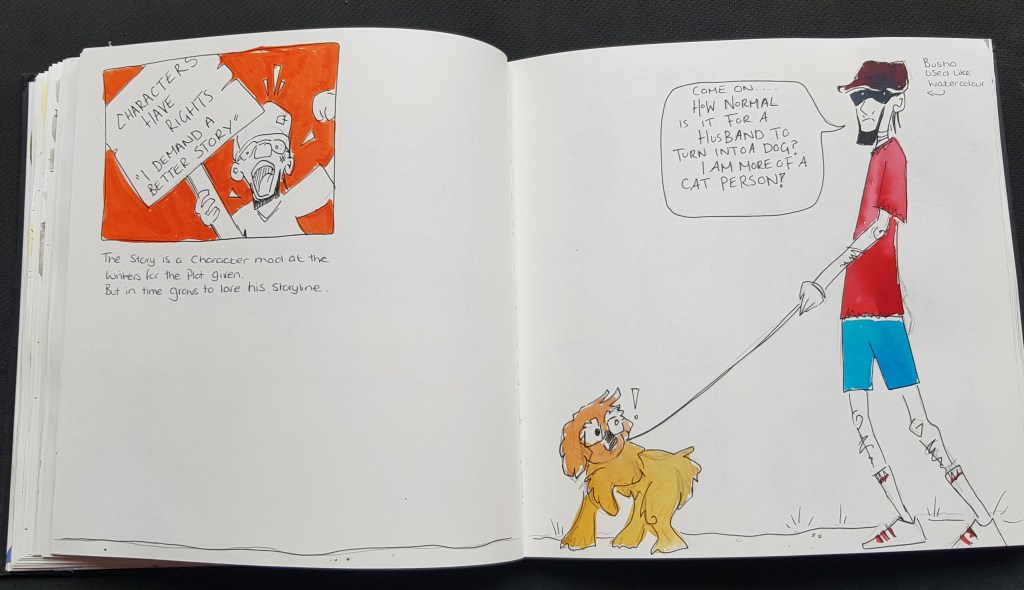
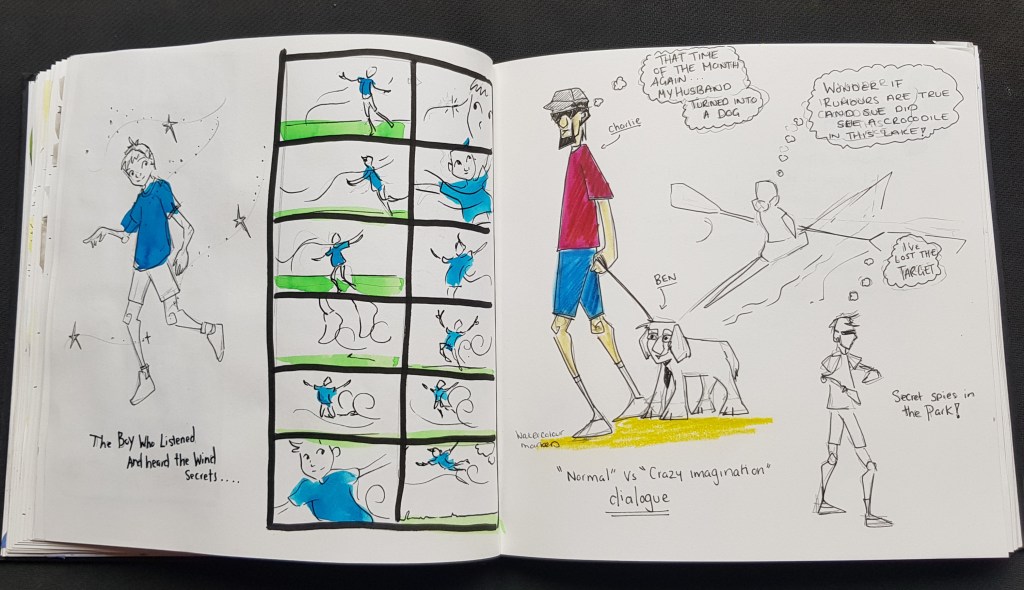
I ended up going down a route of creating a story between a Man and his husband that turned into a dog once a month. Writing letters to each other.
This then turned into a whole story plot of this man, being annoyed at the “plot” of his own story at the creator. Starting a character movement “characters have rights“, stating this poor character “Charlie” deserved a better story narrative from me.
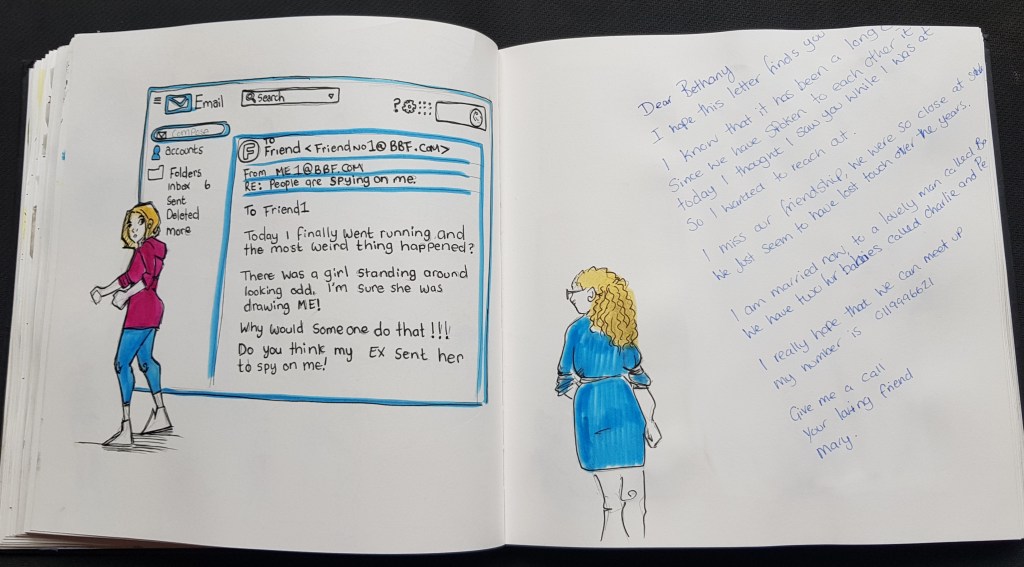
I’m being honest I enjoyed the craziness of this moment, maybe getting creativity carried away and lost again, but I wanted a more “everyday” conversations so I revisited some figure sketches and created this more normal (boring) inner character dialog from these.
From this, I took two of these and made into an email and letter from the character.
This may come across as a bit wacky at first, but my imagination has been my friend from very young. I people watch and often give them stories or create characters based around little snippets I get into a person in a glance. But, I never truly did anything with this, took anywhere or explored in this sense…
This is something I do subconsciously without thinking, now I’m creating something from this and it has been fun. Never mind these characters, I feel this also helps me understand my own way of thinking and it is fun to explore this side of me. I know it is clear which dialog I liked and was inspired by the most (the Dog husband one)
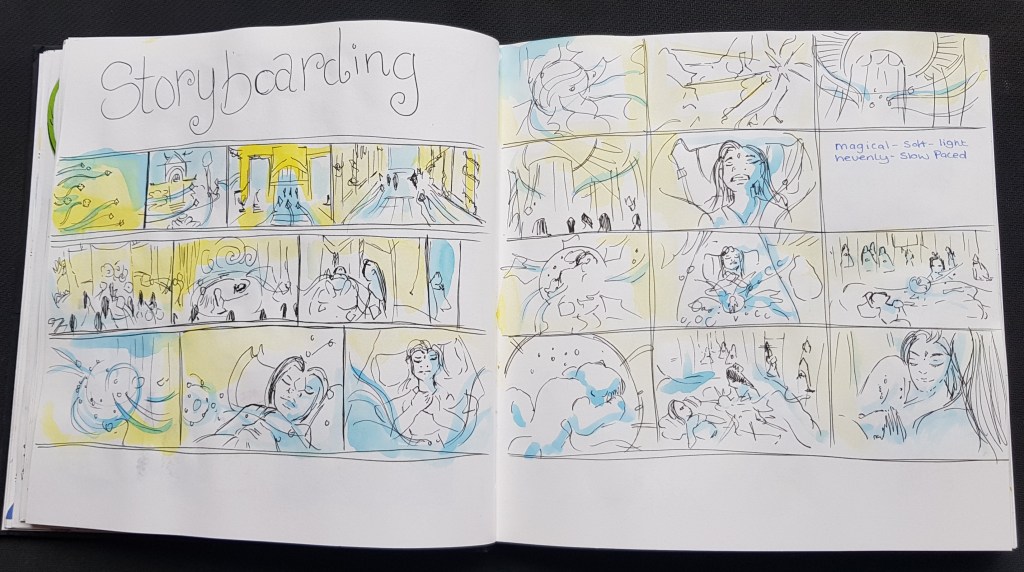
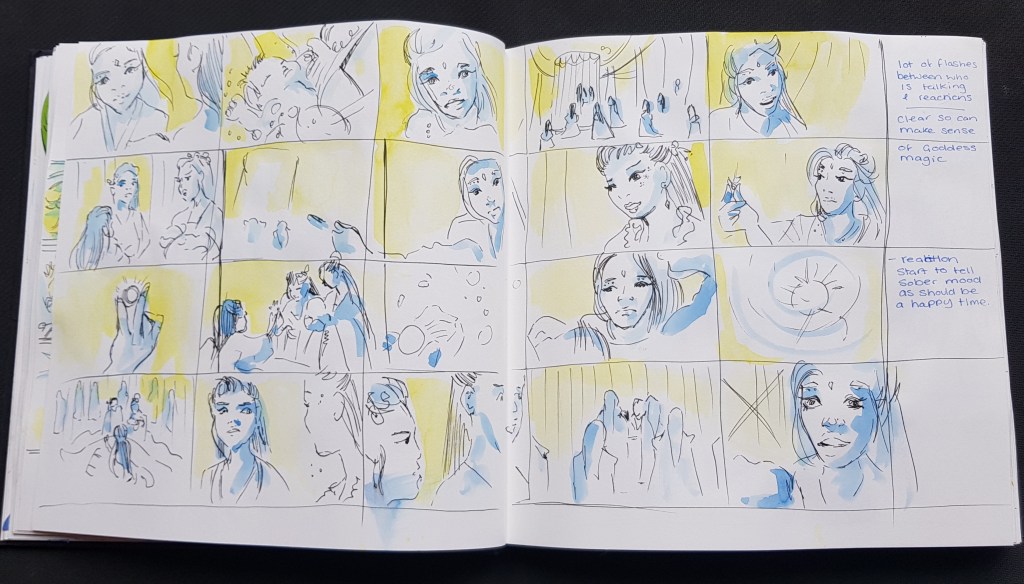
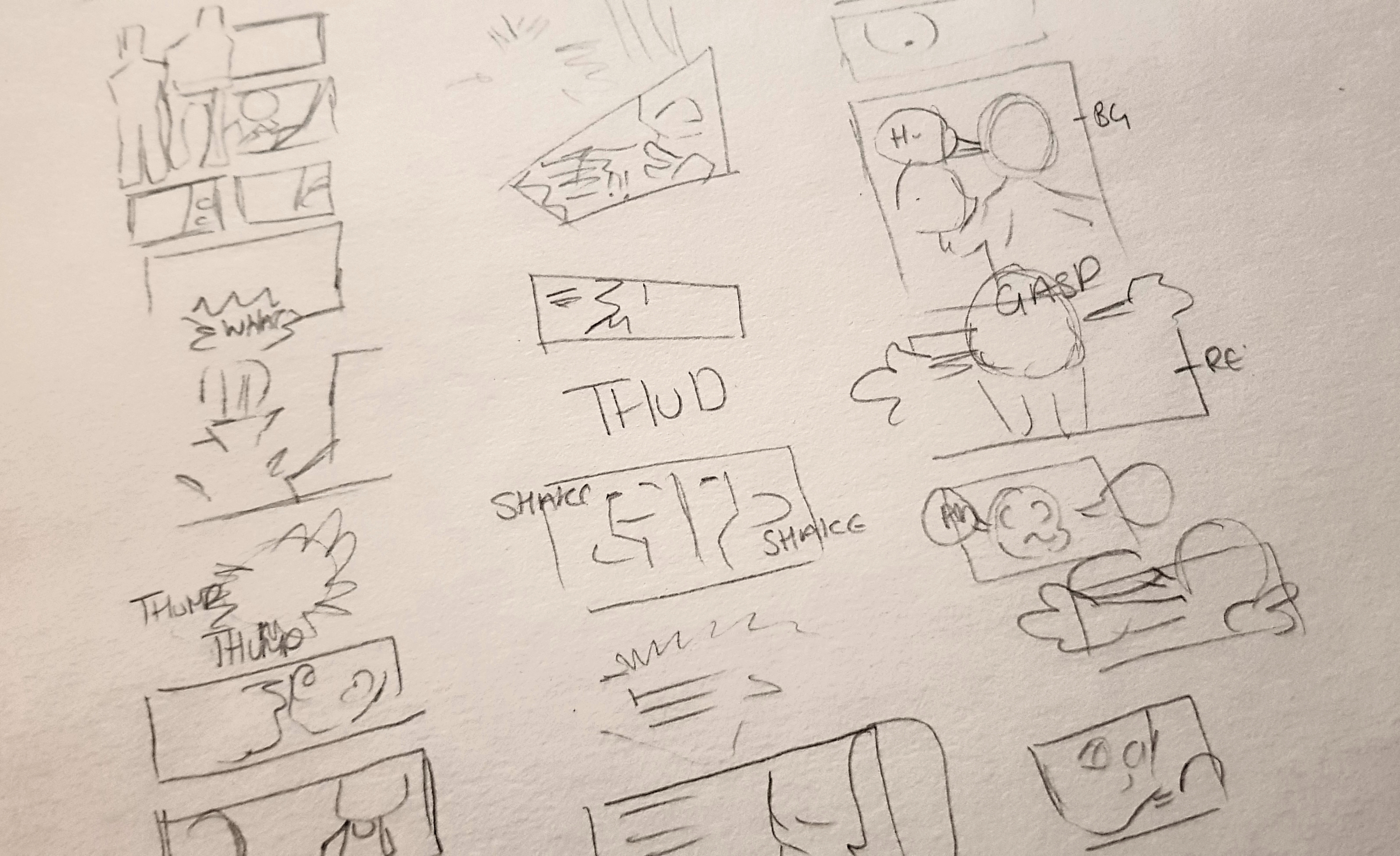
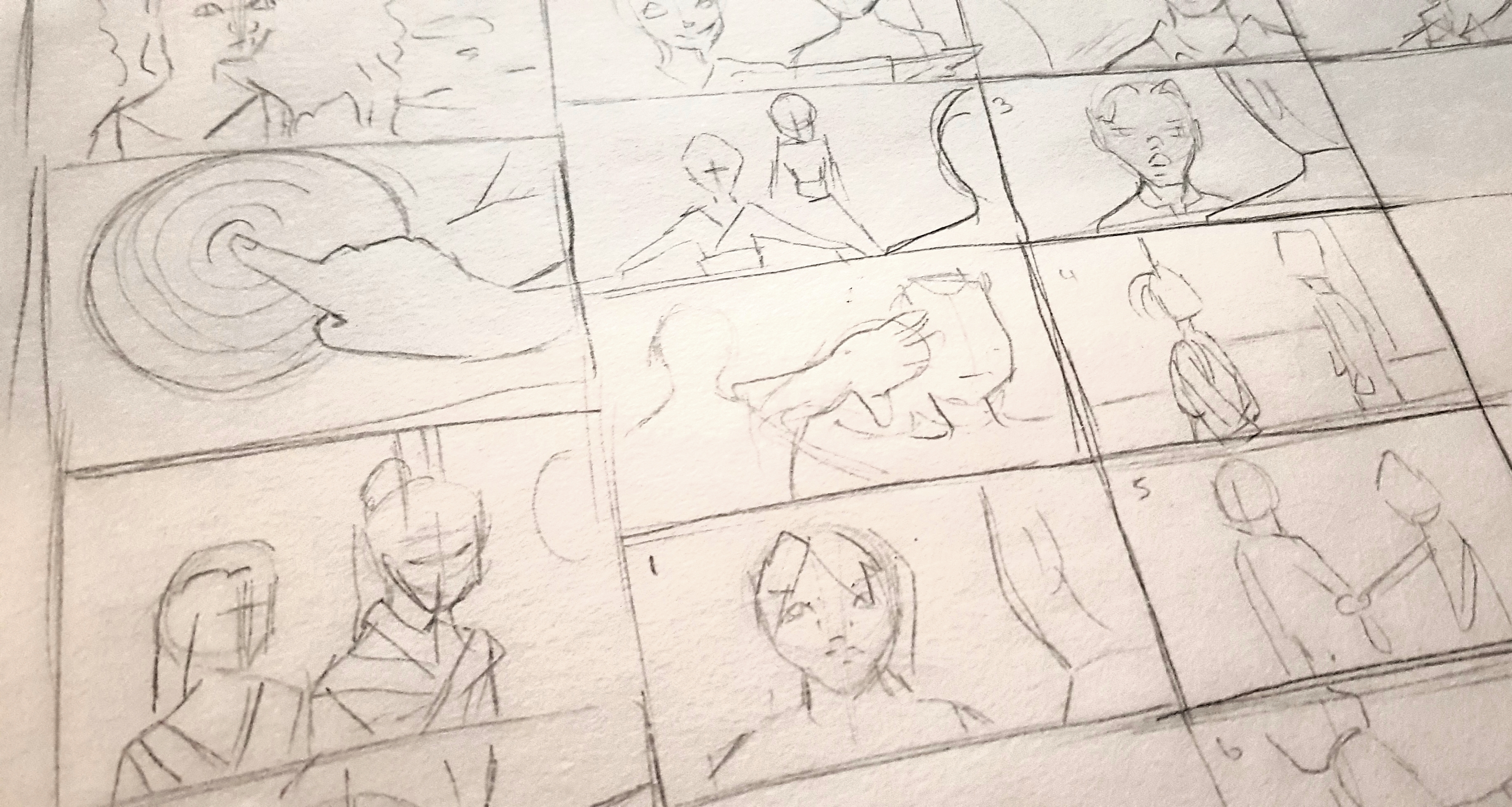
First Story Board This is based upon a Chinese Xianxia/Fantasy drama called Ashes of Love https://en.wikipedia.org/wiki/Ashes_of_Love_(TV_series) This is the opening sequence, where a “goddess” is having a magical birth.
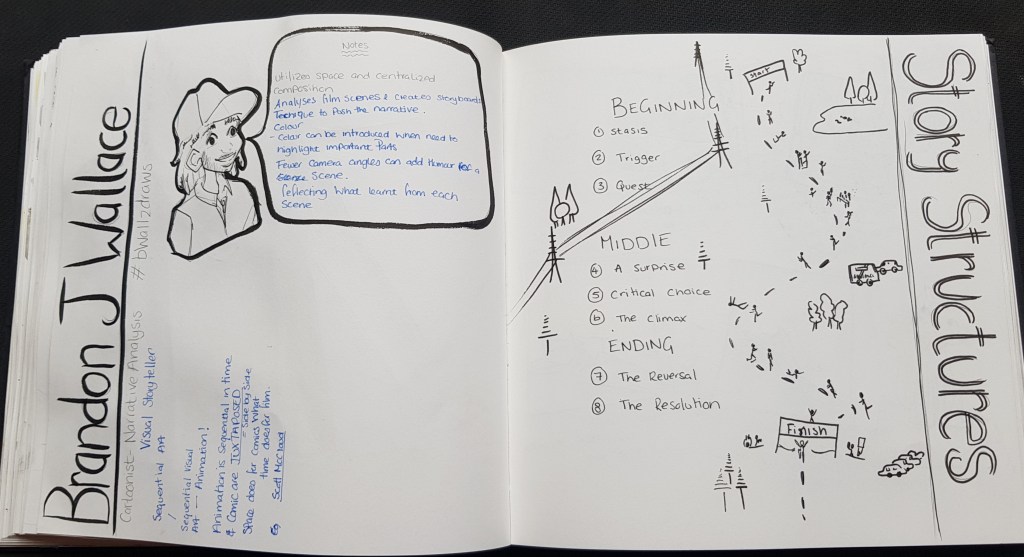
Inspired by Brandon J Wallace I was keen to try give sense of mood and pacing.
The mood is very soft, slow pace and airy.
Expression and reactions are an important part, this dialog with with characters set the whole series off.
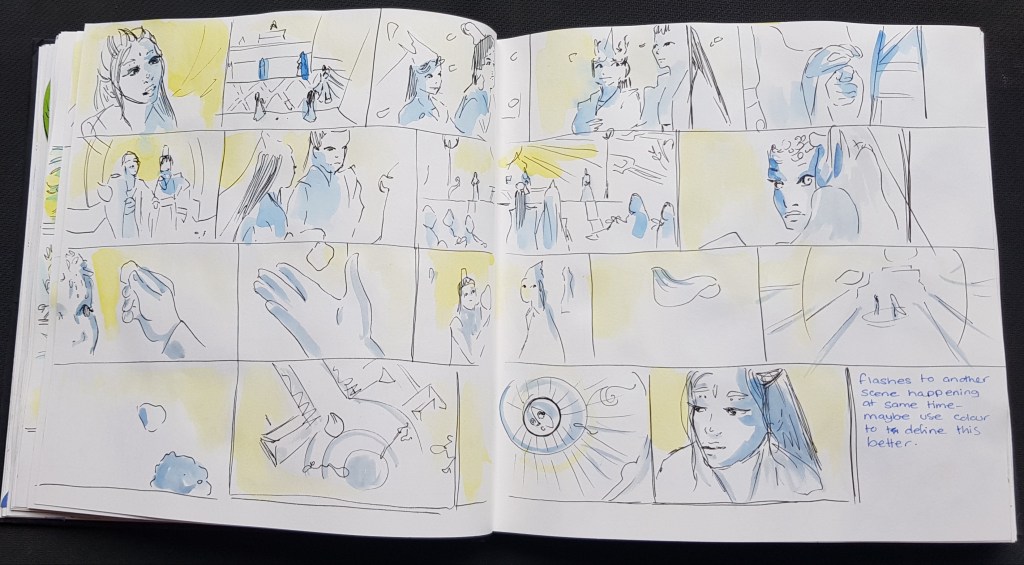
Here the scene sets to another scene, and the mood turns sadder.
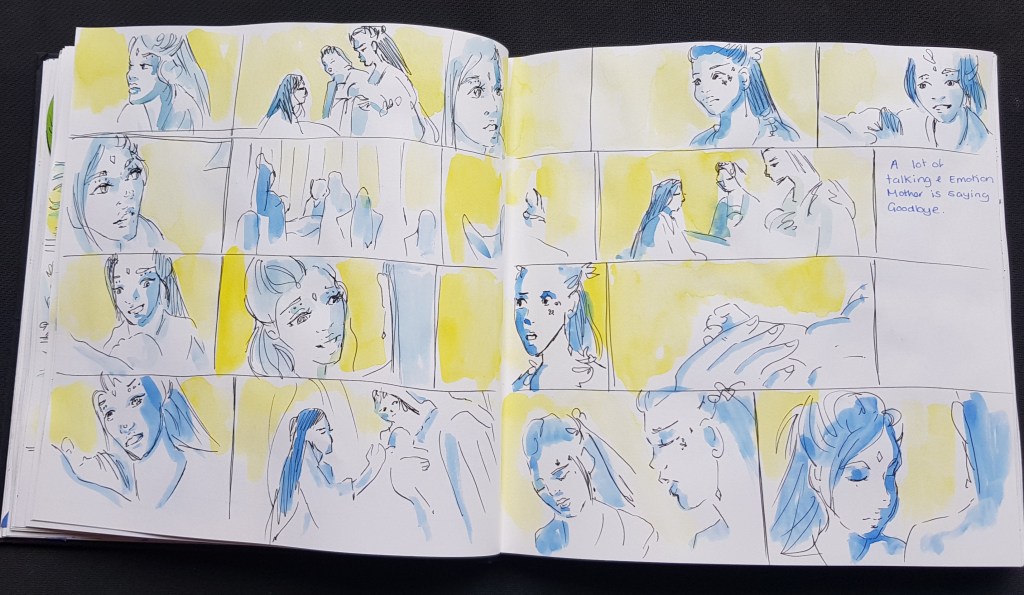
Now more focused on the “goddess” than the birth as she is “fading” away and leaving her subjects wishes regarding her new born daughter.
This one was harder for me as slowly show flowers dying, wasn’t sure how best to show this on the story board. This scene ends.
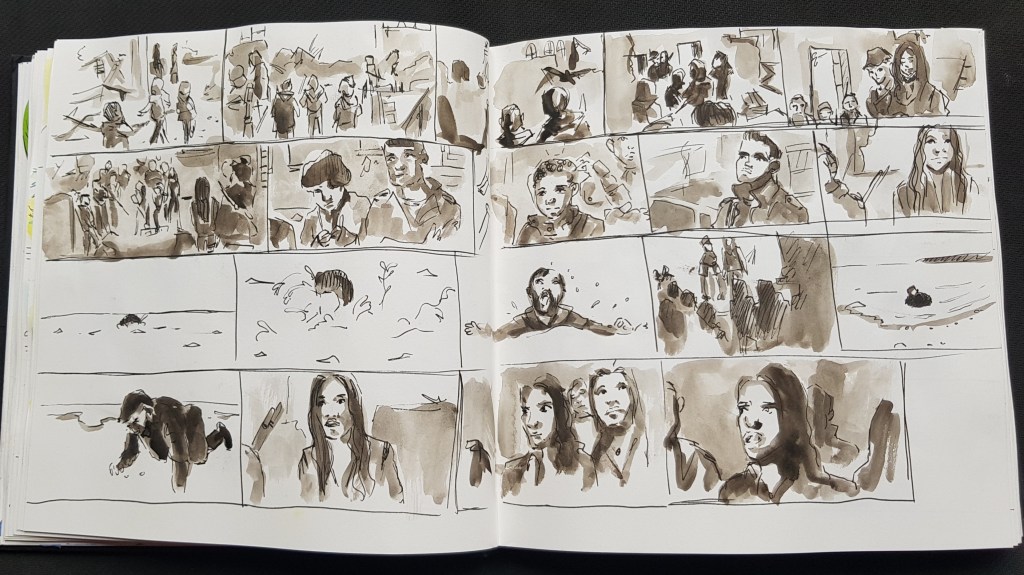
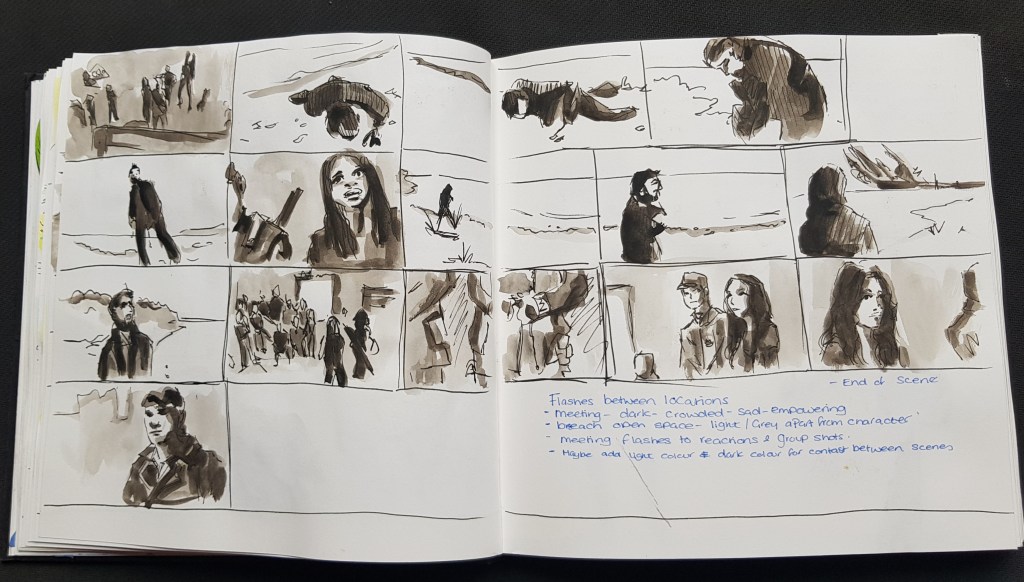
Next I moved on to a Sci-Fi / post apocalyptic drama called Falling Skies While I picked up on a season 5 / it was still the opening scene, I know now I should have picked up somewhere mid-season/show.
It has the same feeling of above / opening “speech”, but the mood is in contrast, it start heavy but ends up on a more positive note.
One of the things I did notice has the scene flips between locations in direct contrast with each other. The main is in a middle of a meeting/mourning, the scene is heavy and dark.
Then you switch to a bright scene, the only dark contrast is the character.
I again choice a scene (unintentially ) a slower pace, and all about facial expressions, which on one hand is good as it is an area I could use as I have lots to learn about characters interacting with each other. BUT, I could have also done an action scene… (nothing to stop me later on doing all scenes in movies/dramas/shows that I’m obsessed with)
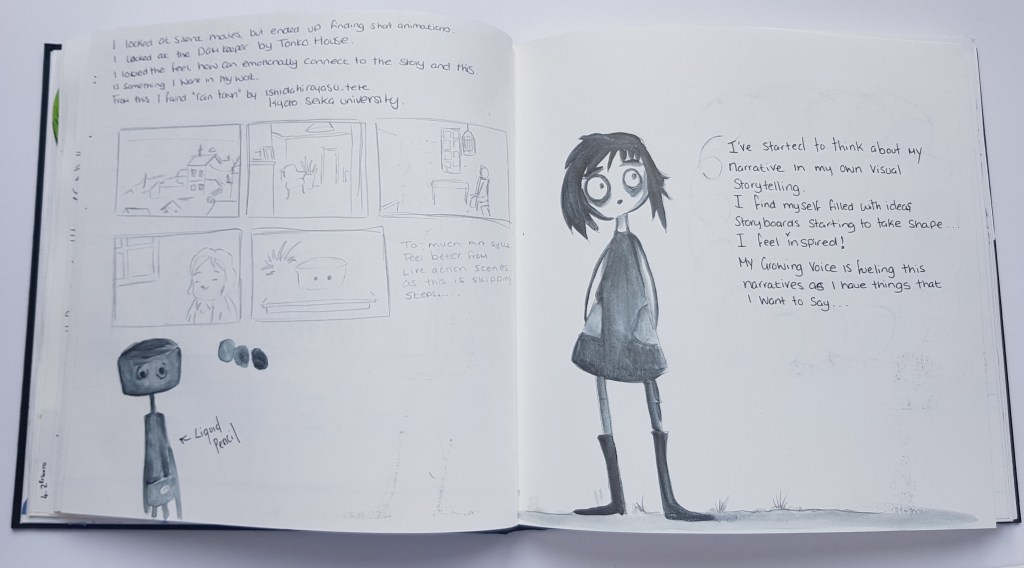
I started another storyboard study, but this one was a mistake. I was starting one based on an animation, within moment I knew this wasn’t going to work the same way and quickly moved away from this. Storyboard study at first in my view should be from “real” sources, it is the same way you cannot learn how to draw the human body via cartoons/drawing you need a more primary source of reference, as a secondary source is never going to give you want an artist needs in order to grow and learn. (Least that is my thoughts). Later can study cartoons/animations to see how move/made but first should be raw.
My inner dialog
Since starting this unit, the moments I had before in my sketchbook, saying this to myself has started a growth. This part in the unit has started to give this growth a method, a way to communte things.
I honestly can say I see the world different, I have a growing strong inner voice that is creating a dialog as I go along, what was thoughts and ideas have now a narrative seaquine of its own. Thoughts, feelings and my emotions are being given a narritive that is capible of expressing in illustrations. The best thing is, that I am not forcing it nor can I stop it.
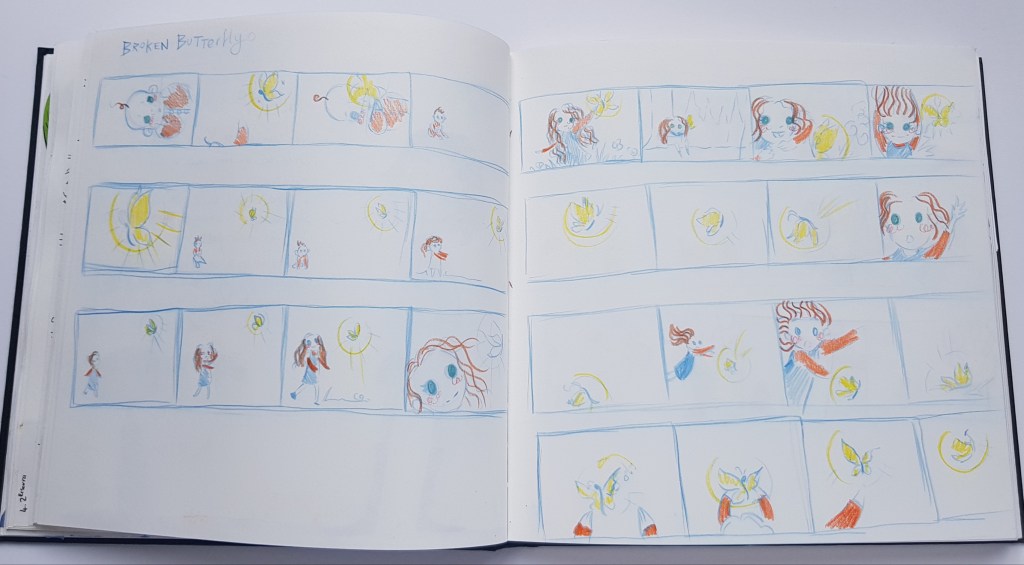
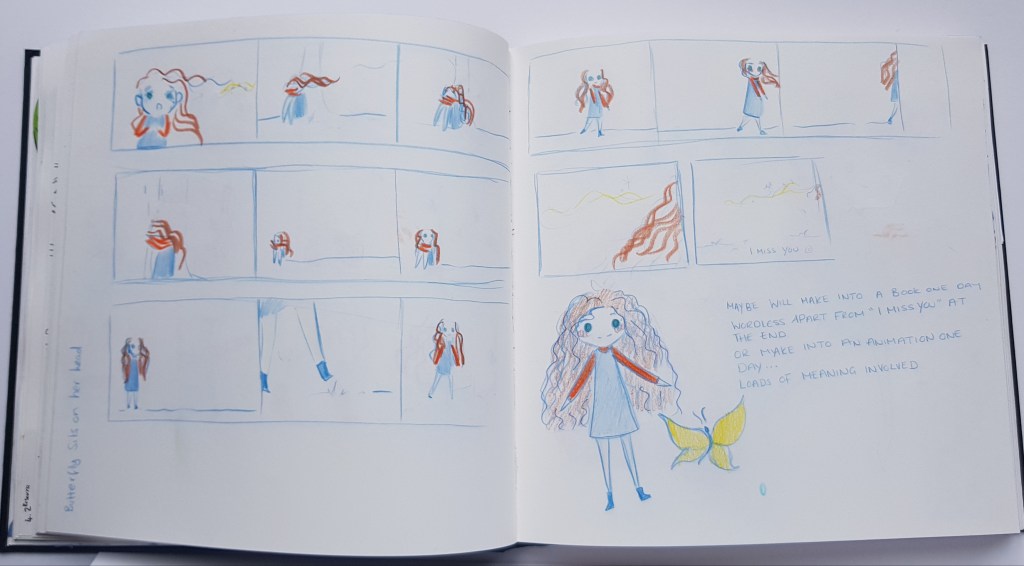
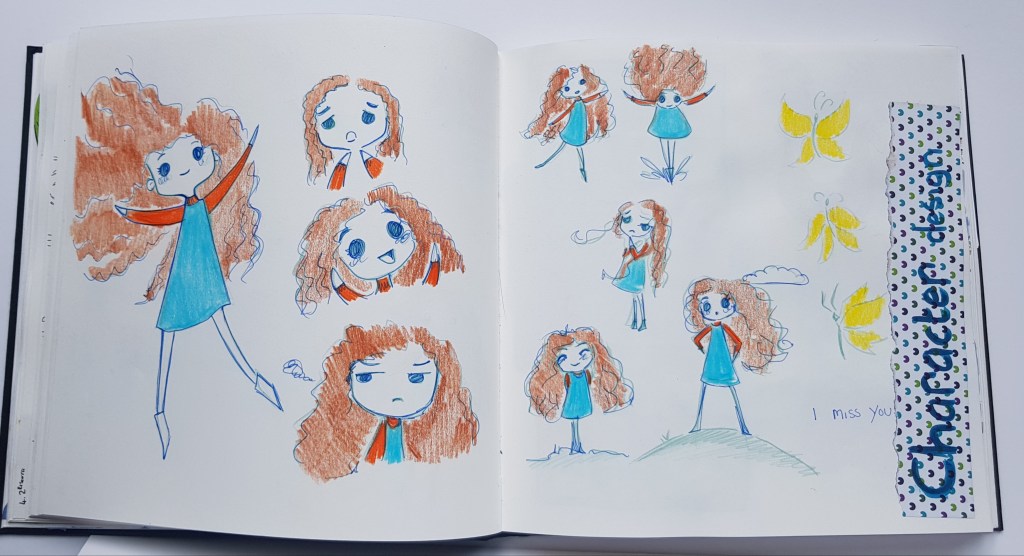
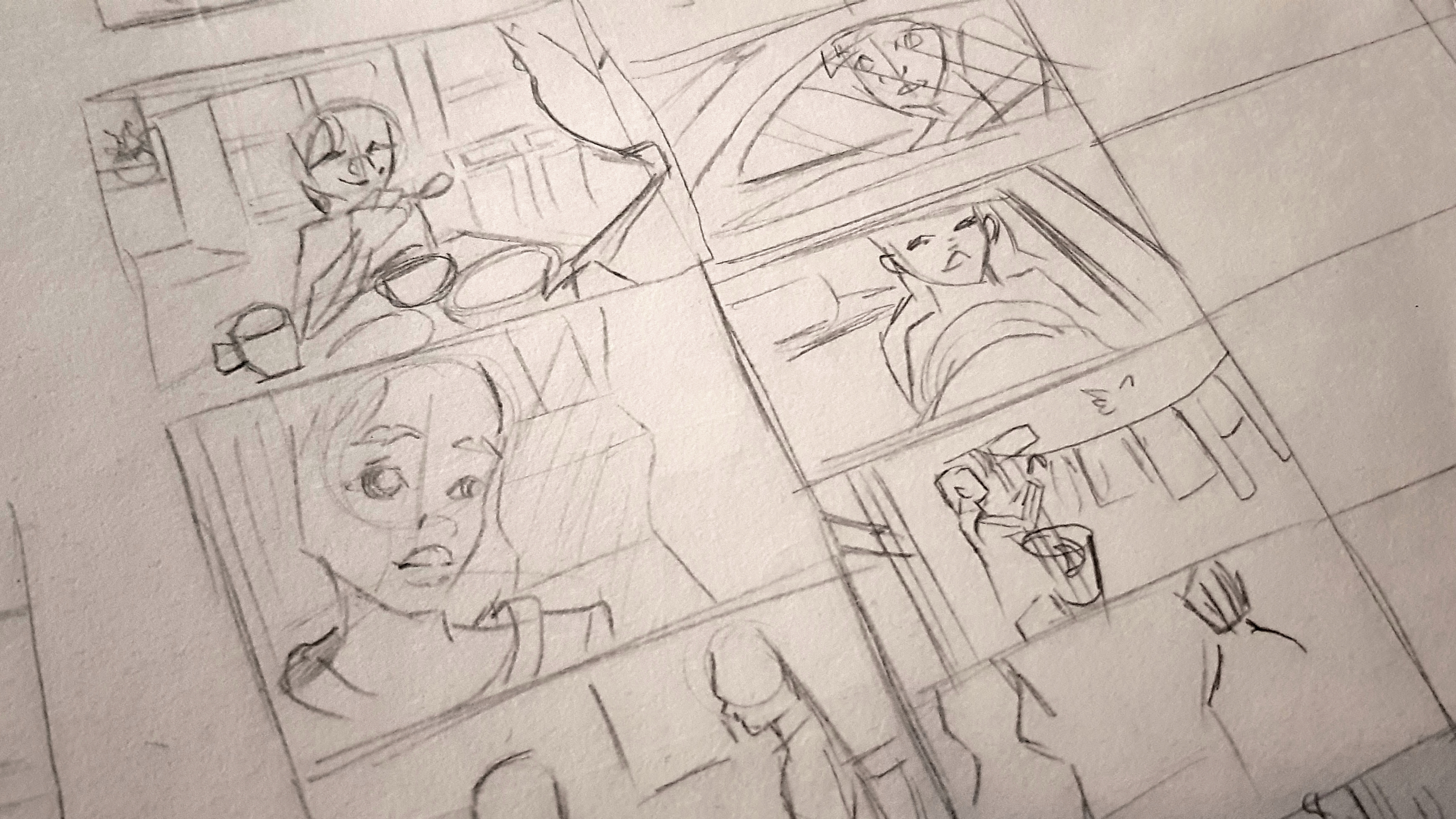
So my extra in my sketchbook following on from my storyboarding, started as a doodle, started seeing this scene in my head to reflect a feeling I held inside me for just over ten years. My own “story board” took shape, very rough but shows promise that one day I may finish this, maybe even animate or create as a picture book. It is the story of the “broken butterfly”. I started as I explored my own story board, thinking about the emotions and story I wish to tell, thinking about pace, angles and colours. What started as a “play” became a story I needed to get down on paper.
I also created in pencil quickly, but I like the nature of this medium and I think it set a mood that would carry forward if was to take this story board to the next level. A character board was created for the young girl
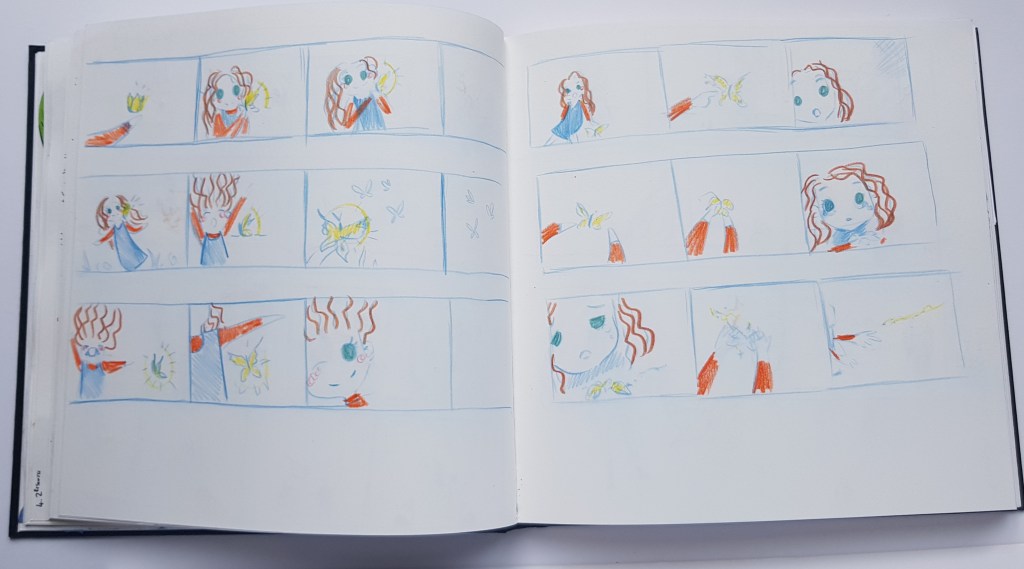
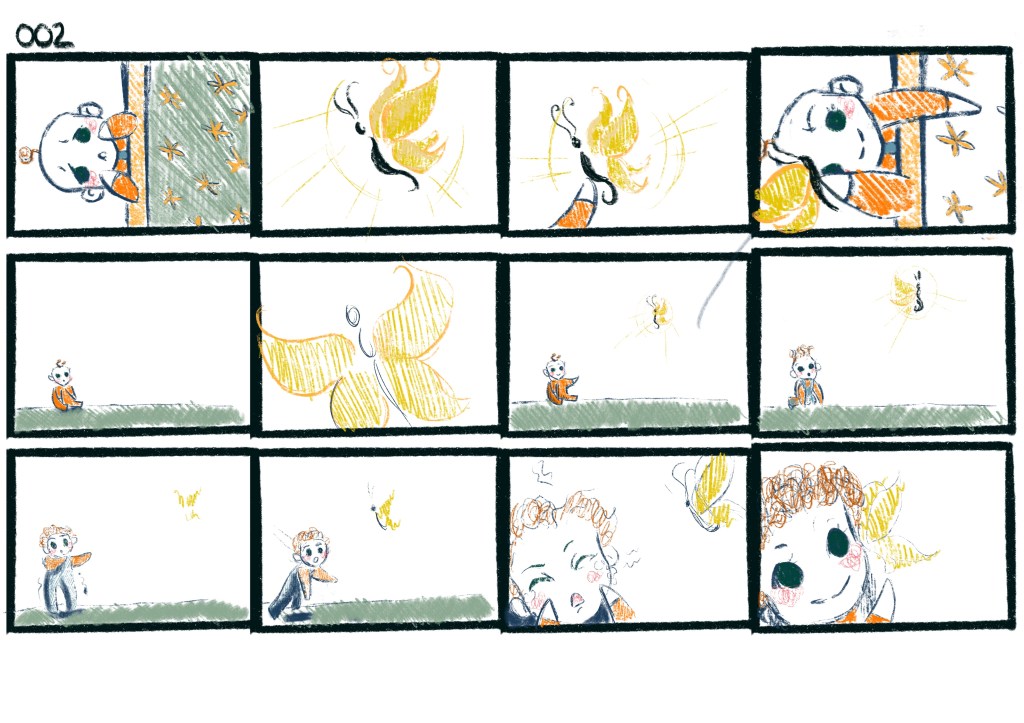
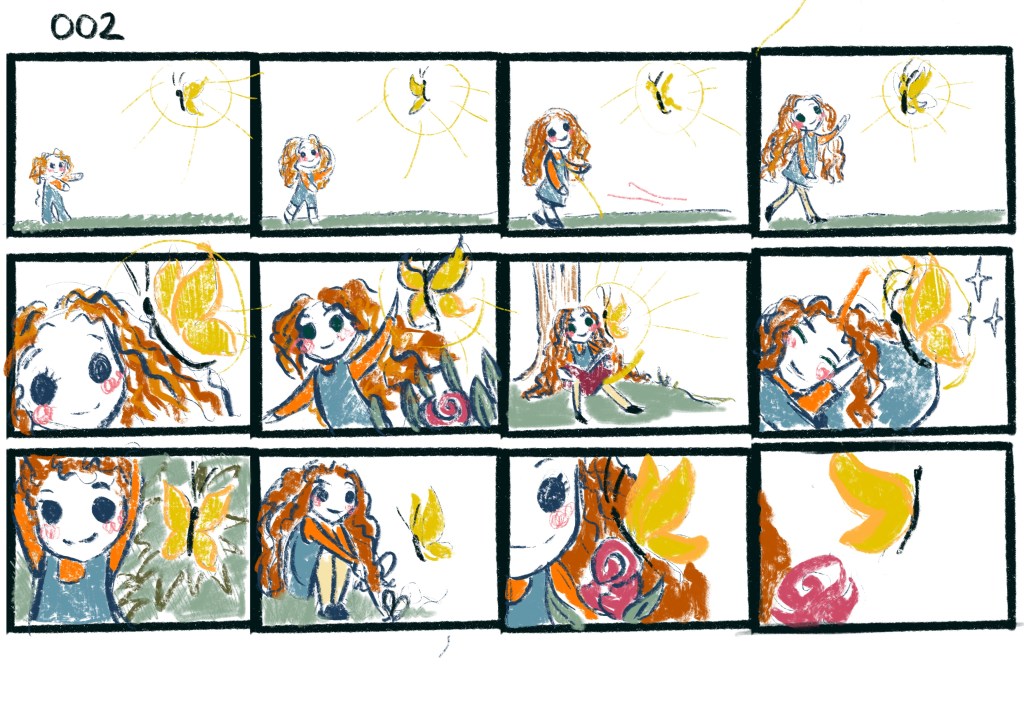
and I started to clean up and make the flow and pace better on a procreate story board.
The Broken Butterfly is a wordless story until the last scene. It starts with a baby girl crying, a butterfly comes and calms her. The girl grows with the butterfly always by her side, encouraging her when she falls and guiding her. They became friends that share so many memories together. Until one say the butterfly falls and the girl fails to catch it, one wing of the butterfly is torn/broken and cannot be fixed. So the girl carries the butterfly in her hair and on her shoulder. The girl tries to cheer the butterfly up by making things as normal as possible, does all the same things. But it isn’t the same, the butterfly misses what it once was, flying free… One day they laid down on the grass and fell asleep. The girl woke, but the butterfly did not. The butterfly was gone, slowly turns to dust in her hands and carried off in the wind. The girl is heartbroken, sits , cries and does not move. Until the day comes she can lift her head alone, takes a first step alone and finally walks on alone. As she walks away, the sparkles of the butterfly follows her in her steps. Finally the words are read and spoken “I miss you”
I was having fun creating story boards, so I didn’t stop there. I made mini story boards for some previous work in this unit I wanted to give more content to, as per my tutors advise.
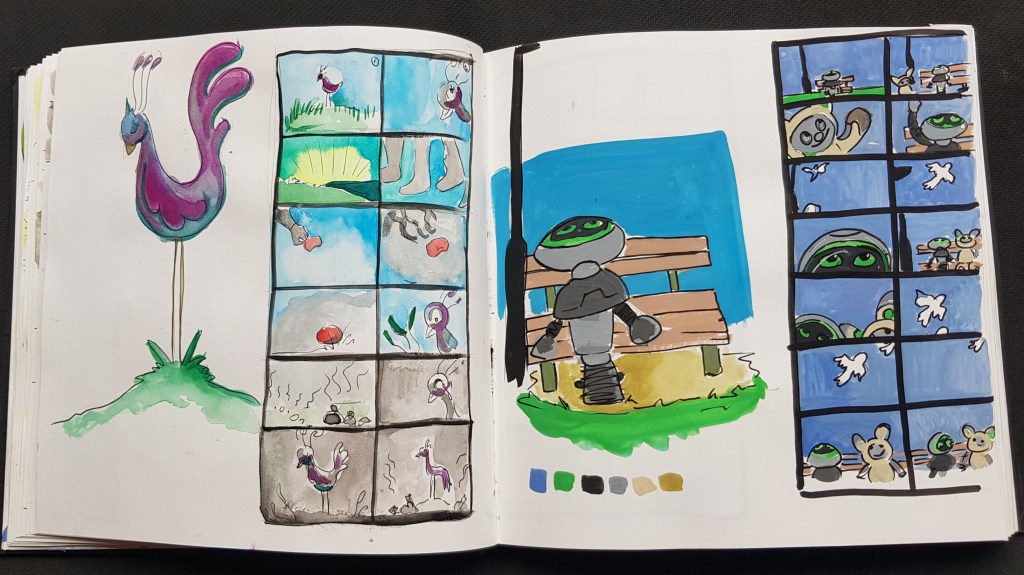
Such as the “Peacock” queen in the grass, the world is a lovely clean/bright place and then some people come along and little. I used colour and expression to show the peacock queens feeling.
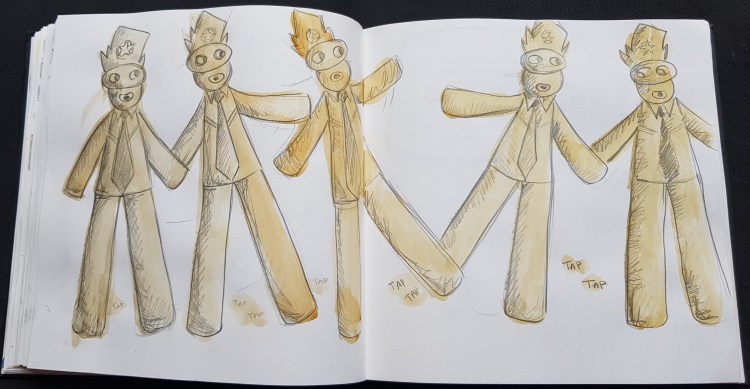
Next was BOLA – I remember my tutor wanting a bit of BOLA’s personality. I wanted to show Bola’s wonder with the world, childlike and curious A.I taking joy in watching birds fly ahead. And simple friendship.
Next and Lastly (for now) Based on taking my son sketches as he run around the garden, I made into a mini story board that he was friends with the wind and the wind taught him how to fly. This one I think was merging a little with the objectives of 4.3 exercise Conversations with pictures.
I had fun, I think spent a lot of time of this as it truly inspired me and I enjoyed it.
I know some areas of growth, such as worthwhile be picking some action scenes or at least a faster pace part of a show/movie. Also you can see where I started to lose interest a little as the details start to fade (which is not always a bad thing)
I did do a bit extra for this, as the concept of story boarding was playing in my head and my own stories started to grow. I was thinking like I was filming, why I wanted to show something, how is best to express this and tie the story together. How can I set the mood and pace. I understand a lot more on a whole.
First I wanted to talk about my experience so far with storyboard/comics.
I have done narrative/story board studies before starting the course. It was part of my own personal growth, I had watched something which a course/class/you tube, it’s a while back I cannot remember (yet). I remember seeing the “I’m your father” story board broken down and explained and why it is good to study and create story boards of television. 1. learning composition – I think this was a major one at the time for me. 2. Story pacing / camera angles. 3. Best way to learn how to create my own graphic novel/webtoon. – which was/still is something I’m interested in. In fact I think still have these easy Sketches (Please note this is Pre-OCA – so will cite myself and not applied to my course work)
Emma Clements – 2016/17
Back then I think it was more about composition and the layout studies over the narrative, so it will interesting to see this element being studied. I am also currently reading Understanding Comics – By Scott McCloud. I think this was important for me to read, as he states what is the differences between motion pictures and comics (story boards I think land somewhere in the middle of the two personally) – not that a HUGE different as he does state motion pictures could be a VERY slow comic. I can see how story board is the “perfect” way to learn.
Brandon J Wallace
Cartoonist I found it very interesting to read the information with each of his post on Instagram. The way he thinks about this can help not just this research task, but improving my own visual language, help me to word and learn how to expend upon the things I research.
Giving me insight into looking at an image beyond a “feeling” but explaining the impact and reasoning. Such as using a colour or pacing to create tension within the story board, the way they use colour/shadow to make the viewer feel things.
While the study on Brandon J Wallace is heavy on his study on his storyboard and recreating I knew I wanted to learn more myself about story boards and even animation itself.
With this in mind I started collecting “Art of” books, which tend to have story boards and colour mood break downs (will also be handy for future inspiration food) I’ve also gotten The Animator Survival Kit by Richard William – I felt this was something good for me to have on my bookshelf.
This one started with the same issues I that faced in 4:0 fill it up fast. Like the prior exercise I thought likely will have to do in two parts, however one morning on the school run I took my sketchbook with the intention to practice – along with the “list” of what I needed to do.
I had no intention to make this the main focal point of my sketchbooks. *This is due to me wanting to sketch something “new”. *I was worried it wouldn’t be exciting enough.
But again, this was a trip in the moment and something very real to my everyday.
I sketched as much as I can in the moment, I wasn’t out as long as I had planned due to started to be sore physically. My “boxes” are not clear cut – due to trying to balance my sketchbook and draw (ideally I should have found somewhere I could sit down)
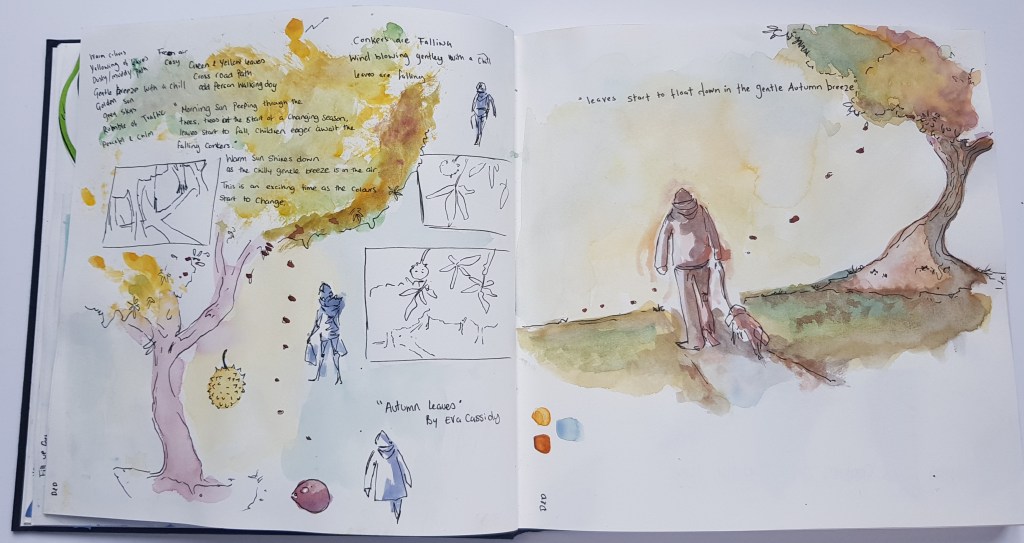
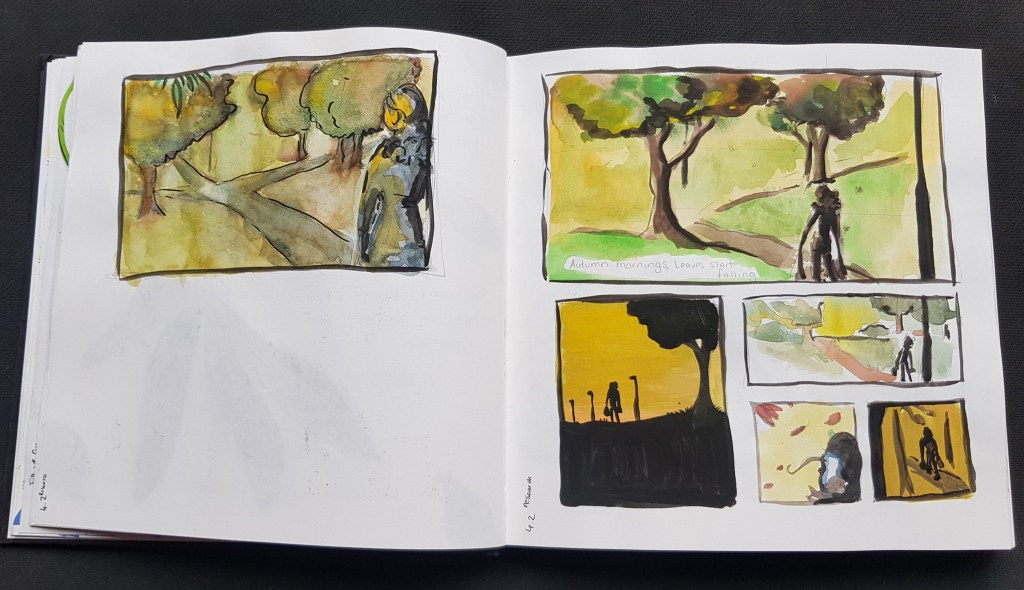
Watercolour and ink
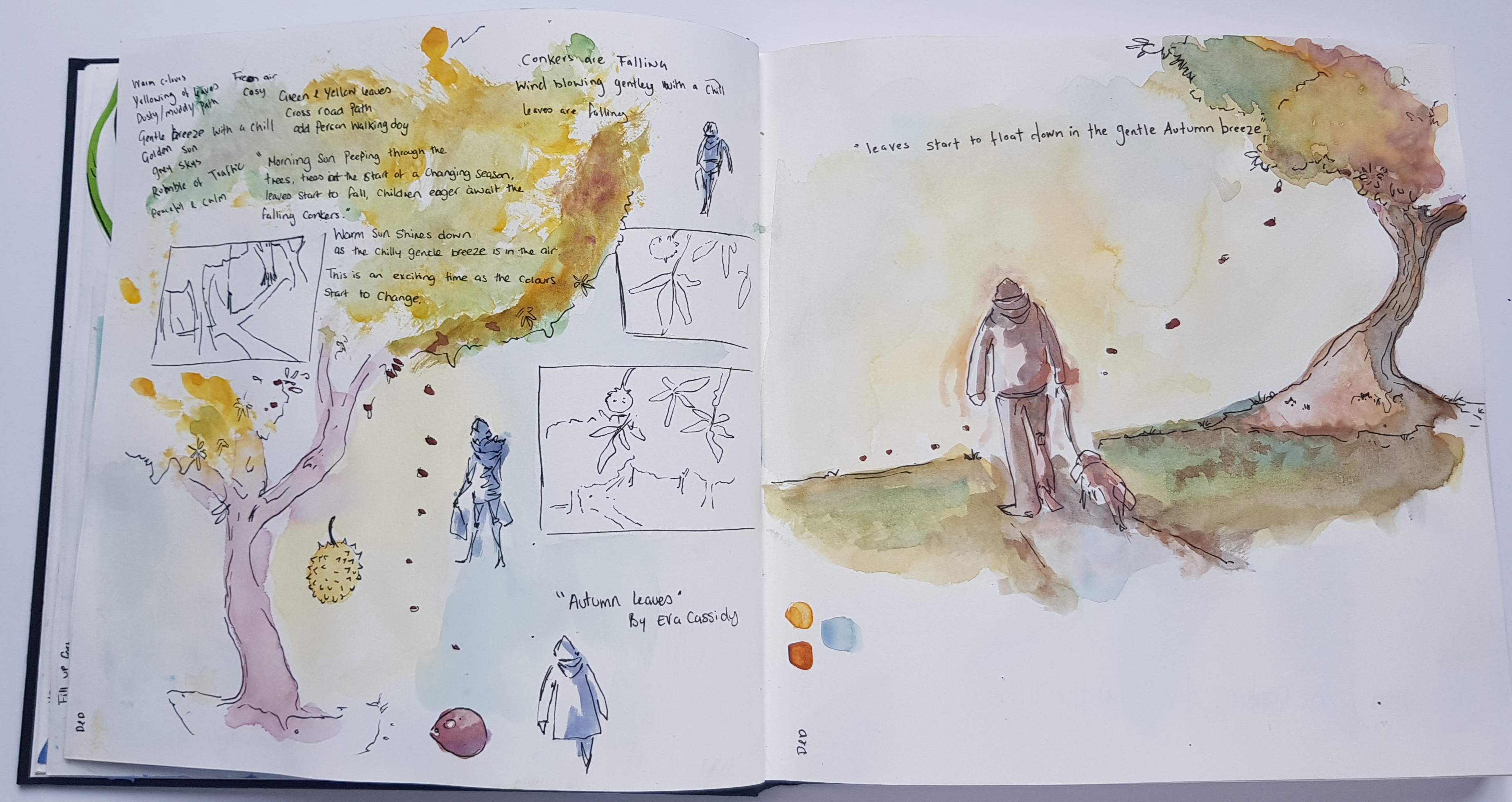
I started writing short hand words/thoughts this naturally started to grow into the “second box” followed by drawings (thumbnails) and loose sketches.
I ended my trip out with a words & illustration mix.
I took photo as well of the scene and found the main thing of interest is the start of the changing of the seasons.
I tried from photos, memory and my words to get a working illustration to show how I felt/my words.
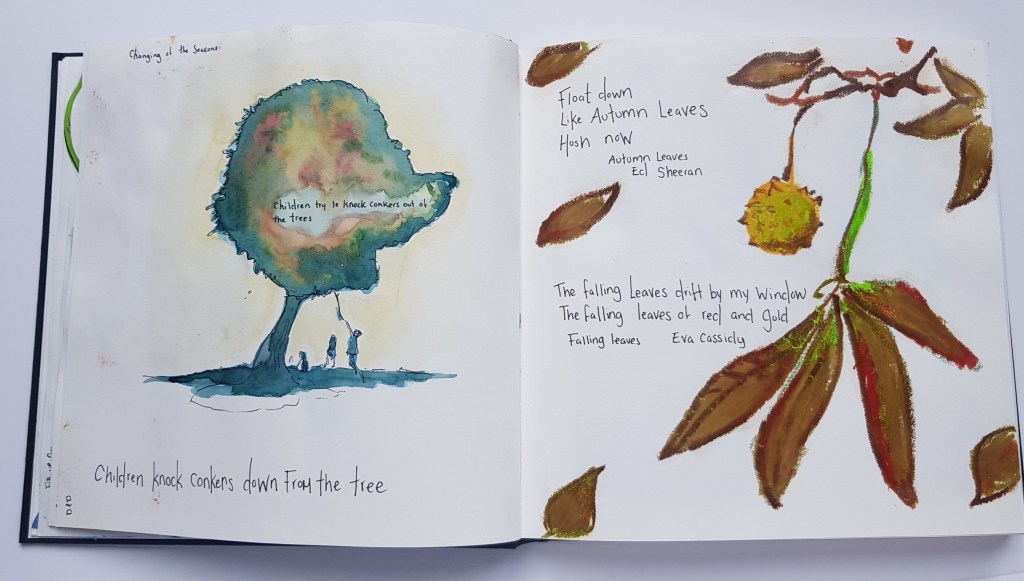
I really wanted to explore the words and illustration, I thought of two songs while doing this so wanted to see the song lyrics with illustrations, nothing much intended of it as my “final” I wanted my own words foremost. More a moment I just explored.
Left Watercolour Right Oil pastels
Next pages taking some of the elements that really stood out the most School run Autumn low sun Crisp soft gentle wind Falling of leaves back to routine Soft and warm feeling.
I guess I wanted to express the normal that has been missing for six months, such as a mother returning home after dropping the kids of at school. Actually have five min peace and enjoy the simple things that very likely took for granted before COVID-19.
Mixed media
This exercise gave me more narrate, more sense of purpose and a louder inner voice almost directing my thought process. “try that angle” “colours what will reflect this mood” “do you feel that?” “pay attention to this deal” Guess in a way helped me see the “bigger” picture. Since this exercise I’m very serious I have this inner “film” director that is almost trying to create a movie now. I’ve started to see the world differently of late, no longer keeping this all inan inner secret world of my won and more and more I want to share my world and I want people to feel the rawness of my work. I’m now starting to see how I can express this, from colours, to lines, to word and illustrations together… This is very new to me and almost feels very nosy in my thoughts as everything I tried to keep “quiet” now wants to scream to be heard, I’ve been given my voice again! So this exercise was good at getting me started, taking the smaller steps with my personal narrative so I’m not driving in head first! This is the start of breaking something down in a way to be able to illustrate, helps makes sense of everything in the moment that you feel.
In summary. While I think I answered the “questions” though out the exercise. I wanted summarise my thoughts.
Which approaches did you enjoy and which will you take forward from this task? I enjoyed a lot of it, again not being planned and in the moment, I can see how this fits into my future sketchbook life. I can also see how to pair and use words as I work… Something had being lacking before. It gives me a narrative method, something again I lacked. What happened when words and images interacted; did they reinforce or play off against each other? I like to thing they work together, as the words I wanted to give images to them, give them colours and textures. I’m not always sure I found the right words, but this is something to explore and discover, so this is exciting. Did describing the scene using words first affect the way you drew afterwards? It made me think more about how to express myself via illustration more, like how can I enhance this feeling or that one. Not just about what I can physically see but how can I show what I feel… I actually also understand on a deeper level some of the master works in a whole new light, such as Van Goth’s sunflowers. Did what you described using words help you to decide the emphasis or your image? Yes, it gave me direction, like I was trying to film the scene from inside my head, not about how can I make this image nice, but how can I make the viewers feel these things?
Part One Due to the nature of this course I plan to do this exercise twice by time completed the unit. This is due to COVID-19 and all the same issues I’ve faced though-out the course, but I also do not want to delay waiting as everyday the “rules” change so I do not know when I will get the chance to do the second “sketchbook”.
With this in mind, my first sketchbook I created for my trip to the hospital. I did this with intention I may or may not be able to draw, lucky I was able to at times and others by remembering just after the event. This means I was able to create something in pretty much on location, in the time and with real feelings I felt.
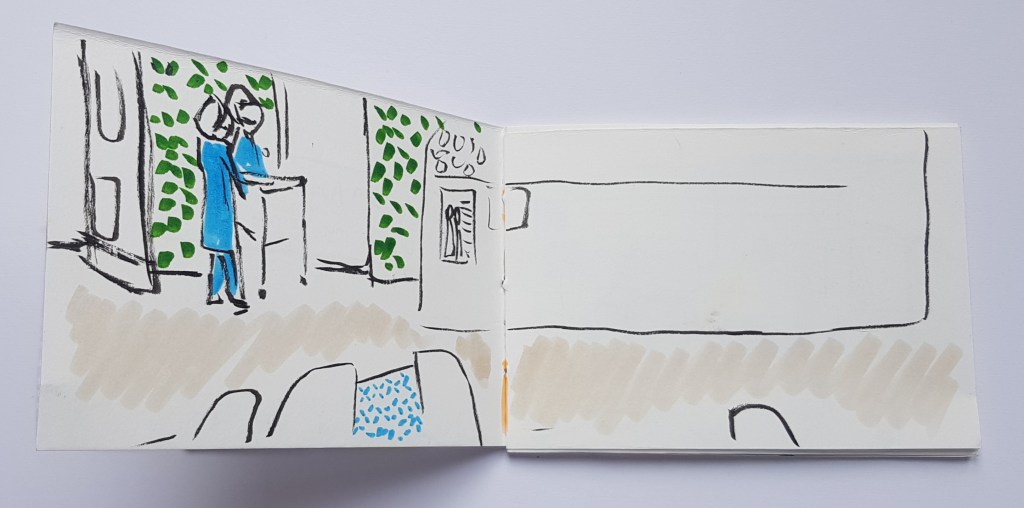
The place – Northern General Hospital – Sheffield. The Event – An hernia operation Mini Sketchbook – Homemade – A5 Landscape – All media paper, sketched bond booklet style. – With a stock paper as the “cover”. Time – 25th August, under mid Covid-19 rules (so I was alone / in a place where most people were wearing mask) Problems I faced – Not able to draw all the time, limited tools (they allowed sketchbook and an ink pen) – so some colour was quickly filled in a little later when had access to my bag. Also I couldn’t “get” in the way and it was fitted in between events. Due to how quick I had to sketch the order is a little out sync (due to me drawing on the wrong page) Also due to being during Covid-19 wasn’t many people around me. Mediums – More limited than I would like, Ink brush pen, fineliner and I think was 4 watercolour makers. (What I could fit in my pocket)
Handmade sketchbook – Size A6 – Landscape
Page spread 1 (Above)- The waiting room – I was alone for a bit of this, I was able to sketch to calm myself. Patterns added later as I made a post to remember the details. This was able to calm me a little. One thing it shows is my state of mind, I wasn’t fully relaxed the lines are tense.
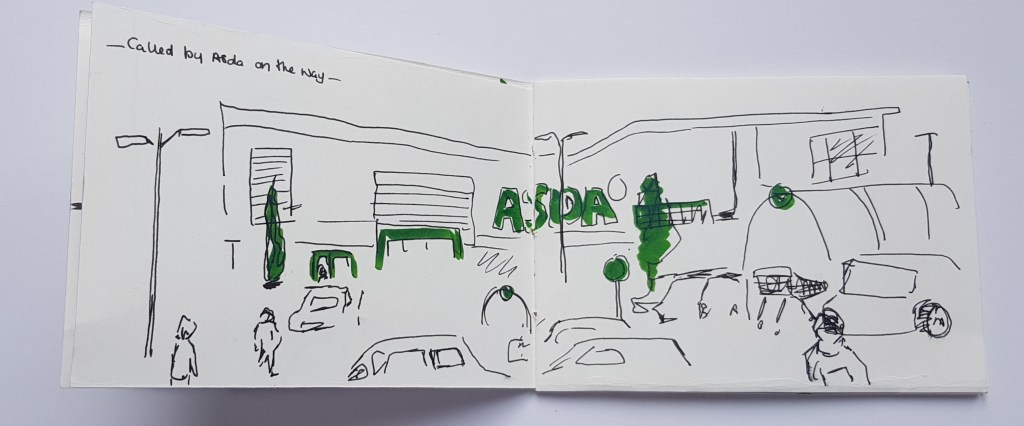
Page spread 2 (this is one out of sync as should have been first) – On the way to the hospital we had called my ASDA, due to shielding I wasn’t able to go in myself, it was raining and I quickly got the building sketch down, added green for the logo and trees to add visual contrast and interest.
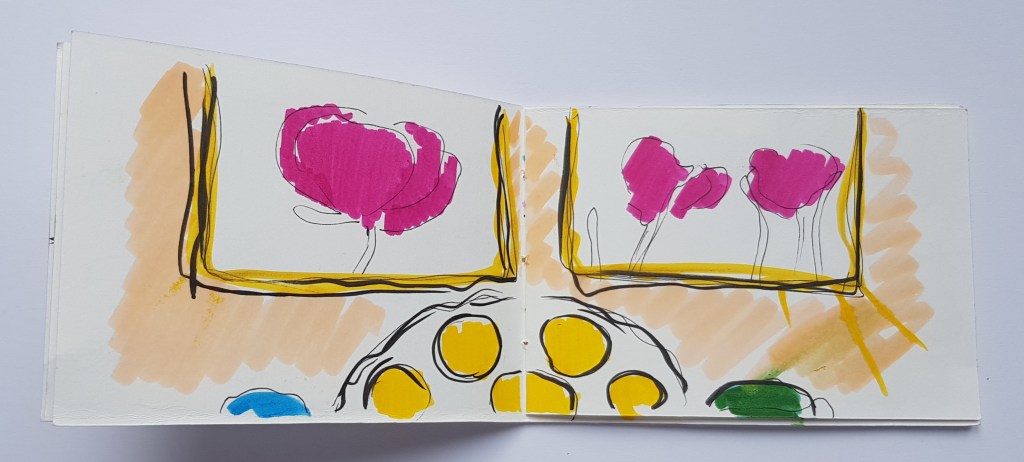
Page spread 3 – This one was drawn after the event (couldn’t sketch in the operation – although didn’t ask) I remember seeing the ceiling and the pictures, how every thing got fuzzy as the drugs started to kick in. I wanted to add colour to this one as the bright light and red of the poppies were the things I remember.
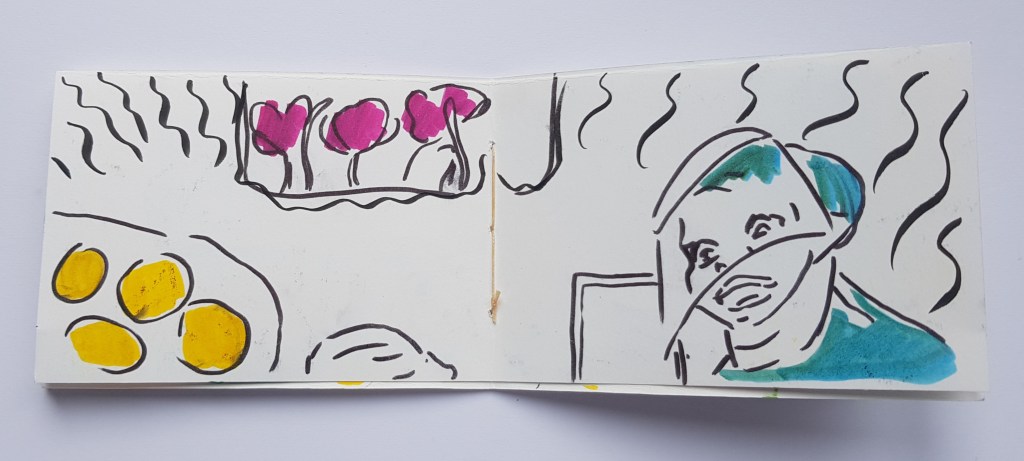
Page spread 4 – This one is of the nurse that stayed by my side, she had removed her mask and was wearing a visor so I could lip read and have her reassure me. The wavy lines I did to show my vison feeling fuzzy, if was to redo this I would make the line of the objects fuzzy (like blind contour)
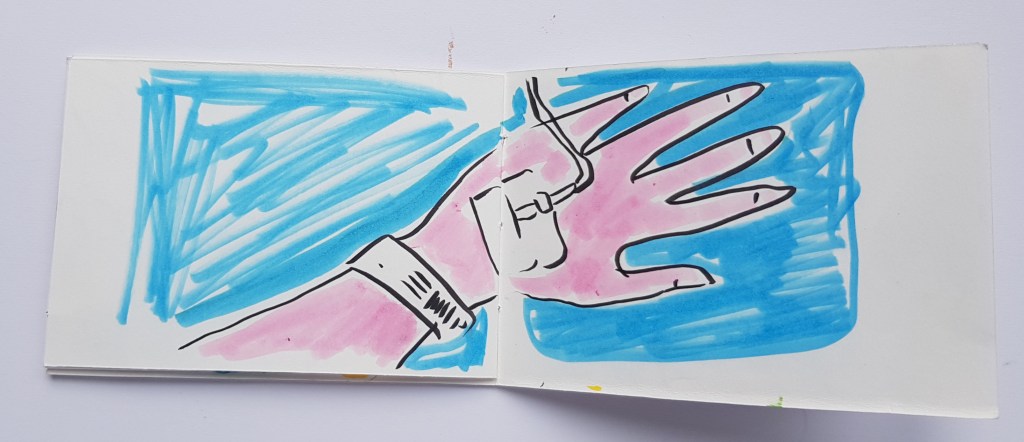
Page Spread 5 – In recovery, I sketched my hand – Layer adding colour quickly.
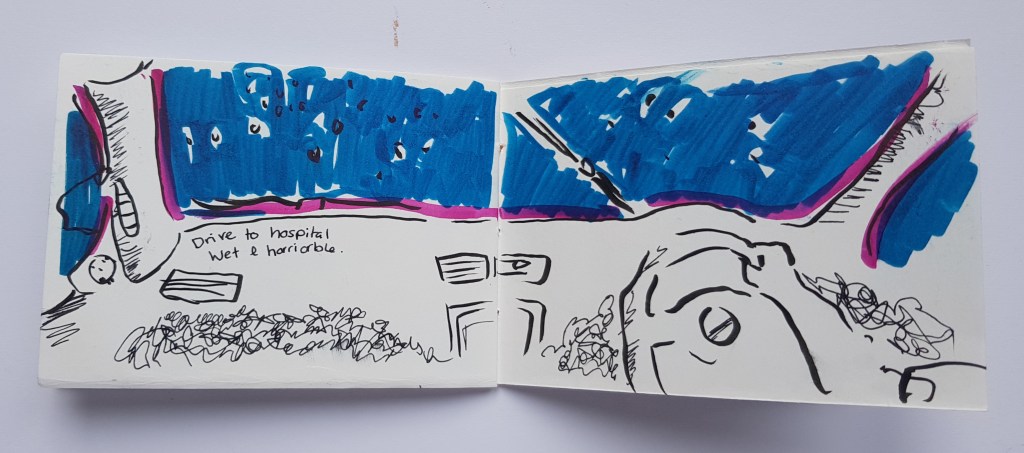
Page Spread 6 – This was another out of sync – this was the drive to the hospital, I was full of nerves. Added the blue to create impression of “wet” day.
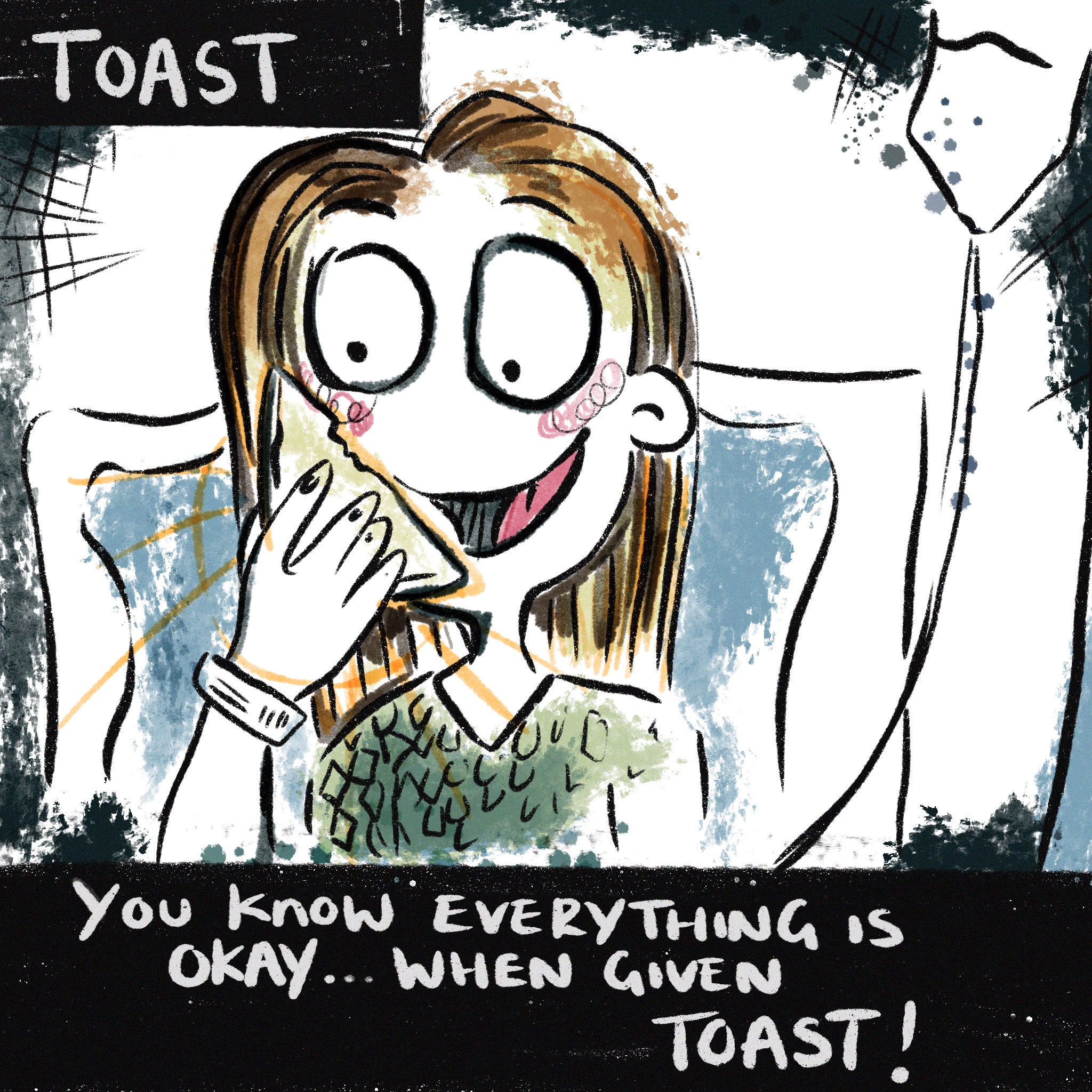
Page Spread 7 – In recovery, this the page I liked the most (had my colours back with me) as it sums up the day, at the point given toast I knew I was ok.
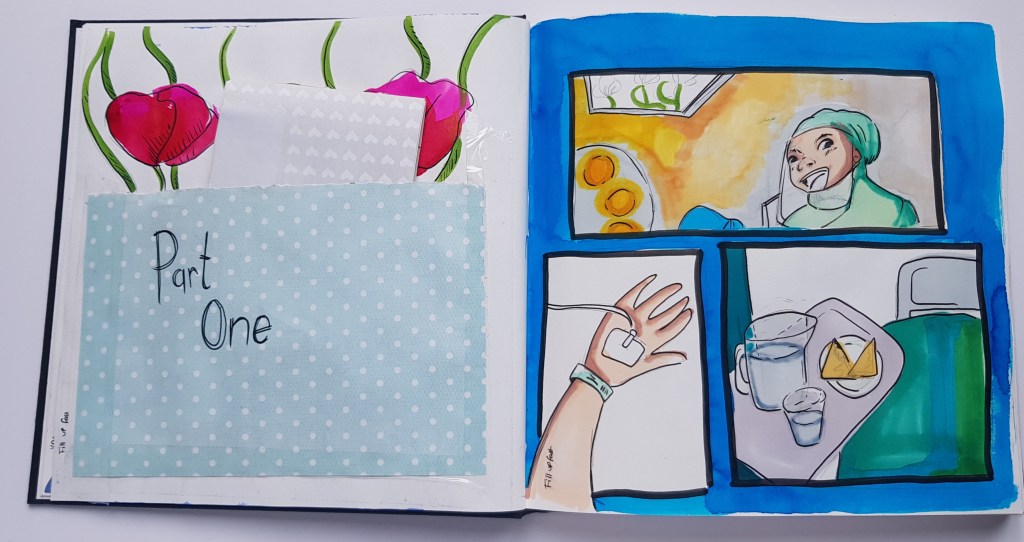
(Above) after the event. Created a page to hold my mini sketchbook and a “diary diary” comic page to sum the day up. – This wasn’t really fast, but based upon the information I was able to get sketched in the mini sketchbook.
This was a good “real” on location / in the moment “draw it fast” When/If I get to Part two I wish to be able to explore more with mediums, less limitations other than “time” and drawing quickly. It would be interesting to compare the two mini sketchbooks with each other. Also in part two will be able to follow the “rules” more and explore while doing so.
Knowing I have no idea when can make the most of this exercise, I used “part one” to guess say use the mini sketchbook, filling it up in a very real event that not a “plan” trip. It was more case drawing/filling when I could. It is something very real to me, I can look at this mini sketchbooks and feel everything I felt in that moment as a flash back. So “bending” the rules applied to this moment.
I do still want to do again, therefore have plans for Part two, at moment I am still in recovery and seem the country may be heading for another lock down. I want to draw crowds of people, however this is something I should be avoiding for the unforeseeable future, therefore I’m leaving part 2/Sketchbook two open ended and will carry around with me until the “perfect” time.
It is hard for me to reflect upon this exercise as I do not feel “done”.
I’m not going to lie, I normally find it better for me to research one or two artist/illustrators at one time. I can have an information overload quite easily, as I do like to really learn and research in depth, plus I also need to get better at expanding upon my thoughts more.
As I started to explore this task, I firstly wanted to create my own mini list so I started to go though my books. *Thinking Visually for Illustrators by Mark Wigan *Sketchbooks – The hidden art of designers, illustrators & Creatives by Richard Brereton *Illustration – A Theoretical & Contextual Perspective – by Alan Male I didn’t find much to help, but was a great refresher for the up and coming exercises, I have bookmarked some pages with narrative research. I was a bit wary to keep relying too much on pinterest, google and skillshare for main part of my research, I know during Covid-19 it is a must.
I checked out http://www.1000journals.com, I did enjoy looking though the pages, however none really spoke to me in the way I’m inspired at them moment. I wanted illustrators like Mimi Chao and Myfanwy Tristram (both whom which I covered in the task before – so wasn’t keen to “repeat”)
I started the list (and added a couple of my own)
What am I after? I’m after what Marilyn Frasca called “being present and seeing what’s there.”
Lynda Barry – Maria Popova – Brainpickings – 2014
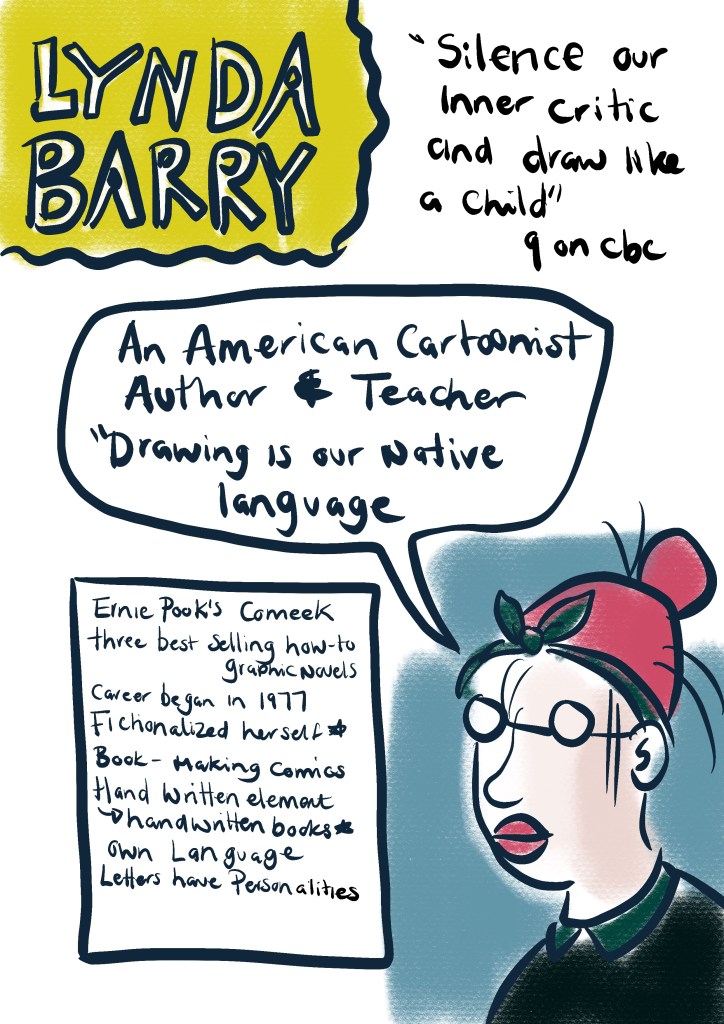
Lynda Barry An American Cartoonist, Author and teacher Believe in hand written elements.
Lynda Barry – Visual diary
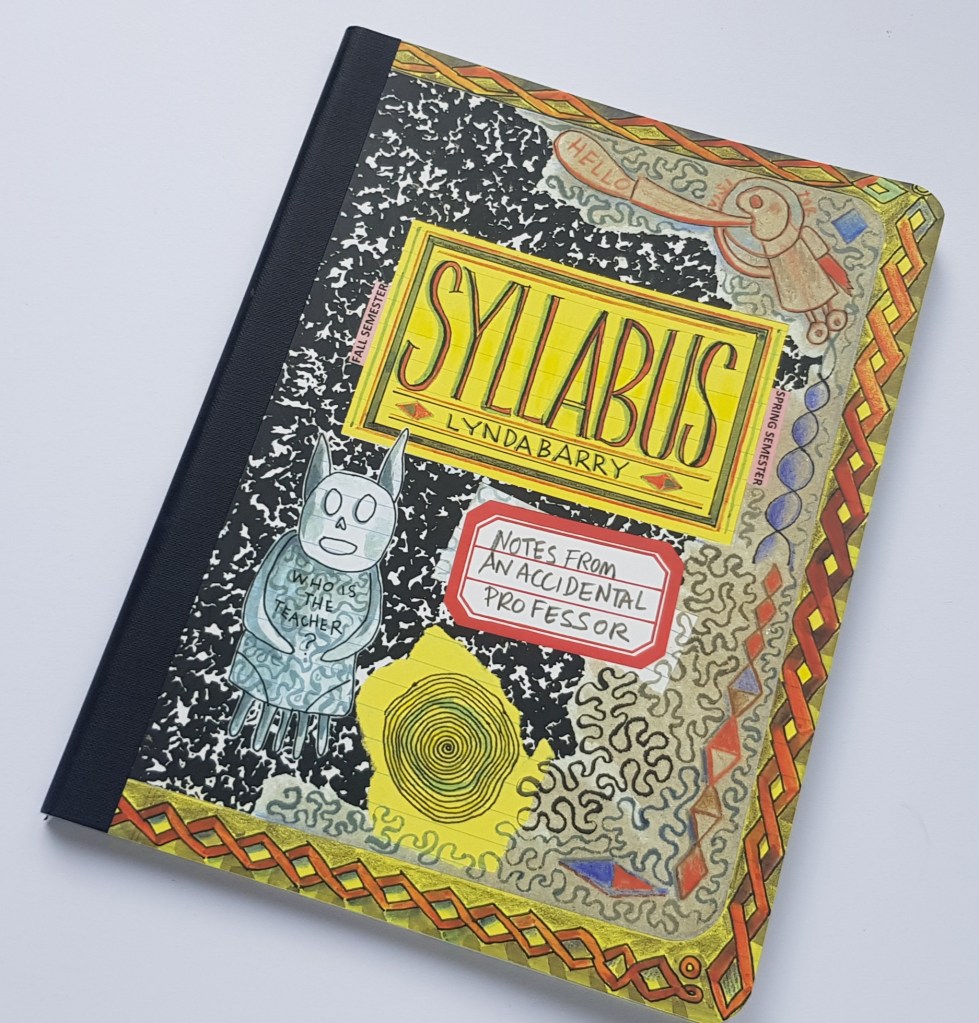
I have got Lynda Barry’s book “SYLLABUS“. The book is made like a journal/diary, it would be easy to forget this is a book and not picked up someone’s personal journal. From this book it kind of guides you into creating your own visual diary in one of the most fun, childlike innocent way. It is almost like viewing the world again from my my inner child eyes….
Youtube ( https://youtu.be/2CfmeTPQHLE ) There is something about Lydia insight that is freeing as a terms of visual journal, her childlike nature grows upon me and I find myself in this new state of wonder by keeping a diary.
What I’ve learnt from my studies of Lydia Berry. Use everyday paper, from lined to sticky notes. She uses humour in everyday, her random thoughts and ideas. She writes as well as “doodles” She made a career based upon her visual diaries as a form of comic.
I found myself most fascinated by Lydia Berry, I found my study around her was a moment I started to “see” things differently, I started to feel the desire to have fun with it and give myself a silly class name!
Jean Jullien https://www.jeanjullien.com/ Graphic Artist (Paris) Painting, illustrations, Photography – Vast body of work
After searching around, finding many new illustrators of interest, I came across this little gem of a visual Artist. (He would have been perfect find for part two of the sketchbook unit) That being said I was drawn to his visual diary first.
Jean Jullien Moleskin Journal
One word that comes to mind with Jean Jullien’s work and that is FUN! The layout, randomness, colours, text is likely the most along the lines of my kind of thing.
I like the fact also some of his diaries feel like he also got lost in the moment “doodling” something I can do easily.
The layout format is something not too far away from my own.
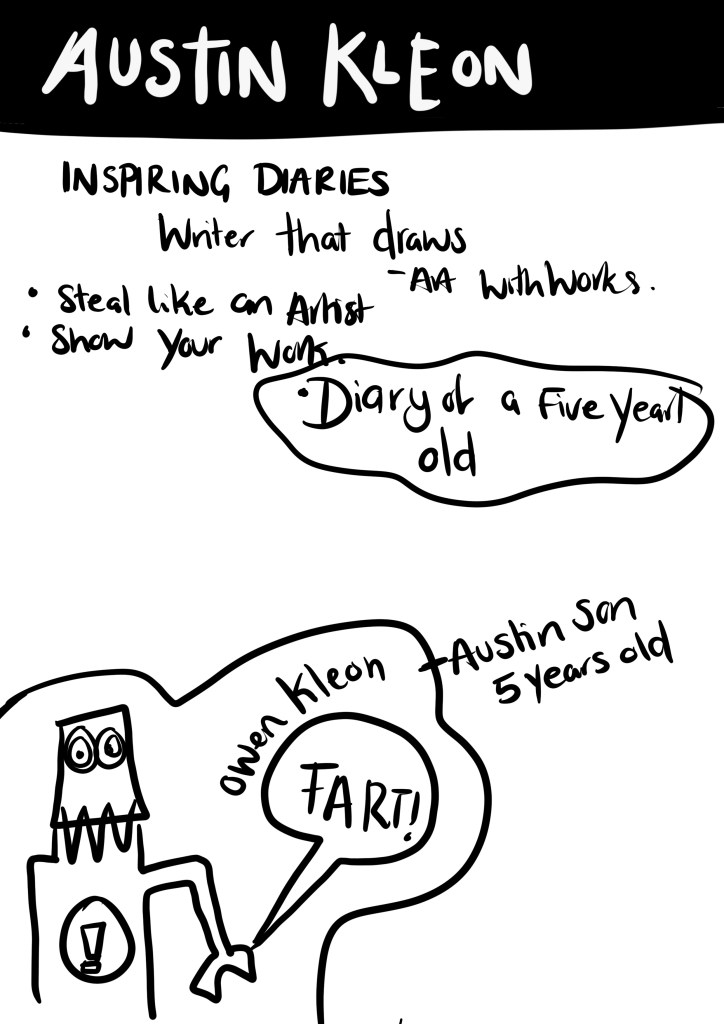
While this is meant to be more about the “sketchbook” and “Visual Diary” I really like who Austin Kleon is a person and his mindset to keeping a visual diary.
Again another I can relate in terms of Randomness.
I like the hand written “thoughts” it seems to add more randomness if possible to his diary, it is like a creative brain on paper!
Her sketches tend to be individual with text I looks like a a sketchbook with notes that she like to make. Tend to make quick sketches inn her diary then make a diary illustrated piece after. She tends to carry the same humour in her diaries into her work.
Very colourful and seem fairly quick study sketches.
Quite neat and organised.
Studies both places and the people. (building of places she visits and food.) I like her little notes, tell a story without too much details and information overload.
Nicky is the diary that I would say feels most like a visual diary, the work seems like a comic of. Sadly at the moment it seems Nicky website is down, and my searches I find are of fellow students work. So my research is purely visual and images, this being said I was keen to include as this would have been the one before all this research been the one that ticked what I was under the impression a visual diary was, now I have a boarder outlook and have been able to gain a wider influence via this research task.
I really love how Bryce Wymer has displayed his sketchbook on his website, like a piece of artwork it self, each one looks personal and like it tells a story. https://www.aflatearth.com/new-index-1
His books feel like a journal and sometimes just uses an actual diary. (maybe I could sketch inside mine as well in 2021 – after all makes sense as I crazy this most of the time.)
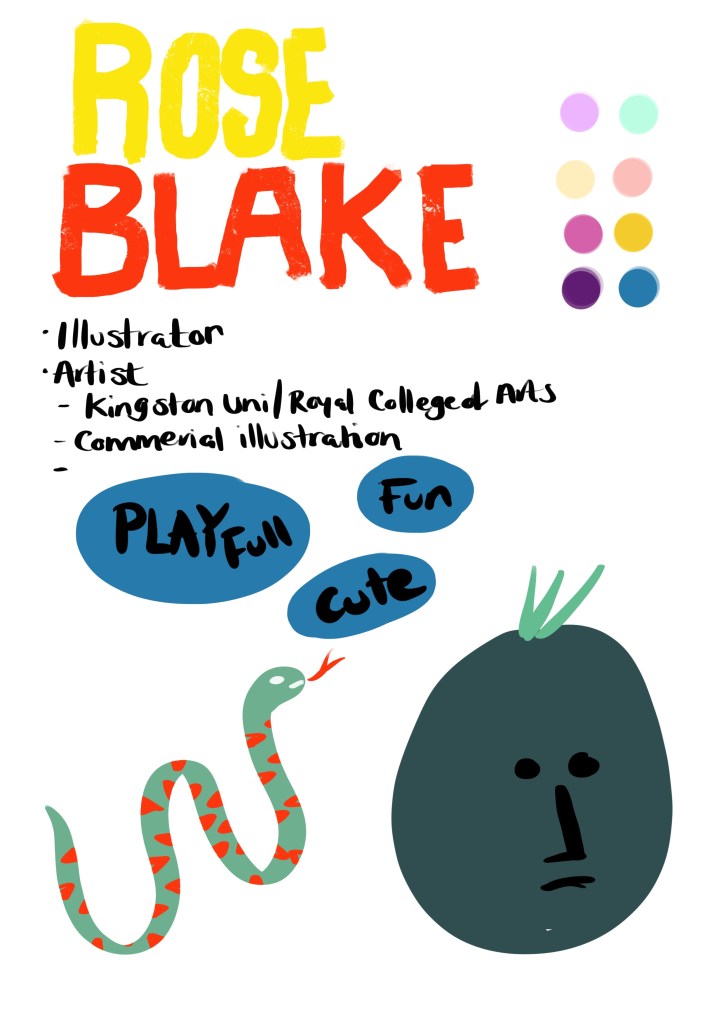
What I’ve leant from my study of Rose Blake She used Notepad like journals and simple one figure/object drawings Mostly figures – no hard lines and explores colours You can see she is creating content for books and illustrations from things around her. No words, but the random of some of these can see she is seeing and drawing what is around her. I can see a clear connection from her sketchbook to her professional finished work.
Lastly and a bit of a honourable one Luke Healy http://www.tcj.com/luke-healy-day-one/ Luke Healy visual diaries are digital, very simple yet they completely make me feel. I found Luke Healy due to my tutor sending me a link to an article to read and I was moved (Couldn’t forget his work.) I like how he words things, just simple and you get the point completely.
I think in my own visual diary and my illustrations I want to make people feel!
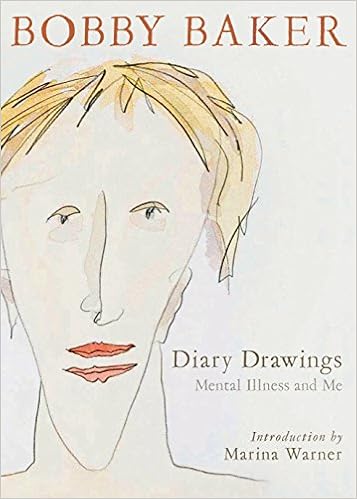
Diary Drawings mental illness and me, Bobby Baker Profile Books; Main edition (6 May 2010)
I also came across Bobby Baker, I found online searching the UCA library. What interested me with “baker” is the reason she started her visual diary, in 1997 when she was diagnosed with a mental illness. For 11 years over a series of drawings and watercolours followed her as she came to terms with this.
Just the title alone is a powerful inspiration. The fact she keep people she loved and knew her in the dark as well, you can feel her outlet is in her drawings. This is something I can relate to myself.
Away from using humour like many others, she shows the anger, confusion, raw emotions of her illness. More so as her personity is said to be very funny and yet you see this reality of how she felt during that time. No words.
Diary Drawings captures not only “the relentless doubleness of mental illness”-hiding behind masks and angrily striking out-but performs, in drawings as on stage, a character who “is herself ” doubling the situation of the actor
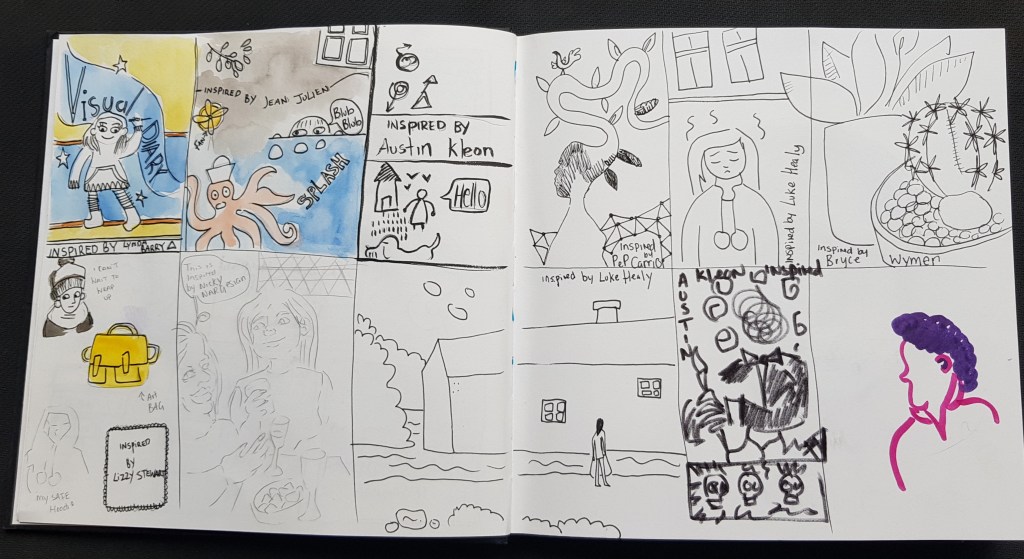
Firstly wanted to explore styles and layouts inspired by most of the artist I’ve researched. Then I moved on to a couple of pages exploring both the emotion and layout via creating a page. (Gluing lined paper, oil pastel and Goauche)
This task was great to take my mind of things, I have an operation next week and needed something to really get my teeth into and inspired by. I didn’t cover all the list, some wasn’t “me” at all and I couldn’t see myself going down them routes for my own. That not to say I didn’t value their work, in fact Oliver Jeffers, Joohee Yoon and Rachel Gannon work inspired me in other ways and been added to a list of illustrators of interest.
One thing I’ve learn it that visual diaries are unique to yourself, they have to come from you. Studying these illustrators if anything have given me a good starting point, also made me ask myself “what do I want from my own visual diaries?”
The answer it simple a narrative for myself Or I could word more suitable for myself and say “to find a voice for myself”. I also want to play more, explore more and just sometimes have fun!
You will find some of the objectives of the research in a couple of these artist notes above, but I started to go a bit in my own direction, my own thoughts into each visual diary method. I wanted to “study” more and deeper than just ticking the boxes, which is hard when have more than one or two artist to study at once.
Just as I was about to finished this research task I found myself watching another skillshare class, which was by Kate McMahon titled “Creative journal Comics: Drawing your life.” While most of the class ended up being about “drawing skills” she did give me some food for thought upon finished this and changed my outlook on my own visual diary a little. She says that your own visual “comic” does not have to be always funny, you can do the bad as well as the good days, also even if you think your life is boring, by drawing your perception of the event can change. I agree with this, while in lock down and shielding, each day feels the same, in that senstance alone I could do a visual diary like ground hog day, but not staying the same, dates are actually moving forward.
My personal Sketchbook Work This is a little all over the place, as I was trying to find my own feet and ways to express myself all whilst being inspired by many artists at once.
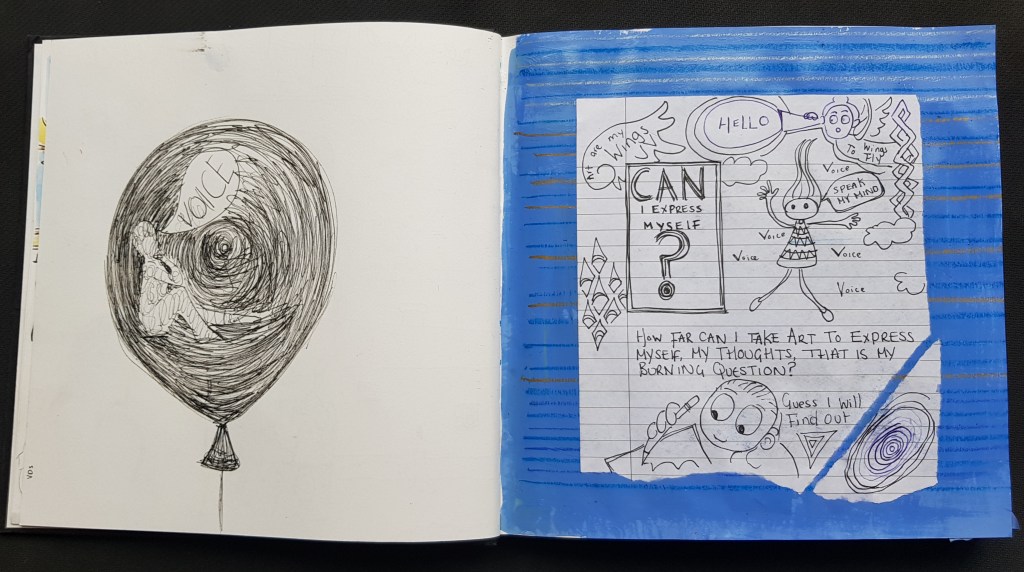
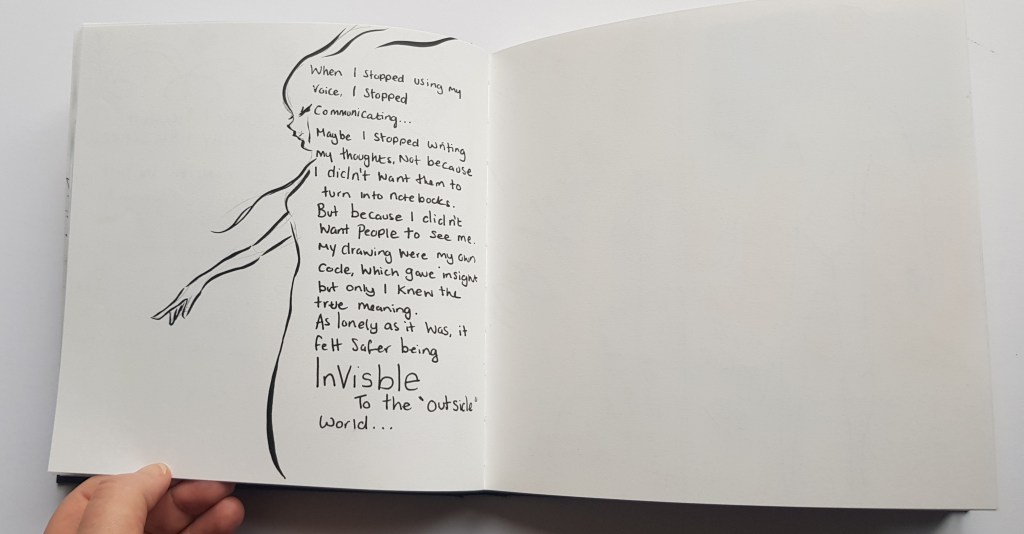
One thing I didn’t want to create a visual diary for the state of it, it is now about me expressing myself and being myself. I’m treating as if I would be the only person reading and viewing, at times it got a little personal, but this needed to happen so that I can move forward in expressing myself and learning to use my “voice”. I needed to let go of some past hurt and that “blocking” or “holding” me back.
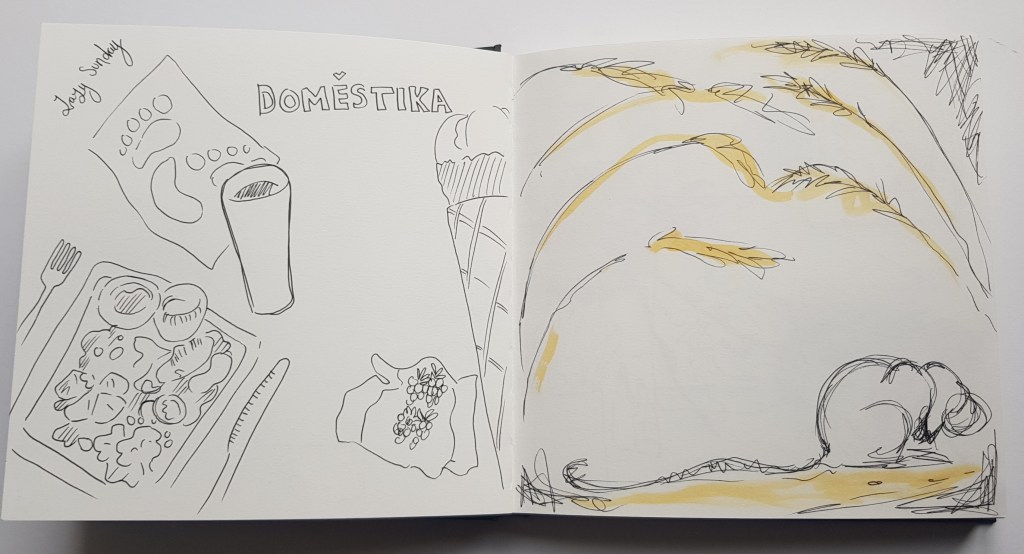
I started with a simple visual pen drawing of my day (that ended up in a sketch of a mouse) At the time was doing a course on Domestika.
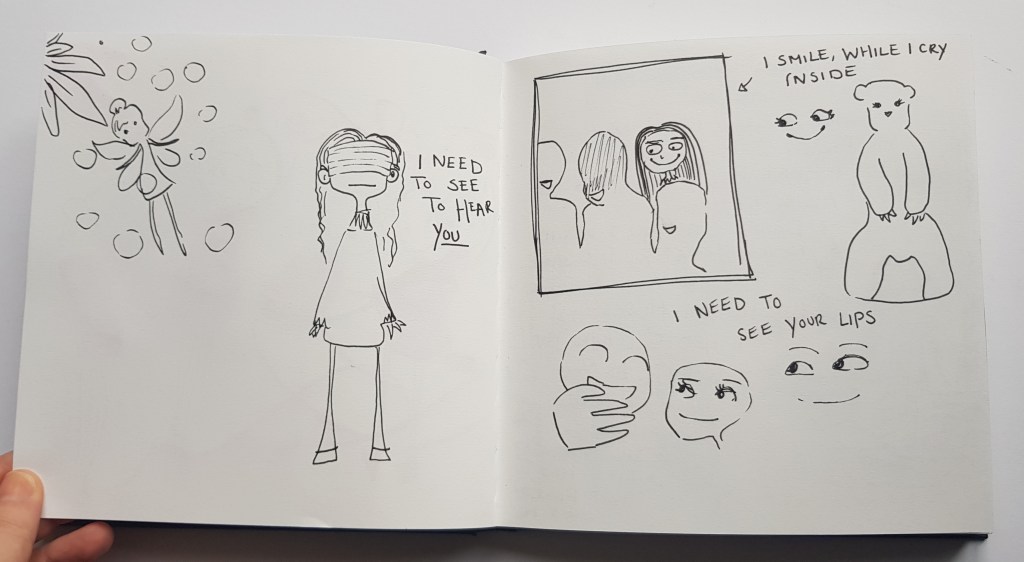
I was trying to express some inner thoughts and feeling I’m feeling these days. The whole “mask” situation during “covid-19” is stirring up some feeling of times people make it hard for me to join in and lip read them. This led into the next page…
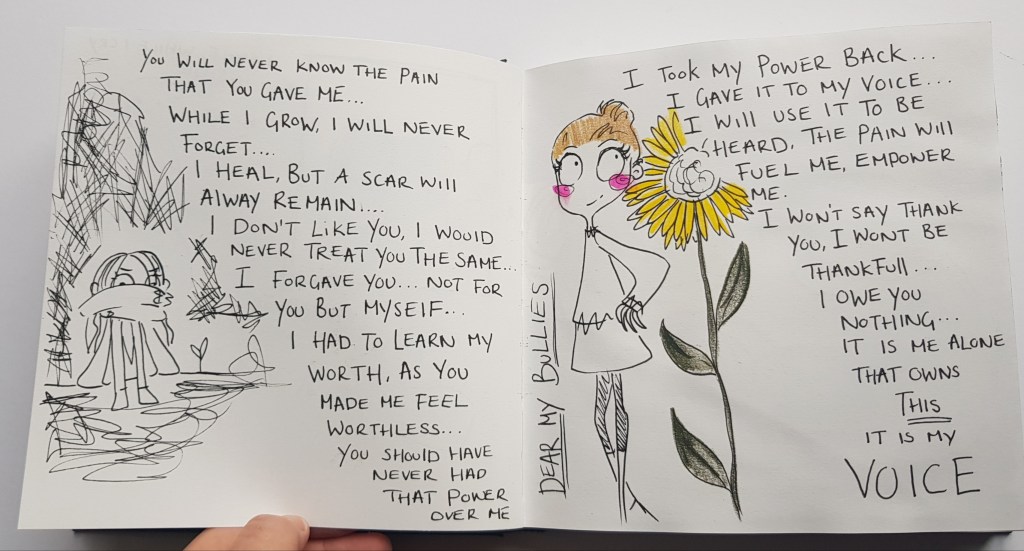
Putting my thoughts in words and images. Something quite personal, it was for myself and it was a moment I could close the book on this and move on. If was a title for this page spread it would be titled “Dear my bullies”.
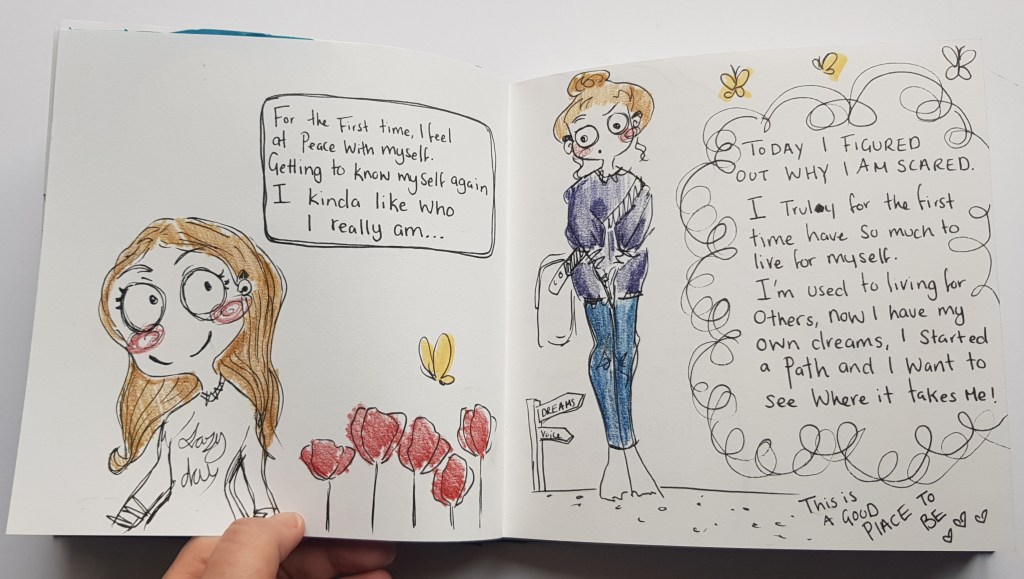
The following days thoughts turned positive. Letting go of things in the unit as started me being friends with myself.
Guess could say it is Art therapy via visual diaries!
But why did I stop in the first place…
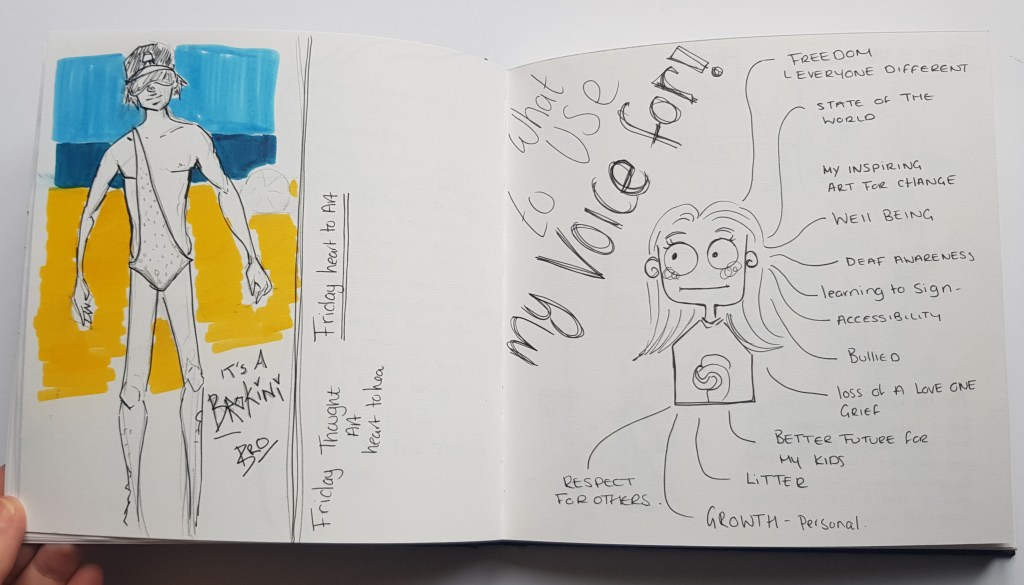
Time to start using my voice… So started to work out what I wanted to say. (With an added doodle left)








 Emclemmie OCA Sketchbooks