“Reportage has to have flesh, bones and, above all, life in it. One is not illustrating, but pushing one’s nose info life.”
Ronald Searle, 1977
Quick notes on list of contemporary and historical artist known for their works as reportage illustrators.
Pinterest board with works that appeals to me.
Laura Carlin
www.Lauracarlin.com
Calin is London based and worked for The Guardian, The New York Times, The New Yorker and the Boston Globe to name a few.
As well as Illustration she works as a ceramicist.
I find her work whimsical and yet a touch of a heavy mood of the seriousness of some of her pieces.
Paul Holgarth
1917-2001
English Illustrator
Covers for Penquin edition of Graham Greenes books.
I like how Holgrarth can see quite detailed at times when actually quite loose, also using blocks of colour such as a solid blue background and plain foreground, or building with a sharp contrast of red.
David Gentleman
https://davidgentleman.com/
Olivier Kugler
http://www.olivierkugler.com/
Kugler work first came to my attention in exercise, his work seems the most reportage in nature.
Emmanuel Guilbert
French comic artist,
First thing about Guilberts work I really love is his use of colour, the inky, watercolour washes, the pieces where he used to seriously contrasting colours are stunning.
Lucinda Rogers
Chloe Regan
Works in Bath and London
Likes to use idioms then explore a narrative.
I love her playful matter of her work, I even was able to find this https://vimeo.com/chloeregan Which includes videos of her working on location in her sketchbook. I can really relate to the way Regan works.
George Butler
http://www.georgebutler.org/
I’ve said before, I love the mood which Butler sets in his illustrations.
His website is amazing. I like that he “reports” as well for papers such as the guardian and is so hands on.
https://www.bbc.co.uk/news/av/entertainment-arts-36915751 – BBC news
This report is very interesting as George Butler actually talks about what it is like to be a reportage illustrator. He talks about what I’ve started to realise myself, there is a big different between seeing something on the news, in a picture vs actually being there. Even when he revisit the places back home in his studio he can still picture himself there.
Louis Netter
The ugly Muse – http://www.louisnetter.com/
(Reportage / Comic Illustration / Animation)
I love the fact he covers many areas and interests.
Reportage style – very sketchy – reminded a little of Quentin Blake
Veronica Lawlor
http://www.veronicalawlor.com/
Urban Sketcher – inspiration – more information found in Research Task 3.1
Agnes Dechourchelle
French artist and illustrator, childhood in Africa.
http://agnesdecourchelle.com/sketchbooks
Before I read “about” Agnes, first thing I spotted were her bright colours and later finding this came from living in Africa around strong and vivid colours.
Evan Turk Maurice Sasek
http://evanturk.com/travel01a.html
Illustrator, animator and designer working in new York city.
Beyond the list (other illustrators and artist of interest for the future)
Wendy MacNaughton
Peter Arkle
While doing my research I enjoyed this class by Faith Mistacoglu
https://www.skillshare.com/classes/Watercolor-Sketch-Journaling-Illustrations-Typography-and-Composition/1034811451?via=custom-lists
Who’s style seem very reportage, and I don’t think sketch journaling is to far step away from reportage as you are using the same skills, same information to document just the intended propose is different, such as journaling is more for yourself while reportage is reporting news to others.
There is a interesting section called seeing vs looking.
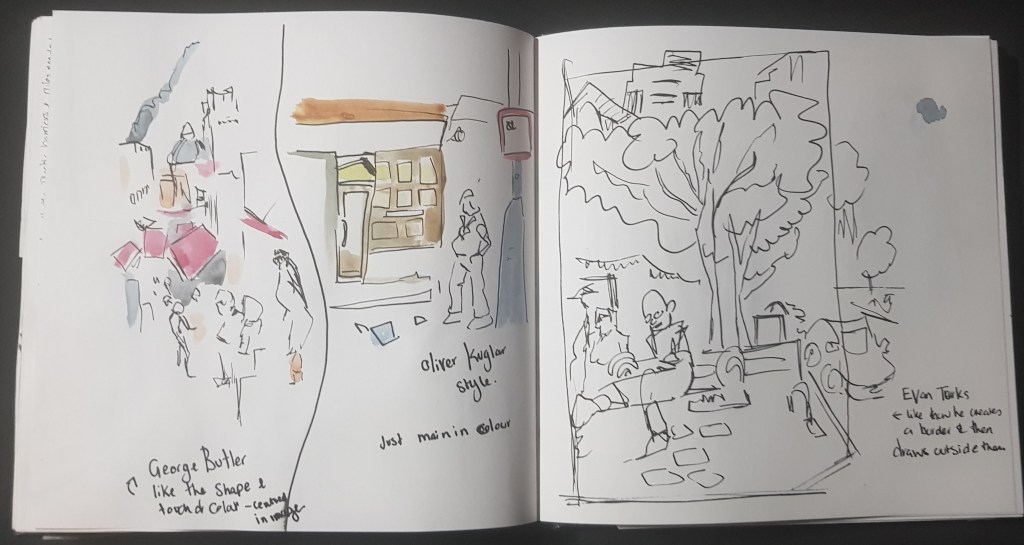
Above and below – Course sketchbook 1
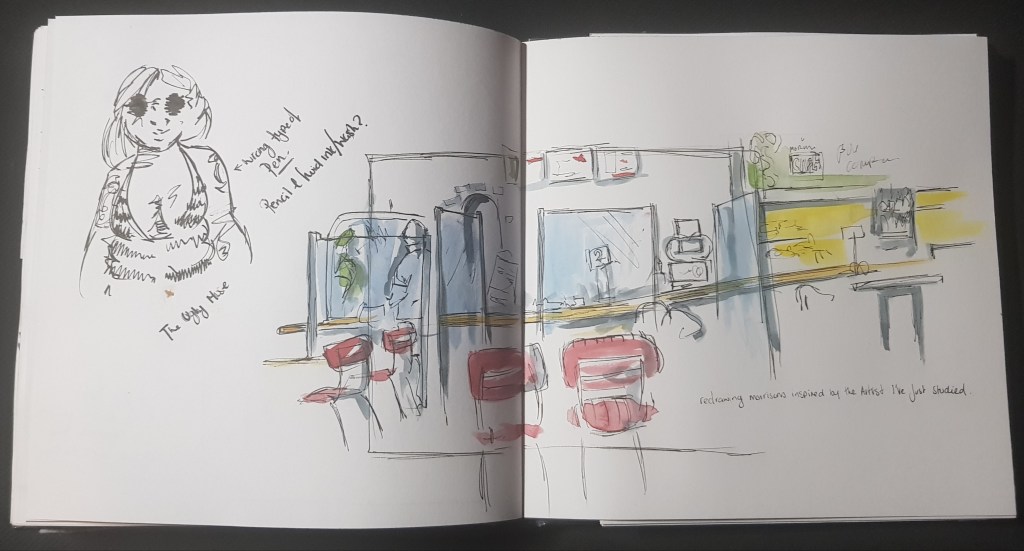
Inspired by the styles of the artist and illustrators I wanted to break down the images and the best way I find I do that is to recreate (with my own touch) so that I can see brush stokes, composition and way they used colour.
I moved on to recreate my sketch that I did for the last exercise in morrisons with a mix of the style elements that was inspiring me the most.
http://eyemagazine.com/feature/article/ardizzone-at-peace-and-in-conflict – Edward Ardizzone (1900-79) – First official war artist (Alongside Bawden / Eric Ravilious and Barnett Freeman)
My thoughts
Ardizzone created a written record published – We know his responses to the war and experiences, I think his cheer nature may have been a shield. Reading this the reality of reportage illustration isn’t just traveling to nice places all over the world. There is a harsh truth that you can only add the emotions fully needed to be on location, if you want to shock people with what is happening in the news, you need to be shocked yourself first.
http://www.eyemagazine.com/feature/article/olivier-kugler-bearing-witness – Oliver Kugler
My Thoughts
Kugler does not jump in with subject to sketch, he takes its all in first. Later on will create the illustration in his studio.
The camera will pick up the details, this is true and one of the things I agree with as once we’ve been there, we can remember and relate. There won’t always be a chance to sit down an sketch every time.
http://eyemagazine.com/opinion/article/framing-the-evidence-of-war – Didier Lefèvre, Emmanuel Guibert and Frédéric Lemercier
My thoughts
A reportage and graphic novel hybrid – this sounds amazing and such an interesting take on something so serious as the Russia’s Afghan war, I can see this reaching people on another level.
More so you find out that Lefèvregave so much to this project and died early.
My conclusion on this research task is one that I have been heading toward for the last few exercises. It does not matter if you take pictures, but what matters is that you have to be there in the moment, you have to “feel”. It makes sense that I as an illustrator has to be make that emotional connection to a place/event/moment.
 Emclemmie OCA Sketchbooks
One thought on “Research task 3.2: Reporting and documenting”